


















Lesson 23 of 45 · Induction Motors
The rotating magnetic field
See how three coils fed by three currents 120° apart add up to one magnetic field of constant size that rotates at synchronous speed, and how to reverse it.
A single coil fed by alternating current makes a magnetic field that pulses back and forth along one line. It never turns. To spin a rotor you need a field that actually rotates, and a three-phase supply gives you exactly that with no moving parts at all. In 1888 Nikola Tesla (and, independently, Galileo Ferraris) described this rotating field, and it is still the basis of the motors that run most of industry.
In this lesson you build the field from three sine waves, find its size and speed, and learn how to reverse it.
What you will learn
- Why three windings 120° apart and three currents 120° apart create a rotating field.
- That the resultant field has a constant size of 1.5 times the peak field of one phase.
- How to calculate synchronous speed from frequency and the number of poles.
- How swapping two supply leads reverses the direction of rotation.
Key terms
Stator: the stationary part of the motor that carries the three-phase windings.
Rotating magnetic field (RMF): the combined field of the three windings, constant in size and turning in space.
Synchronous speed ns: the speed of the rotating field, ns = 120 f / P in rpm.
Pole pair: one north and one south pole; a motor with P poles has P/2 pole pairs.
Phase sequence: the order in which the three phase currents reach their peak (a-b-c or a-c-b).
One coil: a pulsating field
Put a coil in a slot pair of the stator and send i = Im cos ωt through it. The field along the coil axis is B = Bm cos ωt. It grows, shrinks, reverses and repeats, but it always points along the same line. You can describe it as two equal fields rotating in opposite directions (this idea returns in the single-phase lesson). Alone, it gives no net push on a rotor at standstill.
Three coils: a rotating field
Now place three identical coils so that their axes are 120° apart in space, and feed them with currents 120° apart in time:
ia = Im cos(ωt)
ib = Im cos(ωt − 120°)
ic = Im cos(ωt − 240°)
Each coil produces a pulsating field along its own axis with the same shape as its current. Add the three vectors. At the instant ωt = 0, phase a is at its positive peak and phases b and c carry −0.5 Im each. The components along the axis of phase a add up to Bm + 0.25 Bm + 0.25 Bm = 1.5 Bm, and the components at right angles cancel. At ωt = 60° the same total points 60° further around. The picture below shows the three currents and the resultant at three instants.
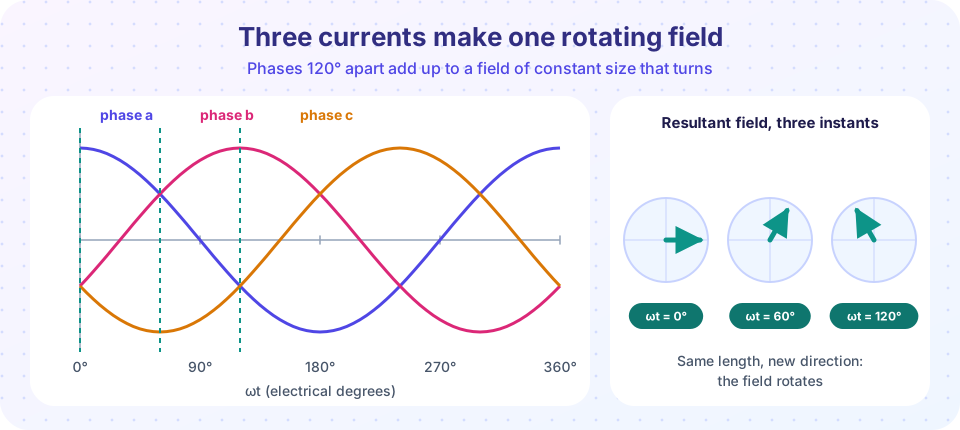
The result: a field of constant magnitude 1.5 Bm whose direction advances by exactly one electrical degree for every electrical degree of ωt. Because the size never changes, the torque it produces on a rotor is smooth, unlike a single-phase motor whose torque pulsates.
How fast does it turn?
For a motor with one pair of poles (P = 2), one electrical cycle is one mechanical turn, so the field makes f turns per second. For P poles the field only needs to move from one pole to the next to complete a cycle, which is 2/P of a turn:
ns = 120 f / P (rpm, f in Hz, P = number of poles)
| Poles | 50 Hz | 60 Hz |
|---|---|---|
| 2 | 3000 rpm | 3600 rpm |
| 4 | 1500 rpm | 1800 rpm |
| 6 | 1000 rpm | 1200 rpm |
| 8 | 750 rpm | 900 rpm |
More poles mean a slower, more powerful (higher torque for the same power) machine. The rated speed on a motor nameplate is always a little below one of these numbers, because of slip.
Reversing the direction
The field turns in the order the phases reach their peak. Swap any two of the three supply leads and the order flips from a-b-c to a-c-b: the field, and therefore the rotor, runs the other way. This is how a hoist or a conveyor is reversed with two contactors.
Common misconceptions
"The magnetic field is created by something spinning." Nothing in the stator moves. Only the pattern of currents changes.
"The field gets stronger and weaker as it turns." For balanced three-phase currents it stays at 1.5 Bm all the time. If the currents are unbalanced the field becomes elliptical, which causes extra heating and vibration.
"Speed depends on the load." The speed of the field depends only on frequency and poles. The rotor speed varies a little with load, as the next lesson shows.
Try it
Add the three coil fields yourself. The first program prints the resultant magnitude and angle for a full cycle; the magnitude should stay at 1.5 for every instant. The vectors are drawn as arrows, which all have the same length.
Press Run (or Ctrl + Enter) to see the result here.
Program input · what you'd type while the program runs
Type the answers before you press Run, one per line. Each time the program reads a line (with input()), it gets the next line from this box.
The second demo animates the field. Press the button to swap two phases and watch the direction reverse. It is a simplified model that adds the three vectors exactly as above.
Check your understanding
Quick check · 5 questions
of 5 answered You scored / 5 · perfect!
-
1. Three equal coils are placed 120° apart and fed by balanced three-phase currents. The resultant field has a size of
The three fields add as vectors to a field of 1.5 Bm that does not change in size as it rotates. -
2. What is the synchronous speed of a 6-pole motor on a 60 Hz supply?
ns = 120 × 60 / 6 = 1200 rpm. -
3. How do you reverse the direction of a three-phase induction motor?
Swapping two phases reverses the phase sequence and so the direction in which the field rotates. -
4. A motor on a 50 Hz supply has a field speed of 750 rpm. How many poles does it have?
P = 120 f / ns = 120 × 50 / 750 = 8 poles. -
5. Why is the torque of a three-phase motor smoother than that of a single-phase motor?
The rotating field of constant magnitude gives a steady torque, while a single-phase field pulsates.
Summary
- Three windings 120° apart, fed by three currents 120° apart, make a rotating field of constant size
1.5 Bm. - Its speed is
ns = 120 f / Prpm. - Swapping two supply leads reverses the rotation.
- Nothing moves in the stator: the rotation is a pattern of currents.
Track your progress
Create a free account to tick off lessons and pick up where you left off on any device.
of Electrical Machines lessons completed