


















Lesson 25 of 45 · Induction Motors
Torque, starting and speed control
Read the induction motor torque-speed curve, calculate pull-out torque, and compare direct, star-delta, autotransformer and soft starting plus the main ways to control speed.
The equivalent circuit tells you what the motor does at one slip. The torque-speed curve tells you what it does at every speed, and that curve decides almost everything in practice: whether the motor can start a given load, how much its speed drops under load, and how much torque you have in reserve before it stalls.
In this lesson you derive the curve from the circuit, read its three landmark points, and then see how starting methods and speed controls reshape it.
What you will learn
- The torque equation and the formulas for pull-out torque and the slip at which it occurs.
- Why starting current is large while starting torque is only modest.
- How direct-on-line, star-delta, autotransformer and soft starters differ.
- How rotor resistance, voltage and frequency change speed and torque.
Key terms
Starting torque Tst: the torque at standstill (s = 1).
Pull-out (breakdown) torque Tmax: the maximum torque the motor can produce; beyond it the motor stalls.
Pull-out slip sm: the slip at which Tmax occurs.
Direct-on-line (DOL) start: connecting the motor straight to the full supply voltage.
Thevenin equivalent: replacing the supply and stator branch by one source Vth and one impedance Rth + jXth.
The torque equation
Replace everything to the left of the rotor branch by its Thevenin equivalent: Vth = V1 · jXm / (R1 + j(X1 + Xm)) and Zth = Rth + jXth = (R1 + jX1) · jXm / (R1 + j(X1 + Xm)). Then the rotor current is Vth / [(Rth + R2'/s) + j(Xth + X2')], the air-gap power is 3 I2'² R2'/s, and torque is air-gap power divided by ωs:
T = 3 Vth² (R2'/s) / ( ωs · [ (Rth + R2'/s)² + (Xth + X2')² ] )
Setting the derivative to zero gives the two landmark results:
sm   = R2' / √( Rth² + (Xth + X2')² )
Tmax = 3 Vth² / ( 2 ωs · [ Rth + √( Rth² + (Xth + X2')² ) ] )
Three consequences are worth memorizing. Tmax is proportional to V²: halve the voltage and the pull-out torque falls to a quarter. Tmax does not depend on the rotor resistance R2'. The slip sm is proportional to R2', so more rotor resistance moves the peak toward standstill.
Reading the curve
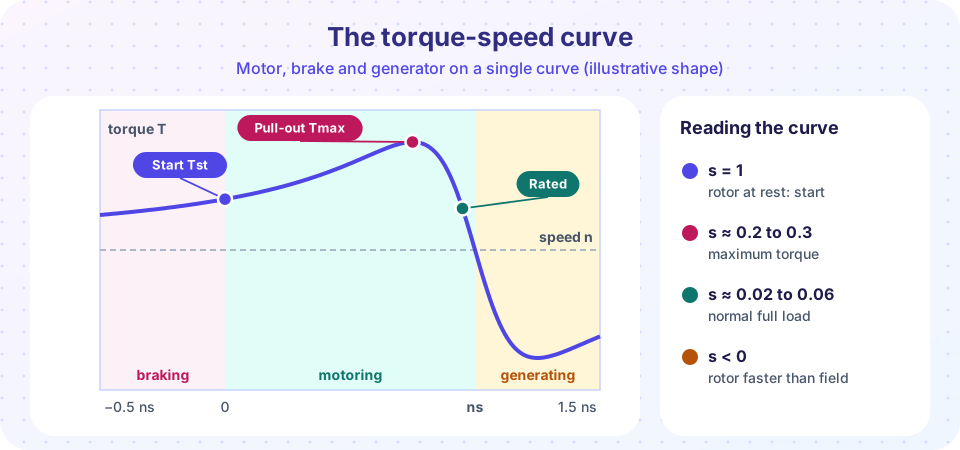
For the example motor of the previous lesson the formulas give Tmax = 226 N·m at sm = 0.166 (1252 rpm). At s = 0.03 the torque is 88 N·m, so the motor has about 2.6 times its rated torque in reserve. At standstill the torque is 81 N·m while the current is 122 A, more than five times the 22.9 A at 3 % slip. Why so much current for so little torque? Because at standstill the rotor circuit is mostly reactance, the power factor is about 0.34, and most of the current is reactive.
The curve has three regions. Between s = 0 and s = sm the curve is nearly a straight line, so a small increase in load needs only a small drop in speed. This is the stable region where the motor normally runs, and it is why an induction motor is called a "constant-speed" machine. Between sm and s = 1 the torque falls as the speed falls, which is unstable for loads that need constant torque. For s > 1 the rotor is pushed backward against the field (plugging, used for braking). For s < 0 the rotor is driven faster than the field and the machine generates power back into the supply.
Starting methods
A direct-on-line start gives the full torque but 5 to 8 times the rated current, which can cause a voltage dip and overheat the windings if repeated. Reducing the voltage reduces the current, but since torque goes with V² the torque falls faster than the current.
| Method | How it works | Line current | Torque |
|---|---|---|---|
| Direct-on-line | Full voltage at once | 100 % of the locked-rotor value | 100 % |
| Star-delta | Start in star (phase voltage ÷ √3), then switch to delta | 1/3 | 1/3 |
Autotransformer (tap k) |
Reduced voltage kV |
k² |
k² |
| Soft starter | Thyristors ramp the voltage up | k (motor current) |
k² |
| Variable-frequency drive | Ramps voltage and frequency together | about rated | up to rated |
A wound-rotor motor has slip rings and lets you insert external resistance in the rotor circuit. Adding resistance raises sm without changing Tmax. With the right value (R2' ≈ √(Rth² + (Xth + X2')²), about 1.8 Ω in our example) the full pull-out torque is available at standstill, and the starting current actually falls. As the motor accelerates, the resistance is cut out.
Speed control
- Voltage control is simple but gives a narrow range, and it lowers
TmaxbyV². It is used for small fans. - Rotor resistance (wound rotor only) gives a wide range, but the extra resistance wastes power: the efficiency falls roughly in proportion to
1 − s. - Pole changing (for example the Dahlander winding) switches the stator between two pole numbers, giving two fixed speeds such as 1500 and 3000 rpm.
- Frequency control with a variable-frequency drive is the best method: with
V/fkept constant the whole torque curve slides along the speed axis with its shape almost unchanged. The lesson on drives returns to this.
Common misconceptions
"A high starting current means a high starting torque." The current at standstill is mostly reactive. Torque depends on the in-phase component of the rotor current, which is small.
"Star-delta starting gives full torque with a small current." It reduces both to a third. It suits loads that start light, such as fans and pumps, not loaded conveyors.
"Adding rotor resistance increases the maximum torque." It only shifts the slip at which that torque occurs.
Try it
Plot torque against speed for several rotor resistances. The program uses the Thevenin formula above, so the R2' = 0.30 Ω curve reproduces the numbers in this lesson. It prints starting torque and pull-out slip for each case.
Press Run (or Ctrl + Enter) to see the result here.
Program input · what you'd type while the program runs
Type the answers before you press Run, one per line. Each time the program reads a line (with input()), it gets the next line from this box.
Now compare starting methods for the same motor. It starts from the direct-on-line current and torque and applies the factors from the table.
Press Run (or Ctrl + Enter) to see the result here.
Program input · what you'd type while the program runs
Type the answers before you press Run, one per line. Each time the program reads a line (with input()), it gets the next line from this box.
Check your understanding
Quick check · 5 questions
of 5 answered You scored / 5 · perfect!
-
1. If the supply voltage to an induction motor drops to half, the pull-out torque becomes about
Torque is proportional to the square of the voltage, so Tmax falls to 1/4. -
2. Compared with direct-on-line starting, star-delta starting gives a line current and starting torque of
The phase voltage drops by √3, so current and torque both fall by a factor of 3 (V² for torque; the line current in star is a third of that in delta). -
3. Adding resistance to the rotor circuit of a wound-rotor motor
sm is proportional to R2', while Tmax does not depend on R2'. -
4. Why is the starting current high but the starting torque only moderate?
At standstill the rotor circuit is mostly reactive, so the torque-producing component of the current is small. -
5. A motor is loaded beyond its pull-out torque. What happens?
Past the peak the torque falls as speed falls, so the motor keeps slowing down until it stops.
Summary
T = 3 Vth² (R2'/s) / (ωs [ (Rth + R2'/s)² + (Xth + X2')² ]);Tmax ∝ V²and does not depend onR2'.sm = R2' / √(Rth² + (Xth + X2')²): more rotor resistance moves the peak toward standstill.- DOL start: large current, full torque. Star-delta: one third of both. Autotransformer and soft starters trade torque for current.
- Frequency control with
V/fconstant is the most efficient way to change speed.
Next: Chapter review
Track your progress
Create a free account to tick off lessons and pick up where you left off on any device.
of Electrical Machines lessons completed