


















Lesson 30 of 45 · Synchronous Machines
Chapter review: synchronous machines
Review alternators and synchronous motors with a V-curve summary picture, a table of the key formulas and a ten-question mixed quiz.
Alternators and synchronous motors share one model: an internal voltage E behind a synchronous reactance Xs. Everything in this chapter is that model viewed from two sides, as a generator pushing power out and as a motor taking it in.
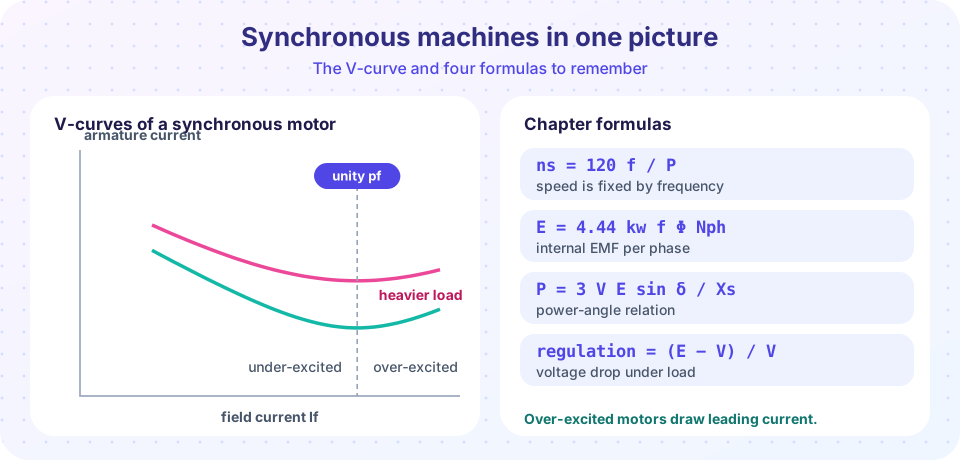
Recap table
| Idea | Formula or rule | Remember |
|---|---|---|
| Speed | ns = 120 f / P |
no slip, exactly synchronous |
| Generated EMF | E = 4.44 kw f Φ Nph |
Φ follows the field current |
| Equivalent circuit | E = V + I (Ra + jXs) |
motor: V = E + I (Ra + jXs) |
| Regulation | (E − V) / V |
largest for lagging loads; can be negative for leading |
| Power angle | P = 3 V E sin δ / Xs |
maximum at 90° |
| Starting | damper cage, VFD or pony motor | no starting torque on its own |
| V-curve | current against field current | minimum at unity power factor |
| Grid control | prime mover sets P, field sets Q |
over-excited = supplies reactive power |
| Synchronizing | same voltage, frequency, sequence, phase angle | check with a synchroscope |
Try it
Check the arithmetic on a new machine: a 11 kV, 2 MVA alternator with Xs = 40 Ω and Ra = 2 Ω. Change the numbers and the power-factor choices.
Press Run (or Ctrl + Enter) to see the result here.
Program input · what you'd type while the program runs
Type the answers before you press Run, one per line. Each time the program reads a line (with input()), it gets the next line from this box.
The second TryIt turns the motor formula around: given a load, how big must the load angle be, and how much margin do you have?
Press Run (or Ctrl + Enter) to see the console output here.
No output.
Check your understanding
Quick check · 10 questions
of 10 answered You scored / 10 · perfect!
-
1. A 4-pole alternator must produce 60 Hz. What speed must the prime mover provide?
n = 120 f / P = 120 × 60 / 4 = 1800 rpm. -
2. Which condition is NOT required before closing an alternator onto the grid?
Voltage, frequency, phase sequence and phase angle must match. The power is set after connection. -
3. A synchronous motor drives a constant load. Increasing its field current from the unity-power-factor point makes it draw
Beyond the minimum of the V-curve the motor is over-excited and the armature current is leading and rising. -
4. What limits the power a synchronous motor can deliver at a given excitation?
P = 3 V E sin δ / Xs cannot exceed 3 V E / Xs. -
5. For which load can an alternator show negative voltage regulation?
A leading current magnetizes the machine, so the terminal voltage can rise above E. -
6. Which of these is a typical cure for the lack of starting torque in a synchronous motor?
Damper windings let the motor start as an induction motor before the DC field is applied. -
7. An alternator is connected to a large grid. To deliver more real power you should
Real power comes from the prime mover; field current mainly changes reactive power. -
8. The synchronous reactance of an alternator combines
Xs is a lumped model of leakage flux and armature reaction. -
9. A synchronous motor with V = 3810 V, E = 4573 V and Xs = 15 Ω carries 1 MW. Its load angle is about
sin δ = P Xs / (3 V E) = 1 000 000 × 15 / (3 × 3810 × 4573) ≈ 0.287, so δ ≈ 16.7°. -
10. An unloaded over-excited synchronous machine connected to a grid is called
It draws no real power but supplies reactive power, which supports the voltage.
Summary
- One model,
EbehindRa + jXs, covers both the alternator and the motor. - The prime mover sets real power; the field current sets reactive power and voltage.
- The load angle carries power, limited at 90°; the V-curve shows power-factor control.
- Synchronous motors need an external way to start but offer constant speed and adjustable power factor.
Track your progress
Create a free account to tick off lessons and pick up where you left off on any device.
of Electrical Machines lessons completed