


















Lesson 31 of 45 · Special Motors and Drives
Chapter overview: special motors and drives
A guide to the motors beyond the standard three-phase machine: single-phase, universal, stepper, brushless DC and servo motors, and the drives that control them.
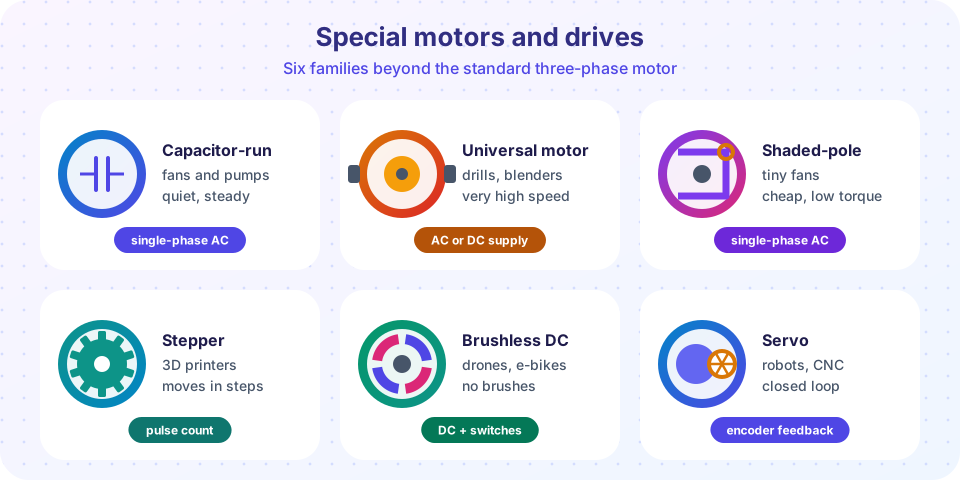
So far the supply was three-phase and the loads were big. Look around your home, though, and you will find single-phase supply, small motors and loads that need precise speed or position: a fan, a washing machine, a drill, a printer, a robot arm. Each of these uses a motor tuned for the job, usually together with electronics that control it.
This chapter surveys those machines and then looks at the drive electronics that has changed the field in the last forty years. A modern drive can make a plain induction motor behave like a precise servo.
What you will learn
- Why a single-phase induction motor has no starting torque and how a second winding fixes that.
- How a universal motor runs on both AC and DC.
- How stepper, brushless DC and servo motors position and spin loads under electronic control.
- How a variable-frequency drive changes the speed of an AC motor.
The chapter in slides
Single-phase motors
Lesson 2 also covers shaded-pole and universal motors.
Positioning and control
Lesson 3 explains each with formulas.
Drives
Lesson 4 ends with a V/f profile.
Lessons in this chapter
- Single-phase and universal motors: the double-revolving-field idea, split-phase, capacitor-start, shaded-pole and universal motors.
- Stepper, brushless DC and servo motors: step angle, commutation, back-EMF and feedback.
- Variable-frequency drives and vector control: the power stages, the
V/frule and field-oriented control. - Chapter review: a comparison table and ten questions.
Try it
A stepper motor moves a fixed angle per pulse, so speed is a matter of counting. This helper turns a pulse rate into rpm.
Press Run (or Ctrl + Enter) to see the console output here.
No output.
A simple chooser shows how the requirements steer the choice. It is a rule-of-thumb demonstration, not a design tool.
Press Run (or Ctrl + Enter) to see the console output here.
No output.
Summary
- Special motors fit special jobs: single-phase supply, precise positioning, high speed or variable speed.
- Electronics (drives) now decide speed and torque for most of them.
- The chapter covers single-phase, universal, stepper, BLDC, servo and variable-frequency drives.
Track your progress
Create a free account to tick off lessons and pick up where you left off on any device.
of Electrical Machines lessons completed