


















Lesson 21 of 45 · DC Machines
Chapter 4 Review: DC Machines
Review DC machines: construction, EMF and torque equations, generator types and build-up, motor characteristics, starting, speed control and braking, with a ten-question quiz.
The DC machine ties together everything in the first four chapters: a magnetic circuit with a gap, Faraday's law for the voltage, the Lorentz force for the torque, and a power balance with losses. It also gives you the cleanest statement of how voltage, speed and torque relate, which you will meet again in the AC machines of the second half of the course.
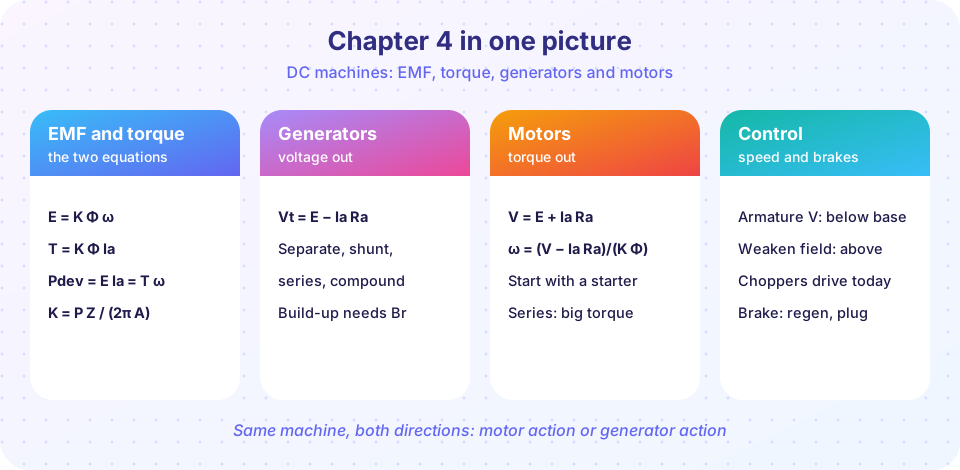
What you will learn
- How the lessons of the chapter fit together.
- The small set of equations that solves almost every DC machine problem.
- A step-by-step method for generator and motor problems.
The chapter at a glance
| Lesson | Big idea | Key formulas |
|---|---|---|
| Overview | Parts, commutator, types by excitation | shunt, series, compound, PM |
| EMF, torque, commutation | The two machine equations | E = K Φ ω, T = K Φ Ia, K = P Z/(2π A) |
| Generators | Build-up, characteristics, efficiency | Vt = E − Ia Ra, Ia = IL + If |
| Motors and speed control | Starting, control, braking | V = E + Ia Ra, ω = V/(KΦ) − Ra T/(KΦ)² |
A method for DC machine problems
- Decide the mode: generator (
Vt = E − Ia Ra) or motor (V = E + Ia Ra). - Write the currents from the connection (shunt:
Ia = IL ± If). - Find
Efrom the circuit, then useE = K Φ ωto get speed or flux. - Find torque from
T = K Φ Ia, or from power:T = E Ia / ω. - Tally the losses: armature and field copper, iron, mechanical, brush.
- Check: is the current within limits, is
Epositive and sensible?
Common misconceptions
"The same K Φ applies at different flux levels." K Φ changes with the field current; when you change Φ, update it (and remember saturation).
"Starting current equals rated current." Without a starter or voltage control, it is V/Ra, often 10 to 25 times rated.
Try it
Press Run (or Ctrl + Enter) to see the result here.
Program input · what you'd type while the program runs
Type the answers before you press Run, one per line. Each time the program reads a line (with input()), it gets the next line from this box.
Check your understanding
Quick check · 10 questions
of 10 answered You scored / 10 · perfect!
-
1. A 4-pole machine, wave winding (A = 2), Z = 500 conductors, Φ = 30 mWb, runs at 900 rpm. What is E?
E = P Φ Z n / (60 A) = 4 × 0.03 × 500 × 900 / 120 = 54 000 / 120 = 450 V. -
2. A shunt generator delivers 90 A at 240 V, Rf = 120 Ω, Ra = 0.25 Ω. What is the generated EMF?
If = 240/120 = 2 A, Ia = 92 A, so E = 240 + 92 × 0.25 = 263 V. -
3. A DC motor has V = 200 V, Ra = 0.5 Ω, Ia = 20 A. The back-EMF is:
E = V − Ia Ra = 200 − 10 = 190 V. -
4. The torque of that motor at 190 rad/s is about:
T = E Ia / ω = 190 × 20 / 190 = 20 N·m (so K Φ = 1 V·s/rad). -
5. Which motor is dangerous to run with no load?
At no load the series motor's current and flux are small, so its speed rises without bound. -
6. To raise the speed of a shunt motor above base speed you should:
Weakening the field raises speed (at the cost of torque per ampere). -
7. Why does a shunt generator sometimes fail to build up?
Build-up requires residual flux, aiding polarity, speed above critical and a field resistance below critical. -
8. Regenerative braking works when:
When E exceeds V the armature current reverses and power flows back to the supply. -
9. Interpoles are connected in series with the armature because:
The reactance voltage and the cross-magnetizing effect both grow with armature current. -
10. A starter limits the current of a 400 V, Ra = 0.8 Ω motor to 50 A. The external resistance needed is:
Total resistance 400/50 = 8 Ω; minus Ra = 7.2 Ω.
Summary
E = K Φ ωandT = K Φ Ia;P_dev = E Ia = T ω.- Generators:
Vt = E − Ia Ra. Motors:V = E + Ia Ra. - Shunt machines are nearly constant-speed, series machines have high starting torque, compound machines combine them.
- Control speed with armature voltage and field; brake with regeneration, resistors or plugging.
Track your progress
Create a free account to tick off lessons and pick up where you left off on any device.
of Electrical Machines lessons completed