


















Lesson 45 of 45 · Projects and Practice
Further study: where electrical machines lead next
Where to go after electrical machines: power electronics, circuit analysis, analog electronics, semiconductor devices and control systems, with a small speed-control simulation as a taste.
You now know how the main families of electrical machines work, how to model them with a circuit, and how to choose one. Machines are a junction in electrical engineering: below them sit the physics of circuits and devices, beside them sit the electronics that drive them, and above them sit the systems that use them, from factories to electric vehicles to power grids.
This lesson maps the neighboring topics and shows one tiny example of the next step, feedback control of a motor.
What you will learn
- Which topics connect directly to electrical machines.
- Where each idea from this course reappears in those topics.
- How a feedback loop controls the speed of a motor.
Key terms
Power electronics: converters (rectifiers, inverters, choppers) that shape electrical power with switching devices.
Control system: a feedback arrangement that makes a quantity (speed, position) follow a command.
PI controller: a controller whose output is a proportional term plus an integral of the error.
Closed loop: a system where the measured output is compared with the reference.
Electric drive: motor + converter + control, working together.
A map of what comes next
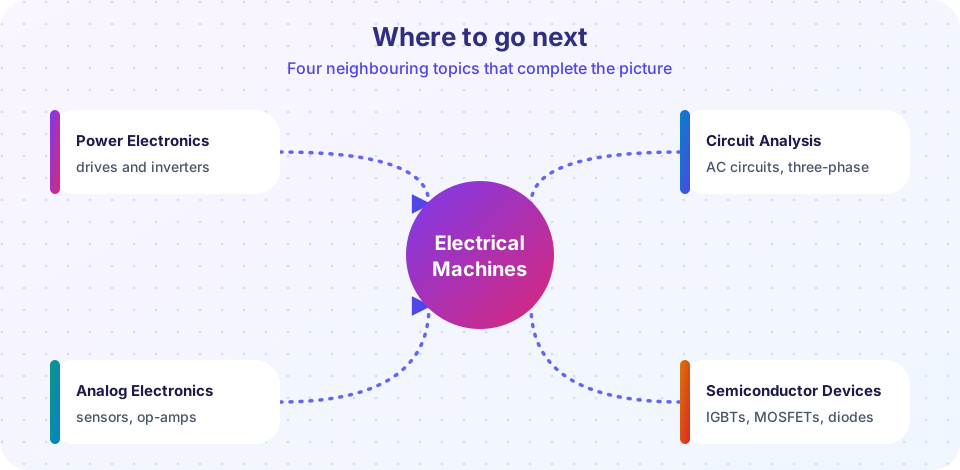
- Power Electronics is the natural next step. The variable-frequency drive of chapter 7 is a power-electronic converter; there you learn rectifiers, DC-DC converters, inverters, PWM and the thermal design of switches. If you enjoyed the drive lesson, start here.
- Circuit Analysis is the foundation under the equivalent circuits of this course. Phasors, three-phase power, complex power, transients and Thevenin equivalents all return in machine calculations.
- Analog Electronics covers the sensing and signal circuits around a drive: amplifiers, filters, current sensing and gate drivers.
- Semiconductor Devices explains the diodes, MOSFETs and IGBTs that make drives possible, and why their losses matter.
- Control Systems shows how to design the speed and position loops that turn a motor into a servo.
Beyond those, you may meet power-system topics (generation, transmission, protection and stability), where the synchronous machine of chapter 6 is the central actor, and electric-vehicle design, where permanent-magnet synchronous motors and inverters are the heart of the powertrain.
From theory to practice
Three habits turn what you learned into skill. First, always check a result against typical values (slip 2 to 6 %, power factor 0.8 to 0.9). Second, draw the picture before the equation: an equivalent circuit, a phasor diagram or a power-flow diagram. Third, read real data sheets; manufacturers publish torque-speed curves, efficiency maps and thermal limits that connect directly to the formulas you used. If you can, measure a small motor yourself with a wattmeter and a tachometer, and compare the result with the model.
A taste of control
A motor on its own does not hold a speed: when the load increases, it slows down. A feedback controller measures the speed and adjusts the voltage to correct the error. The simulation below uses the DC-equivalent model of a motor, L di/dt = V − R i − Ke ω and J dω/dt = Kt i − B ω − T_load, with a PI controller on speed. It is a simple model for learning, not a real drive design.
Try it
Watch the PI controller recover from a sudden load. The speed dips and then returns to the reference, because the integral term keeps adding voltage until the error is zero.
Press Run (or Ctrl + Enter) to see the result here.
Program input · what you'd type while the program runs
Type the answers before you press Run, one per line. Each time the program reads a line (with input()), it gets the next line from this box.
Finally, a tiny planner: tell it what you want to build and it suggests the track to study next. It is only a lookup table, but it shows how the topics connect.
Press Run (or Ctrl + Enter) to see the console output here.
No output.
Check your understanding
Quick check · 5 questions
of 5 answered You scored / 5 · perfect!
-
1. Which topic explains the converters inside a variable-frequency drive?
Rectifiers, inverters and PWM are the subject of power electronics. -
2. Where do phasors and three-phase power calculations come from, as used in machine equivalent circuits?
Phasor analysis and three-phase power are standard circuit-analysis topics. -
3. What does the integral term of a PI speed controller achieve?
The integral keeps adding voltage until the speed error is zero. -
4. Which device family makes inverter switching possible at high power?
IGBTs and MOSFETs switch quickly and efficiently, which is why modern drives use them. -
5. Which habit helps you spot calculation mistakes?
Comparing with typical ranges (slip, power factor, efficiency) reveals many errors quickly.
Summary
- Electrical machines connect to power electronics, circuit analysis, analog electronics, semiconductor devices and control systems.
- The drive of chapter 7 is where machines and power electronics meet; feedback control turns a motor into a servo.
- Build skill by drawing pictures first, checking typical values, reading data sheets and measuring a real motor.
Back to the Electrical Machines track.
Track your progress
Create a free account to tick off lessons and pick up where you left off on any device.
of Electrical Machines lessons completed