


















Lesson 20 of 45 · DC Machines
DC Motors and Speed Control
Learn DC motor equations, back-EMF, starting current and starters, shunt, series and compound characteristics, speed control by armature voltage and field weakening, and braking.
The DC motor's great strength is that its equations are simple and its behavior is easy to control. Raise the armature voltage and the speed goes up in proportion. Weaken the field and it goes up again. Add load and it slows down a little and draws more current. Everything in a DC drive follows from three relations, and this lesson shows you how to use them for starting, running, speed control and braking.
What you will learn
- The motor equations and the role of back-EMF.
- Why a DC motor needs a starter and how to size one.
- The characteristics of shunt, series and compound motors.
- How to control speed by armature voltage, field weakening and armature resistance.
- How the motor brakes.
Key terms
Back-EMF (E): the voltage K Φ ω generated by the rotating armature, opposing the supply.
Base speed: the speed at rated voltage and full field.
Field weakening: reducing the field current to raise speed above base speed.
Regenerative braking: letting the motor act as a generator and return energy to the supply.
Plugging: braking by reversing the armature connection while rotating.
The motor equations
Three relations govern the motor:
V = E + Ia Ra          (voltage balance; E is the back-EMF)
E = K Φ ω
T = K Φ Ia
Eliminate Ia and E and the speed is:
ω = V / (K Φ) − Ra T / (K Φ)²
The first term is the no-load speed (set by V and Φ); the second is the speed drop with load (proportional to torque and to Ra). Since Ra is small, the speed falls only a few percent from no load to full load in a shunt motor.
Worked example
A shunt motor has V = 230 V, Ra = 0.5 Ω and K Φ = 1.0 V·s/rad.
- No-load speed:
ω0 = 230 rad/s = 2196 rpm. - At
Ia = 20 A:E = 230 − 10 = 220 V,ω = 220 rad/s = 2101 rpm,T = 1.0 × 20 = 20 N·m. - Power: electrical input
230 × 20 = 4600 W; armature copper loss20² × 0.5 = 200 W; developed (mechanical) powerE Ia = 4400 W, andT ω = 20 × 220 = 4400 W. ✓
The back-EMF is why the motor needs less current when it runs than when it starts: the current is Ia = (V − E) / Ra.
Starting
At standstill ω = 0, so E = 0 and the current is V / Ra. For this motor that is 230 / 0.5 = 460 A, which is 23 times the rated current: it would damage the commutator and brushes and overheat the winding, and give an enormous jerk. A starter inserts resistance in series with the armature and removes it in steps as the speed rises.
Worked example. To limit the starting current to 40 A (twice rated): the total resistance must be 230 / 40 = 5.75 Ω, so the starter resistance is 5.75 − 0.5 = 5.25 Ω. Modern drives avoid starters by raising the armature voltage gradually from zero with a power-electronic controller.
Characteristics of the main types
- Shunt motor:
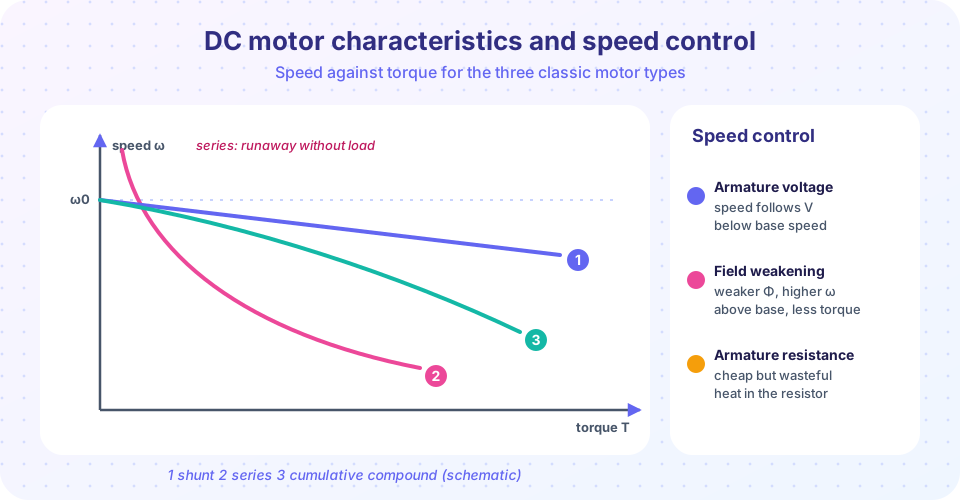
Φis nearly constant, so the speed-torque line is almost flat (speed regulation 3 to 8 %) andT ∝ Ia. Used for fans, pumps, machine tools. Danger: if the field circuit opens,Φfalls to the residual value, and the speed climbs to dangerous levels. - Series motor: the armature current also flows in the field, so
Φ ∝ Ia(below saturation) andT ∝ Ia². The result is enormous starting torque, and a speed that falls roughly as1/√T. At no load the speed is limited only by friction, so it races dangerously: never couple a series motor to a load through a belt that can slip or break. Used in traction, cranes, starter motors and (as universal motors) household appliances. - Cumulative compound motor: a series field adds to the shunt field. It has good starting torque and a limited no-load speed. Used for presses and elevators with intermittent loads.
- Permanent-magnet motor: like the shunt motor with a fixed
Φ.
Speed control
From ω = (V − Ia Ra)/(K Φ) there are three levers.
- Armature voltage control. Vary
V(with a controlled rectifier or a chopper). The speed changes in proportion toV, below base speed. The flux is full, so the torque per ampere is full: constant-torque operation. Efficient and smooth, down to very low speeds. - Field weakening. Reduce
Φwith a rheostat or by reducing field current. The speed rises above base, but the torque per ampere falls withΦ. For constant power,T ∝ 1/ω: the constant-power range. - Armature resistance control. Insert resistance in series with the armature. The speed falls for a given load, but the resistance dissipates heat: cheap, but inefficient, used for short periods.
Worked example: field weakening. The same motor with Φ cut to 80 % (K Φ = 0.8) and Ia = 20 A: ω = (230 − 10) / 0.8 = 275 rad/s = 2626 rpm, with T = 0.8 × 20 = 16 N·m. The speed rose by 25 % and the torque fell by 20 %. (If the load needs 20 N·m, the current becomes 20 / 0.8 = 25 A, and the speed is about 2596 rpm.)
The classic Ward-Leonard system used a motor-generator set to give a variable voltage to a DC motor. Today a thyristor or transistor converter does the same job, and with four-quadrant converters the motor can drive and brake in both directions.
Reversing and braking
- Reversal: reverse the armature current or the field current (not both).
- Regenerative braking: raise
EaboveV(by reducingVor increasing the field), soIareverses and the machine feeds energy back into the supply. Efficient; used in trains and electric vehicles. - Dynamic (rheostatic) braking: disconnect the armature from the supply and connect it to a resistor. The motor acts as a generator and dissipates the energy as heat.
- Plugging: reverse the supply connection while rotating.
EandVnow add, so a resistor must limit the current. Quick but wasteful.
Common misconceptions
"More current means higher speed." The speed is set by (V − Ia Ra)/(K Φ). More load current lowers the speed slightly; torque goes up.
"Weakening the field reduces the speed." It raises it: with less flux the motor must spin faster to generate the back-EMF E ≈ V.
"A DC motor draws constant current." The current follows the load torque; Ia = T/(K Φ).
Try it
Press Run (or Ctrl + Enter) to see the result here.
Program input · what you'd type while the program runs
Type the answers before you press Run, one per line. Each time the program reads a line (with input()), it gets the next line from this box.
Press Run (or Ctrl + Enter) to see the result here.
Program input · what you'd type while the program runs
Type the answers before you press Run, one per line. Each time the program reads a line (with input()), it gets the next line from this box.
Check your understanding
Quick check · 6 questions
of 6 answered You scored / 6 · perfect!
-
1. A DC motor has V = 220 V, Ra = 0.4 Ω and Ia = 25 A. What is the back-EMF?
E = V − Ia Ra = 220 − 10 = 210 V. -
2. What is the starting current of that motor with no starter?
At standstill E = 0, so Ia = V/Ra = 220/0.4 = 550 A. -
3. Which motor has the highest starting torque for a given current?
In a series motor Φ ∝ Ia, so T ∝ Ia². -
4. What happens to the speed of a shunt motor if its field current is reduced?
With less flux the armature must turn faster to produce the back-EMF that balances the supply. -
5. A motor with K Φ = 1.2 V·s/rad carries 15 A. What is its developed torque?
T = K Φ Ia = 1.2 × 15 = 18 N·m. -
6. Which braking method returns energy to the supply?
In regenerative braking E exceeds V, Ia reverses and the machine acts as a generator feeding the supply.
Summary
V = E + Ia Ra,E = K Φ ω,T = K Φ Ia;ω = V/(KΦ) − Ra T/(KΦ)².- Starting current
V/Rais huge, so use a starter or a gradually rising armature voltage. - Shunt: nearly constant speed; series: huge torque but races at no load; compound: in between.
- Control speed with armature voltage (below base), field weakening (above base) or resistance; brake with regeneration, dynamic braking or plugging.
Track your progress
Create a free account to tick off lessons and pick up where you left off on any device.
of Electrical Machines lessons completed