


















Lesson 43 of 45 · Projects and Practice
Glossary: induction, synchronous and special machines
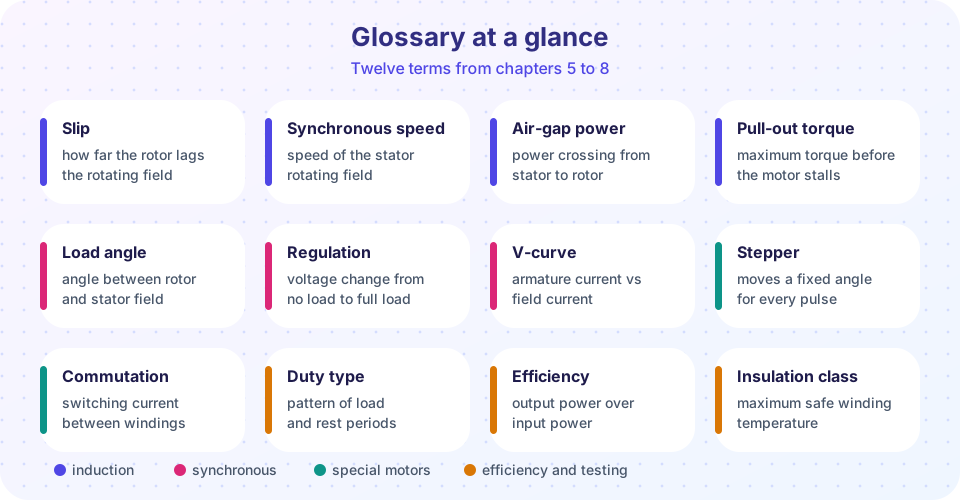
A glossary of the terms from chapters 5 to 8: induction and synchronous machines, special motors and drives, losses, tests and selection, with links to the lessons.
Every field has its own vocabulary, and electrical machines have a lot of it. This glossary collects the terms from the induction, synchronous, special-motor and efficiency chapters. Each entry is one or two lines, with a link to the lesson where the idea is developed. Use the flash cards below the table to test yourself.
What you will learn
- The precise meaning of the main terms in chapters 5 to 8.
- Which lesson to revisit when a term is unclear.
- How to test yourself quickly with flash cards.
Terms
| Term | Meaning | Lesson |
|---|---|---|
Air-gap power Pag |
Power crossing the air gap from stator to rotor | Slip and equivalent circuit |
| Alternator | A synchronous generator | Alternator EMF |
| Armature reaction | Effect of the stator current's own field on the main field | Alternator EMF |
| Blocked-rotor test | Locked rotor at low voltage; gives R1 + R2' and X1 + X2' |
Testing |
| Brushless DC motor | Permanent-magnet motor commutated electronically | Stepper, BLDC, servo |
| Capacitor-start motor | Single-phase motor with a capacitor in the start winding | Single-phase motors |
| Centrifugal switch | Switch opening the start circuit at about 75 % speed | Single-phase motors |
| Commutation | Switching current between windings at the right rotor angle | Stepper, BLDC, servo |
| Constant-torque region | Speed range up to base speed with V/f constant |
VFD |
| Copper loss | I²R heating in windings; variable loss |
Losses |
| Core loss | Hysteresis and eddy-current loss in the iron; fixed loss | Losses |
| Damper winding | Cage in the pole faces for starting and damping | Synchronous motor |
| DC link | Capacitor stage between rectifier and inverter | VFD |
| Double-revolving field | A pulsating field seen as two opposite rotating fields | Single-phase motors |
| Duty type | Standard pattern of load and rest (S1 to S9) | Selection |
| Efficiency | Output power divided by input power | Losses |
| Encoder | Sensor reporting shaft angle as pulses | Stepper, BLDC, servo |
| Field weakening | Operation above base speed with limited voltage | VFD |
| Hunting | Oscillation of a synchronous rotor around its steady angle | Synchronous motor |
| IE class | International efficiency class IE1 to IE4 | Losses |
| Insulation class | Maximum winding temperature (A 105, B 130, F 155, H 180 °C) | Selection |
| Inverter | Converts DC to AC of adjustable frequency | VFD |
Load angle δ |
Angle between rotor field and stator field | Synchronous motor |
| Microstepping | Driving a stepper with sine and cosine currents | Stepper, BLDC, servo |
| No-load test | Rated voltage, free shaft; gives core + friction loss and Xm |
Testing |
| Open-circuit test | Rated voltage on one transformer winding, other open | Testing |
| Over-excited | Field current high enough for leading armature current | Synchronous motor |
| Pole pair | One north and one south pole | Rotating field |
| Pull-out torque | Maximum torque; Tmax ∝ V² |
Torque and starting |
| PWM | Pulse-width modulation of the inverter output | VFD |
| Rotating magnetic field | Field of constant size turning at synchronous speed | Rotating field |
| Service factor | Allowed continuous overload multiplier | Selection |
| Short-circuit test | Rated current with the other winding shorted | Testing |
| Shading ring | Copper loop that delays flux in part of a pole | Single-phase motors |
Slip s |
(ns − n) / ns |
Slip and equivalent circuit |
| Stepper motor | Moves a fixed angle per pulse | Stepper, BLDC, servo |
| Synchronous condenser | Unloaded synchronous machine used for reactive power | Synchronous motor |
Synchronous reactance Xs |
Leakage plus armature reaction as one reactance | Alternator EMF |
Synchronous speed ns |
120 f / P |
Rotating field |
| Universal motor | Series commutator motor working on AC and DC | Single-phase motors |
| V-curve | Armature current against field current | Synchronous motor |
V/f control |
Keeping voltage proportional to frequency to hold flux | VFD |
| Voltage regulation | (E − V) / V of an alternator or transformer |
Alternator EMF |
Try it
Draw a random flash card and say the definition before you reveal the answer. The deck is a sample of the terms above; add your own.
Press Run (or Ctrl + Enter) to see the console output here.
No output.
The second tool finds every term that contains a word, so you can search the glossary by idea.
Press Run (or Ctrl + Enter) to see the console output here.
No output.
Check your understanding
Quick check · 5 questions
of 5 answered You scored / 5 · perfect!
-
1. Which term means the speed of the stator's rotating field?
Synchronous speed is ns = 120 f / P. -
2. Which loss is called a fixed loss?
Core loss depends on voltage and frequency, not on the load. -
3. What does a damper winding do?
The cage in the pole faces provides induction-motor starting torque and damps rotor oscillations. -
4. Which term describes switching current between windings at the right rotor angle?
Commutation is done by brushes in a brushed DC motor and by electronics in a BLDC motor. -
5. Which test uses a locked rotor and a reduced voltage?
The blocked-rotor test gives the series resistances and leakage reactances.
Summary
- The glossary lists the terms of chapters 5 to 8 with links to the lessons.
- Terms cluster by chapter: induction (slip,
ns,Pag), synchronous (δ,Xs, V-curve), special motors and drives (commutation, PWM,V/f), efficiency and testing (losses, tests, duty). - Use flash cards for quick revision before an exam.
Next: Cheat sheet
Track your progress
Create a free account to tick off lessons and pick up where you left off on any device.
of Electrical Machines lessons completed