


















Lesson 32 of 45 · Special Motors and Drives
Single-phase and universal motors
Why a single-phase induction motor cannot start alone, how split-phase, capacitor-start, capacitor-run and shaded-pole motors fix it, and how a universal motor runs on AC and DC.
A house has one phase, not three. Run a single winding from that supply and the stator field only pulses along one line, as you saw in the first lesson of this chapter. A rotor at rest feels equal pulls in both directions and does not move. Yet fans, pumps, refrigerators and washing machines all use single-phase induction motors that start without a hand on the shaft.
This lesson explains the trick behind those motors, then looks at the universal motor, which takes a completely different route and runs on both AC and DC.
What you will learn
- The double-revolving-field idea and why the torque at standstill is zero.
- How split-phase, capacitor-start, capacitor-run and shaded-pole motors get a starting torque.
- How to choose a starting capacitor so the two winding currents are 90° apart.
- Why a universal motor works on AC and DC and what its speed characteristics are.
Key terms
Double-revolving field: a pulsating field modeled as two equal fields rotating in opposite directions.
Auxiliary (start) winding: a second stator winding, displaced 90° in space, that creates a time-phase shift in the field.
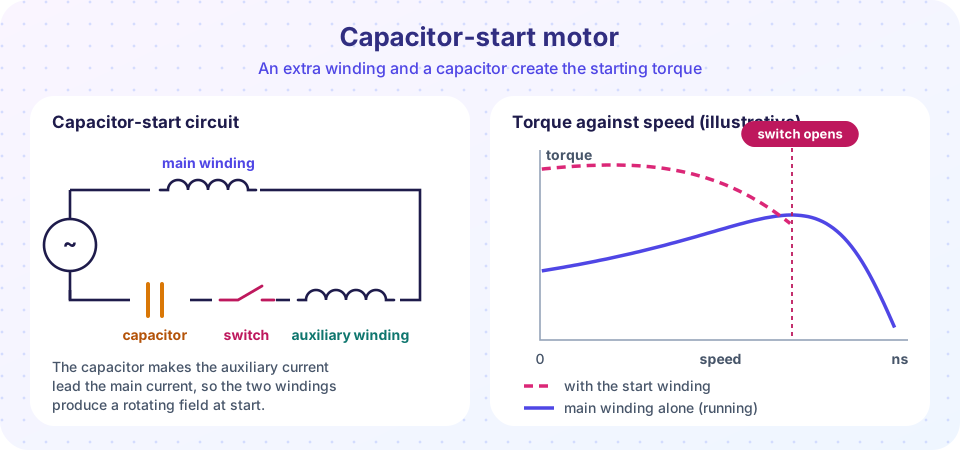
Centrifugal switch: a switch that opens the start circuit at about 75 % of full speed.
Shading ring: a copper loop around part of a pole that delays the flux there.
Universal motor: a series-wound commutator motor that works on both AC and DC.
The double-revolving field
A pulsating field Bm cos ωt is the same as two rotating fields of size Bm / 2, one turning forward and one backward at synchronous speed. Each produces its own induction-motor torque curve. At standstill the two torques are equal and opposite, so the net is zero. If something turns the rotor, say forward, the forward field has slip s and the backward one has slip 2 − s, which is close to 2. The forward torque is then much larger and the motor keeps accelerating in the direction it was started. The net curve passes through zero at s = 1 and is slightly below the three-phase curve for the same size.
Because the field pulsates, the instantaneous power also pulsates at twice the supply frequency, which causes the characteristic hum and vibration. For the same output, a single-phase induction motor is larger, heavier and less efficient than a three-phase one.
Getting a starting torque
If you can make the field rotate even a little at start, there is torque. All single-phase starting methods add a second, auxiliary winding 90° away in space and give its current a different phase from the main winding.
| Type | How the phase shift is made | Starting torque | Typical use |
|---|---|---|---|
| Split-phase | Auxiliary winding with high resistance, low reactance | 1.5 to 2 times rated | Small fans, blowers |
| Capacitor-start | Capacitor in series with the auxiliary winding (switched out) | 3 to 4.5 times rated | Compressors, pumps, loaded starts |
| Capacitor-run (PSC) | Capacitor stays in circuit | Low (0.5 to 1 times) | Fans, quiet drives |
| Two-value capacitor | Large capacitor to start, small to run | High, with good running performance | Heavy-duty compressors |
| Shaded-pole | Copper ring delays the flux of part of each pole | Very low | Tiny fans, under about 100 W |
The shaded-pole motor has no auxiliary winding at all. Its tiny starting torque and low efficiency are the price of its extreme simplicity and low cost, and the rotor turns in the direction from the unshaded toward the shaded part of the pole.
To reverse a capacitor motor, swap the connections of the auxiliary winding relative to the main winding.
Choosing the capacitor
For the best starting torque the auxiliary current should lead the main current by 90°. Take a 230 V, 50 Hz motor whose main winding is 4 + j6 Ω (so the main current lags the voltage by 56.3°) and whose auxiliary winding is 8 + j5 Ω. We need the auxiliary current to lead the voltage by 90° − 56.3° = 33.7°, so tan 33.7° = (Xc − 5) / 8, which gives Xc = 10.33 Ω. That corresponds to C = 1 / (2π × 50 × 10.33) ≈ 308 µF, a typical order of magnitude for a start capacitor (a short-rated AC electrolytic type).
The universal motor
A DC series motor has the armature and field windings in series, so the same current makes the flux and the armature force. Torque is T ∝ Φ I ∝ I², and it does not change sign when the current reverses. That is why the same motor works on AC. Laminated iron avoids eddy-current heating in the field. The main properties are:
- Very high speed, often 10 000 to 25 000 rpm, so a small machine delivers a lot of power.
- High starting torque.
- Speed falls steeply as the load increases and rises without limit when the load is removed, so it must never run unloaded or with a belt that can break.
- Easy speed control: lower the voltage with a triac controller.
- Brushes and a commutator wear and make radio noise.
You will find universal motors in drills, vacuum cleaners, blenders, sewing machines and angle grinders.
Common misconceptions
"A single-phase motor produces no torque at all." It produces none at standstill; once it is turning, the forward field wins.
"The capacitor stays in circuit in every motor." In capacitor-start motors a switch removes it at about 75 % speed; only capacitor-run motors keep it permanently.
"A universal motor is like a small induction motor." It is a series commutator motor with brushes, high speed and a steeply falling speed-torque curve.
Try it
Use the circuit of the example to find the capacitor that gives a 90° phase difference, and see how the relative starting torque varies with capacitance. The torque keeps rising a little beyond the 90° value because a bigger capacitor also raises the auxiliary current, but a 90° shift is the usual design target and keeps that current and the capacitor size moderate.
Press Run (or Ctrl + Enter) to see the result here.
Program input · what you'd type while the program runs
Type the answers before you press Run, one per line. Each time the program reads a line (with input()), it gets the next line from this box.
Now the torque of the double-revolving-field model. The forward and backward torques use the same simplified curve shape, evaluated at slips s and 2 − s. It is a model for understanding, not a prediction for a specific motor.
Press Run (or Ctrl + Enter) to see the result here.
Program input · what you'd type while the program runs
Type the answers before you press Run, one per line. Each time the program reads a line (with input()), it gets the next line from this box.
Check your understanding
Quick check · 5 questions
of 5 answered You scored / 5 · perfect!
-
1. Why does a single-phase induction motor have no starting torque with only its main winding?
A pulsating field equals two counter-rotating fields; at standstill their torques are equal and opposite. -
2. Which single-phase motor is the best choice for a loaded compressor that needs a strong start?
A capacitor-start motor gives a starting torque of about three to four times rated. -
3. What happens to the torque of a universal motor when the current reverses?
In a series motor T ∝ I², so reversing the current does not reverse the torque. -
4. How is the direction of a capacitor-start motor reversed?
Reversing the auxiliary winding reverses the phase relation of the two fields and so the rotation. -
5. A universal motor is left running with no load. The danger is that
A series motor's speed rises without limit as the load falls, so it can destroy itself.
Summary
- A single winding gives a pulsating field, equal to two opposite rotating fields: no starting torque.
- An auxiliary winding with a different phase (resistance, capacitor or shading ring) gives a start.
- Capacitor-start motors have strong starting torque; capacitor-run motors are quiet and efficient; shaded-pole motors are tiny and cheap.
- Universal motors are series commutator motors: high speed, high starting torque, run on AC and DC, speed falls with load.
Track your progress
Create a free account to tick off lessons and pick up where you left off on any device.
of Electrical Machines lessons completed