


















Lesson 37 of 45 · Efficiency, Testing and Applications
Losses and efficiency
Learn the copper, core, mechanical and stray losses of electrical machines, calculate efficiency from a power-flow example, and find the load at which efficiency peaks.
Energy cannot be destroyed, but in a machine some of it ends up as heat that nobody wanted. Those are the losses. They matter for three reasons: they cost money in electricity, they heat the machine and shorten the life of the insulation, and they set the size of the machine, because it has to be big enough to get rid of the heat.
This lesson names each loss, shows where it comes from in the equivalent circuit, and uses it to calculate efficiency. You will also see a classic result: a machine is most efficient when its fixed and variable losses are equal.
What you will learn
- The four main loss types and how each one depends on load and speed.
- How to calculate efficiency from the losses.
- How to follow the power through an induction motor from input to shaft.
- Where the maximum efficiency occurs and why part-load operation matters.
Key terms
Copper loss: I²R heating in the windings; it grows with the square of the current.
Core (iron) loss: hysteresis and eddy-current loss in the magnetic steel; set by voltage and frequency, nearly the same at any load.
Friction and windage: mechanical loss in bearings and from air drag and the cooling fan.
Stray load loss: small extra losses caused by leakage flux, harmonics and eddy currents that appear under load.
Efficiency η: Pout / Pin.
The loss types
Copper loss is 3 I² R in each winding. Resistance rises with temperature: for copper R2 = R1 (234.5 + T2) / (234.5 + T1), which is why losses are always quoted at a reference temperature. Because the current changes with load, copper loss is a variable loss, proportional to the square of the load fraction.
Core loss has two parts. Hysteresis loss comes from the magnetic domains flipping each cycle and is proportional to the frequency and a power of the peak flux density. Eddy-current loss comes from circulating currents in the steel and goes with f²B²t², where t is the lamination thickness. That is why cores are built from thin insulated sheets. Both are set by the flux, which is set by voltage and frequency, so the core loss is nearly constant from no load to full load. In a transformer or an induction motor it is a fixed loss.
Mechanical loss includes bearing friction, brush friction (where present) and windage, the drag on the rotor and the fan. It is nearly constant at constant speed, though windage rises steeply with speed.
Stray load loss is a small catch-all, often assumed to be 0.5 % to 2 % of the output depending on the standard and the machine size.
Efficiency
η = Pout / Pin = Pout / (Pout + losses) = 1 − losses / Pin
Large machines are more efficient than small ones because their losses grow more slowly than their rating. A 1 MW motor can exceed 96 %; a 100 W motor may be below 60 %.
Power flow in an induction motor
Revisit the motor of lesson 2 at s = 0.03, and add a core loss of 250 W, a friction and windage loss of 180 W and a stray loss of 0.5 % of the mechanical power. The program in this lesson gives the full waterfall:
| Step | Power |
|---|---|
Input Pin (with core loss) |
14 631 W |
| Stator copper loss | 549 W |
| Core loss | 250 W |
Air-gap power Pag |
13 832 W |
Rotor copper loss s Pag |
415 W |
Mechanical power (1 − s) Pag |
13 417 W |
| Friction and windage | 180 W |
| Stray load loss | 67 W |
| Shaft output | 13 170 W |
The efficiency is 13 170 / 14 631 = 90.0 %, and the shaft torque is 13 170 / (2π × 1455 / 60) = 86.4 N·m, a little less than the 88.1 N·m of the air-gap torque. The difference is the friction and stray torque.
Maximum efficiency
Write the load as a fraction x of the full load. The output is x S cos φ, the fixed loss is Pc, and the variable loss is x² Pcu, where Pcu is the copper loss at full load:
η(x) = x S cos φ / ( x S cos φ + Pc + x² Pcu )
Setting the derivative to zero gives the condition for maximum efficiency: the variable loss equals the fixed loss, so
x = √( Pc / Pcu )
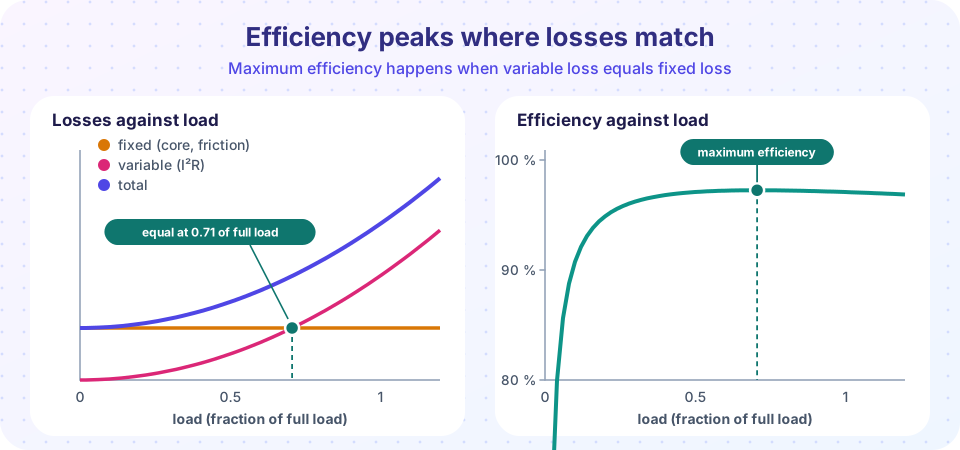
A 100 kVA transformer with an iron loss of 0.6 kW and a full-load copper loss of 1.8 kW reaches its maximum efficiency at x = √(0.6 / 1.8) = 0.577, about 58 % of full load. At 0.8 power factor it has an efficiency of 97.5 % there, against 97.1 % at full load and 96.6 % at quarter load. The curve is flat near the top, which is good news: a machine loaded between 50 % and 100 % is within a fraction of a percent of its best.
Utilities design distribution transformers (which are energized all day but lightly loaded much of the time) with low core loss and a peak efficiency near the average load. The same logic applies to all-day efficiency, calculated from energy instead of power over 24 hours.
Motors have efficiency classes IE1 to IE4 in the IEC 60034-30-1 standard, and many countries require premium efficiency (IE3 or better) for new motors. An oversized motor running at 25 % load has poor efficiency and a poor power factor; matching the size to the load is the cheapest efficiency measure.
Common misconceptions
"Efficiency is highest at full load." It usually peaks at 50 % to 80 % of rated load, where variable loss equals fixed loss.
"Core loss rises with the load." It follows the voltage and frequency; the load changes the copper loss.
"A high rated efficiency guarantees low running cost." Hours of operation, load factor and part-load behavior decide the energy bill.
Try it
Compute the full power waterfall for the induction motor and check that every watt is accounted for.
Press Run (or Ctrl + Enter) to see the result here.
Program input · what you'd type while the program runs
Type the answers before you press Run, one per line. Each time the program reads a line (with input()), it gets the next line from this box.
Now the transformer: find the load of maximum efficiency and compare several power factors.
Press Run (or Ctrl + Enter) to see the result here.
Program input · what you'd type while the program runs
Type the answers before you press Run, one per line. Each time the program reads a line (with input()), it gets the next line from this box.
Check your understanding
Quick check · 5 questions
of 5 answered You scored / 5 · perfect!
-
1. Which loss is nearly independent of the load of a transformer?
Core loss depends on the flux, which is set by the voltage and frequency, so it is nearly constant from no load to full load. -
2. A transformer has an iron loss of 500 W and a full-load copper loss of 2000 W. At what fraction of full load is its efficiency highest?
x = √(Pc / Pcu) = √(500 / 2000) = 0.5. -
3. A motor takes 10 kW and delivers 9 kW. Its efficiency and total loss are
η = 9 / 10 = 90 %, and the loss is 10 − 9 = 1 kW. -
4. In an induction motor with air-gap power 10 kW and slip 0.04, the rotor copper loss is
Pcu2 = s × Pag = 0.04 × 10 kW = 0.4 kW. -
5. Why are transformer cores built from thin insulated laminations?
Thin laminations break up the paths for eddy currents, which go with the square of the thickness.
Summary
- Losses: copper (variable,
∝ load²), core (fixed), mechanical (nearly fixed) and stray load. η = Pout / (Pout + losses); in an induction motorPcu2 = s · PagandPmech = (1 − s) · Pag.- Maximum efficiency occurs when variable loss equals fixed loss:
x = √(Pc / Pcu). - Right-sizing and avoiding long part-load operation save more energy than small differences in rated efficiency.
Track your progress
Create a free account to tick off lessons and pick up where you left off on any device.
of Electrical Machines lessons completed