


















Lesson 34 of 45 · Special Motors and Drives
Variable-frequency drives and vector control
Learn how a variable-frequency drive rectifies, smooths and inverts power to change motor speed, why V/f is kept constant, and how vector control gives a DC-like torque response.
An induction or synchronous motor runs at a speed set by frequency, ns = 120 f / P. If you could change the frequency, you could change the speed. Before power electronics that was impractical; now a box the size of a shoebox does it. The variable-frequency drive (VFD, also called an inverter or adjustable-speed drive) is one of the biggest efficiency upgrades in industry, because most fans and pumps do not need full speed most of the time.
Changing frequency alone is not enough, though. The voltage must change with it, or the motor's iron would saturate. This lesson explains both the hardware and the control ideas.
What you will learn
- The three power stages of a VFD and what each one does.
- Why
V/fis kept constant and what happens above base speed. - How the affinity laws turn a lower speed into large energy savings.
- What vector (field-oriented) control is and how it makes an AC motor behave like a DC motor.
Key terms
DC link: the capacitor bank between the rectifier and the inverter that holds a smooth DC voltage.
PWM (pulse-width modulation): switching the inverter at several kHz with varying pulse widths so that the average output looks like a sine wave.
Base speed: the speed at which rated voltage and rated frequency are applied.
Field weakening: operation above base speed, where voltage is capped and flux falls.
Field-oriented control (FOC): controlling the stator current in a frame that rotates with the rotor flux.
The power stages
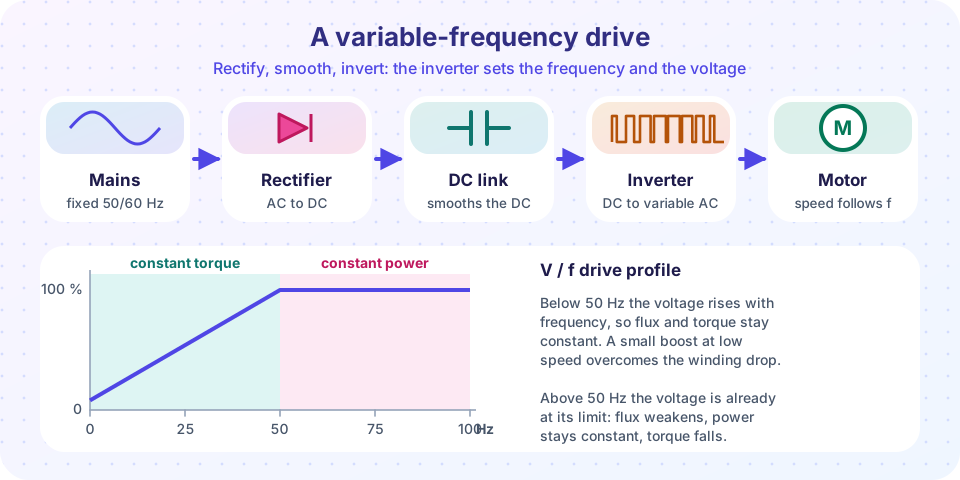
- Rectifier. A diode bridge converts the three-phase supply to DC. For a 400 V supply the DC bus is about
1.35 × 400 V = 540 V. - DC link. Capacitors smooth that DC and store a little energy. A braking resistor or a regenerative front end handles energy returning from a decelerating load.
- Inverter. Six IGBTs switch the DC bus at 2 to 16 kHz in a PWM pattern. The motor's inductance smooths the current, so the windings see nearly sinusoidal currents at any frequency from a fraction of a hertz to well above 50 Hz.
Why V/f is constant
The voltage in a winding is V ≈ 4.44 f N Φ, so the flux is Φ ∝ V / f. If you lower f and keep V the same, the flux rises and the iron saturates; the motor draws large current and overheats. If you lower V in proportion, the flux stays at its rated value. The maximum torque of the motor stays roughly constant, so this region is called constant torque. At very low frequency the stator resistance drop becomes a large part of the applied voltage, so drives add a small voltage boost.
Above the base frequency (usually 50 or 60 Hz) the voltage cannot rise, so V/f falls, the flux weakens, and the available torque falls as 1 / f. Power stays roughly constant, so this is the constant-power region, and pull-out torque falls as 1 / f². Look at the plot in the figure: that is the profile every drive builds.
For a 400 V, 50 Hz, 4-pole motor, 25 Hz gives 200 V and ns = 750 rpm; 10 Hz gives 80 V plus a boost and ns = 300 rpm; 75 Hz is limited to 400 V and gives ns = 2250 rpm, but with only two thirds of the torque.
Other practical points: a shaft-mounted fan cools poorly at low speed, so a long slow run may need a separate fan; PWM voltage pulses add harmonic heating and put stress on cable insulation and bearings, so long cables may need filters; and a drive can start a motor gently, so the 5 to 8 times starting current of a direct start disappears.
Energy savings
For fans and pumps the affinity laws say flow ∝ n, pressure ∝ n² and power ∝ n³. Running at 80 % of full speed uses 0.8³ = 51 % of the power. Throttling a valve instead barely reduces the motor's power, so replacing it with a drive can cut the energy use dramatically.
Vector control
V/f is simple and robust, but it only controls the voltage magnitude and frequency, so torque response is slow and not precise. A DC motor is easy to control because flux and torque have separate knobs: field current sets the flux, armature current sets the torque. Vector control gives an AC motor the same two knobs.
The controller measures (or estimates) the rotor angle θ and transforms the three phase currents into a frame that rotates with the rotor flux:
Clarke:  iα = ia                  iβ = (ia + 2 ib) / √3
Park:    id = iα cos θ + iβ sin θ    iq = −iα sin θ + iβ cos θ
In that rotating frame the sinusoidal currents become constants. id produces the flux and iq produces the torque. For a permanent-magnet machine T = (3/2)(P/2) λ iq; for an induction motor it is T = (3/2)(P/2)(Lm / Lr) ψr iq. Two simple PI regulators drive id and iq to their references, and the result is transformed back to three-phase voltages for the PWM. Torque can then change in a few milliseconds without disturbing the flux. Sensorless variants estimate θ from voltage and current, and direct torque control (DTC) is an alternative that skips the rotating frame.
Common misconceptions
"A drive can make a motor produce more power at any speed." Above base speed the power is constant at best and torque falls.
"Lowering the frequency alone slows the motor safely." Without lowering the voltage the iron saturates and the motor overheats.
"Vector control needs a different motor." An ordinary induction motor works; the control, not the machine, changes.
Try it
Build the V/f profile and the torque and power capability of a motor from 0 to 100 Hz.
Press Run (or Ctrl + Enter) to see the result here.
Program input · what you'd type while the program runs
Type the answers before you press Run, one per line. Each time the program reads a line (with input()), it gets the next line from this box.
Next, the Clarke and Park transformations. The three phase currents are sinusoids that change all the time, but id and iq come out constant.
Press Run (or Ctrl + Enter) to see the result here.
Program input · what you'd type while the program runs
Type the answers before you press Run, one per line. Each time the program reads a line (with input()), it gets the next line from this box.
Check your understanding
Quick check · 5 questions
of 5 answered You scored / 5 · perfect!
-
1. A 4-pole motor is driven at 20 Hz by a VFD. Its synchronous speed is
ns = 120 × 20 / 4 = 600 rpm. -
2. Why does a drive reduce the voltage when it reduces the frequency?
Flux is proportional to V/f; keeping V/f constant keeps the flux and the torque capability. -
3. A pump is slowed to 80 % of full speed with a drive. The power it needs falls to about
Pump power goes with the cube of speed: 0.8³ ≈ 0.51. -
4. Above base speed, a drive with fixed maximum voltage gives
The voltage is capped, the flux weakens, and the available torque falls as 1/f while power stays roughly constant. -
5. In field-oriented control, what do the currents id and iq control?
In the rotating frame id sets the flux and iq sets the torque, much like field and armature current in a DC motor.
Summary
- A VFD rectifies, smooths on a DC link and inverts with PWM, setting both frequency and voltage.
V/fconstant keeps the flux constant (constant torque to base speed); above it the drive weakens the field (constant power).- Pump and fan power goes with speed cubed, so a drive saves a lot of energy.
- Vector control uses the Clarke and Park transformations to control flux (
id) and torque (iq) separately.
Next: Chapter review
Track your progress
Create a free account to tick off lessons and pick up where you left off on any device.
of Electrical Machines lessons completed