


















Lesson 9 of 45 · Magnetic Circuits
Inductance, Stored Energy and Force
Derive inductance from reluctance, compute magnetic energy stored mostly in the air gap, and find the pull of an electromagnet with F = B squared A over 2 mu zero.
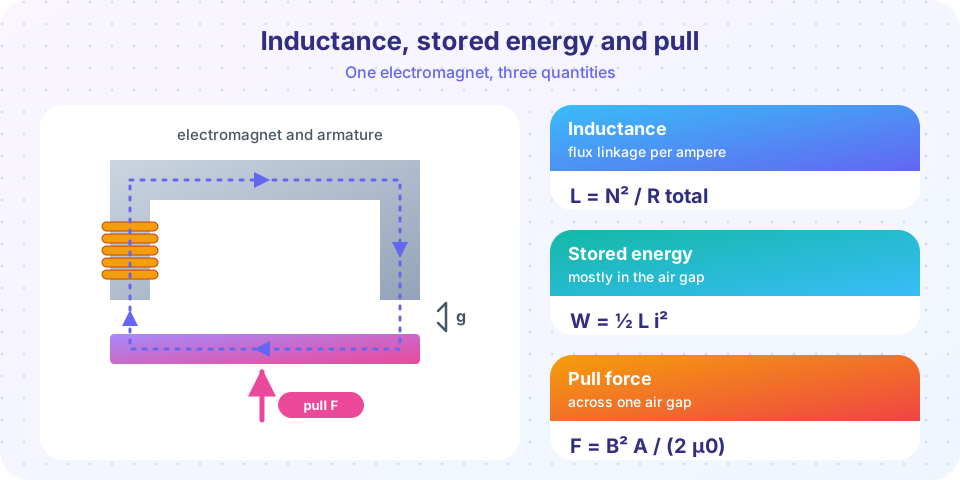
A magnetic circuit is more than a flux calculator. It also tells you the inductance of a coil, the energy stored in its field, and the force that field exerts on a movable piece of iron. These three results, one derived from the next, are the bridge from static magnetic circuits to motors: a motor is an electromagnet whose armature is allowed to move.
What you will learn
- How
L = N² / Rfollows from flux linkage. - Where the magnetic energy is stored and how to compute it.
- The force on an armature from the energy in the gap.
- Why gapped cores are used for inductors and relays.
Key terms
Flux linkage (λ): λ = N Φ, the flux counted once for each turn.
Inductance (L): flux linkage per ampere, L = λ / i, in henries (H).
Magnetic energy density: B² / (2μ), joules per cubic meter.
Virtual work: finding force from how the stored energy changes with a small displacement.
Reluctance force: a force that arises purely from the tendency to reduce the reluctance of the flux path.
Inductance from reluctance
By definition L = λ / i. With λ = N Φ and Φ = N i / R:
L = N² / R
Inductance grows with the square of the number of turns and falls with reluctance. Doubling the turns quadruples L for the same core; adding an air gap lowers L sharply.
Worked example. Take the core of the previous lesson: N = 500, total reluctance R = 2.39×10⁶ A/Wb. Then L = 500² / 2.39×10⁶ = 0.105 H. The voltage across the coil follows v = L di/dt (plus the winding resistance drop). With the gap removed (R ≈ 4.0×10⁵), L would rise to about 0.63 H, six times larger.
Why gap an inductor?
A gap lowers L, but it also makes L constant. Without a gap, the iron saturates at modest currents and L collapses. With a gap, most of the reluctance (and so most of the MMF) is in air, which never saturates, so L stays steady up to a much higher current. Power-electronics inductors for DC currents are gapped for exactly this reason.
Energy stored in the field
Raising the current from 0 to I against the induced voltage requires energy:
W = ∫ i dλ = ½ L I² = ½ λ I
Alternatively the energy is spread through the volume of the field with density w = B² / (2μ). Since μ of iron is thousands of times larger than μ0, the same B stores thousands of times less energy per cubic meter in iron than in air. So the gap, though tiny, holds most of the energy.
Worked example (same core, I = 1.91 A, B = 1.0 T).
- From the inductance:
W = ½ × 0.105 × 1.91² = 0.19 J. - Gap volume:
4×10⁻⁴ × 1×10⁻³ = 4×10⁻⁷ m³, density1² / (2 × 4π×10⁻⁷) = 3.98×10⁵ J/m³, so0.159 J. - Iron volume
1.6×10⁻⁴ m³, density3.98×10⁵ / 2000 = 199 J/m³, so0.032 J. - Sum:
0.191 J.
The two routes agree. The gap stores about 83 % of the energy, the same share as its share of the MMF.
Force from energy
Imagine the gap length g growing by a small amount dg while the flux stays constant. The mechanical work done by the field pulling the gap shut equals the loss of stored energy. In the gap, W_g = (B² / 2μ0) × A × g, and at constant B:
F = dW_g / dg = B² A / (2 μ0)
This is the force pulling on one gap face, in newtons. Equivalently the field exerts a pressure B² / (2μ0): at B = 1 T that is about 398 kPa, nearly four atmospheres. That is why magnetic lifting is so effective.
Worked example. At B = 1.0 T and A = 4 cm²: F = 1.0² × 4×10⁻⁴ / (2 × 4π×10⁻⁷) = 159 N per gap. The C-core electromagnet in the picture has two gaps (one at each pole), so it pulls with about 318 N.
Relay example. A relay armature of mass 2 kg must be lifted: F = 19.6 N. With two gaps of 4 cm² each, F = B² A / μ0, so B = √(F μ0 / A) = √(19.6 × 4π×10⁻⁷ / 4×10⁻⁴) = 0.25 T. A small field suffices.
Force and the gap length
At constant current (not constant flux) the flux falls as the gap opens, so the force falls rapidly with gap length, roughly as 1/g² for large gaps. Electromagnets therefore pull strongly only when the armature is almost touching. Engineers say a plunger solenoid has a "force-stroke curve" that rises steeply near closure.
From force to torque
Rotation works the same way. The torque on a rotor is the rate of change of the stored energy with angle: T = ½ i² dL/dθ for a linear magnetic circuit. If L depends on the rotor angle (a salient rotor that has a short flux path in one position and a long path in another), a torque appears with no permanent magnet and no rotor current. This reluctance torque is exploited in reluctance motors and contributes to modern synchronous motors.
Common misconceptions
"Inductance is a property of the coil alone." It depends on the whole magnetic path: turns, core shape and gaps. Same coil, different core, different L.
"The energy sits in the iron." At working flux densities most of it sits in the air gap, because air stores far more energy per unit of B.
"The pull of an electromagnet is proportional to current." At fixed gap it is closer to the square of the flux (and the current until saturation); at fixed current it also depends on gap length.
Try it
Press Run (or Ctrl + Enter) to see the result here.
Program input · what you'd type while the program runs
Type the answers before you press Run, one per line. Each time the program reads a line (with input()), it gets the next line from this box.
Press Run (or Ctrl + Enter) to see the result here.
Program input · what you'd type while the program runs
Type the answers before you press Run, one per line. Each time the program reads a line (with input()), it gets the next line from this box.
Check your understanding
Quick check · 5 questions
of 5 answered You scored / 5 · perfect!
-
1. A coil of 400 turns on a core of total reluctance 2.0 × 10⁶ A/Wb has what inductance?
L = N²/R = 160000 / 2×10⁶ = 0.08 H. -
2. Where is most of the magnetic energy stored in a gapped iron core at normal flux density?
Energy density is B²/(2μ), and μ of air is thousands of times smaller than that of iron, so the gap stores most of it. -
3. What is the magnetic pressure at B = 1 T (approximately)?
B²/(2μ0) = 1/(2 × 4π×10⁻⁷) ≈ 3.98×10⁵ Pa. -
4. A pole face of 10 cm² carries B = 0.8 T. What is the pull on that one gap face?
F = B²A/(2μ0) = 0.64 × 10⁻³ / (2 × 4π×10⁻⁷) = 254.6 N. -
5. Why do DC-carrying inductors usually have an air gap?
The gap takes most of the MMF in a non-saturating medium, so L stays nearly constant up to higher currents (though it is lower than without a gap).
Summary
L = N² / R: a gap lowersLbut linearizes it.- Field energy is
W = ½ L i² = ∫ B²/(2μ) dV, stored mostly in the air gap. - The force on one gap face is
F = B² A / (2 μ0), a pressure ofB²/(2μ0). - Torque in a rotating machine follows the same virtual-work idea:
T = ½ i² dL/dθin a linear circuit.
Track your progress
Create a free account to tick off lessons and pick up where you left off on any device.
of Electrical Machines lessons completed