


















Lesson 40 of 45 · Efficiency, Testing and Applications
Chapter review: efficiency, testing and applications
Review machine losses, efficiency, the no-load and blocked-rotor tests, transformer tests and motor selection with a one-page summary, a recap table and ten questions.
This chapter moved from "how does it work" to "how well does it work, how do I measure it, and which one should I buy". The same few ideas return again and again: losses split into fixed and variable parts, tests at no load or reduced voltage reveal the circuit, and temperature, not torque, sets the rating.
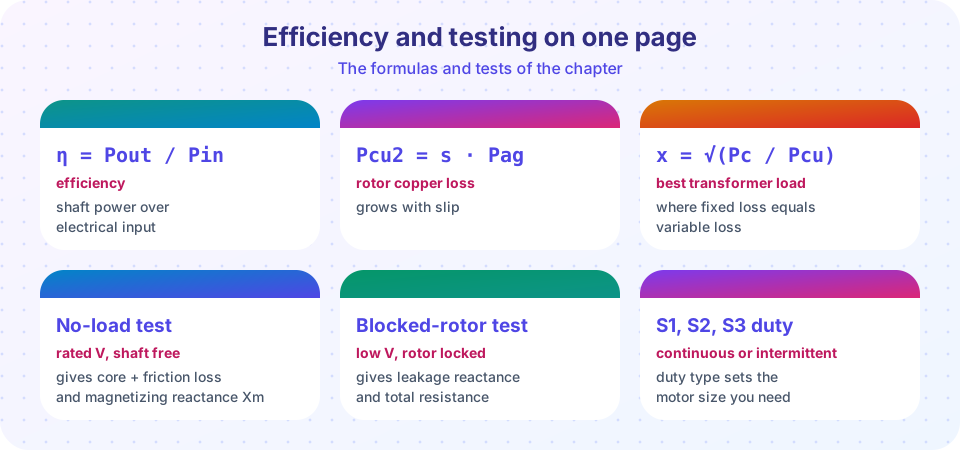
Recap table
| Idea | Formula or rule | Remember |
|---|---|---|
| Efficiency | η = Pout / (Pout + losses) |
losses end up as heat |
| Copper loss | 3 I² R, variable |
grows with load squared |
| Core loss | hysteresis + eddy current, fixed | set by voltage and frequency |
| Maximum efficiency | variable loss = fixed loss, x = √(Pc / Pcu) |
often at 50 to 80 % of load |
| Induction motor power flow | Pag → s Pag, (1 − s) Pag |
torque = Pag / ωs |
| No-load test | P0 − 3 I0² R1 = Pcore + Pfw; gives Xm |
rated voltage, free shaft |
| Blocked-rotor test | Rbr = R1 + R2', Xbr = X1 + X2' |
low voltage, locked rotor |
| Transformer tests | OC gives core loss, SC gives copper loss | OC at rated V, SC at rated I |
| Duty types | S1 continuous, S2 short-time, S3 intermittent | rms power for cycles |
| Insulation classes | A 105, B 130, F 155, H 180 °C | 10 °C extra roughly halves the life |
Try it
Run a complete mini-analysis: from test readings to the efficiency of a motor. Change the load and see how the efficiency responds.
Press Run (or Ctrl + Enter) to see the result here.
Program input · what you'd type while the program runs
Type the answers before you press Run, one per line. Each time the program reads a line (with input()), it gets the next line from this box.
A quick check of the transformer rule x = √(Pc / Pcu) for several transformers helps build intuition.
Press Run (or Ctrl + Enter) to see the console output here.
No output.
Check your understanding
Quick check · 10 questions
of 10 answered You scored / 10 · perfect!
-
1. A motor takes 20 kW and its total losses are 2 kW. Its efficiency is
Pout = 18 kW, so η = 18 / 20 = 90 %. -
2. At which condition is the efficiency of a transformer a maximum?
Maximum efficiency occurs when the variable (copper) loss equals the fixed (core) loss. -
3. Which test gives the magnetizing reactance Xm of an induction motor?
At no load the current is nearly all magnetizing, so Xm follows from V0, I0 and P0. -
4. The blocked-rotor test of a motor gives Pbr = 1020 W at 22.9 A. What is Rbr = R1 + R2'?
Rbr = Pbr / (3 Ibr²) = 1020 / (3 × 22.9²) ≈ 0.65 Ω. -
5. In the transformer short-circuit test, the wattmeter mainly shows
The voltage is low, so the flux and core loss are negligible; the power is the I²R loss at rated current. -
6. Which duty type means repeated cycles of load and rest?
S3 is intermittent periodic duty. -
7. A centrifugal pump is slowed to 50 % speed. Its power falls to about
P ∝ n³, so 0.5³ = 0.125. -
8. Class B insulation allows a maximum winding temperature of
A 105, B 130, F 155, H 180 °C. -
9. Why is core loss called a fixed loss?
The flux, and so the core loss, is set by voltage and frequency. -
10. A motor in a hot, high-altitude plant seems to overheat even at its rated load. What is a likely cause?
The standard rating assumes at most 40 °C ambient and 1000 m altitude.
Summary
- Efficiency is the part of the input power that reaches the shaft; the rest is heat.
- Fixed loss (core, friction) and variable loss (copper) meet at the load of maximum efficiency.
- No-load and blocked-rotor tests, and OC and SC tests, reveal equivalent-circuit parameters cheaply.
- Duty type, insulation class, load torque type and environment decide the right motor.
Track your progress
Create a free account to tick off lessons and pick up where you left off on any device.
of Electrical Machines lessons completed