


















Lesson 41 of 45 · Projects and Practice
Case study: sizing a pump motor
Size an induction motor for a water pump step by step: hydraulic and shaft power, margin, standard rating, torque, starting method, current and the energy saved by a drive.
A town needs a pump to lift water 30 m into a reservoir at 50 liters per second. Which motor do you buy? This case study walks through the decision the way an engineer would: compute the power, add a margin, pick a standard size, check that it can start the pump and then ask whether a variable-frequency drive pays for itself. Every step reuses something from this course.
What you will learn
- How to go from flow and head to the shaft power of a pump.
- How to choose a standard motor rating and check the load factor.
- How to check torque and starting for a centrifugal pump.
- How to estimate the energy saved by running slower with a drive.
Key terms
Hydraulic power: the useful power delivered to the water, ρ g Q H.
Pump efficiency: hydraulic power divided by shaft power.
Load factor: the shaft power divided by the motor rating.
Operating point: the speed at which motor torque equals load torque.
Affinity laws: flow ∝ n, head ∝ n², power ∝ n³ for centrifugal pumps.
Step 1: the power the water needs
With density ρ = 1000 kg/m³, g = 9.81 m/s², flow Q = 0.05 m³/s and head H = 30 m:
P_hydraulic = ρ g Q H = 1000 × 9.81 × 0.05 × 30 = 14 715 W ≈ 14.7 kW
Step 2: the shaft power
The pump is not perfect. With an efficiency of 0.70:
P_shaft = 14.7 kW / 0.70 = 21.0 kW
Step 3: margin and standard rating
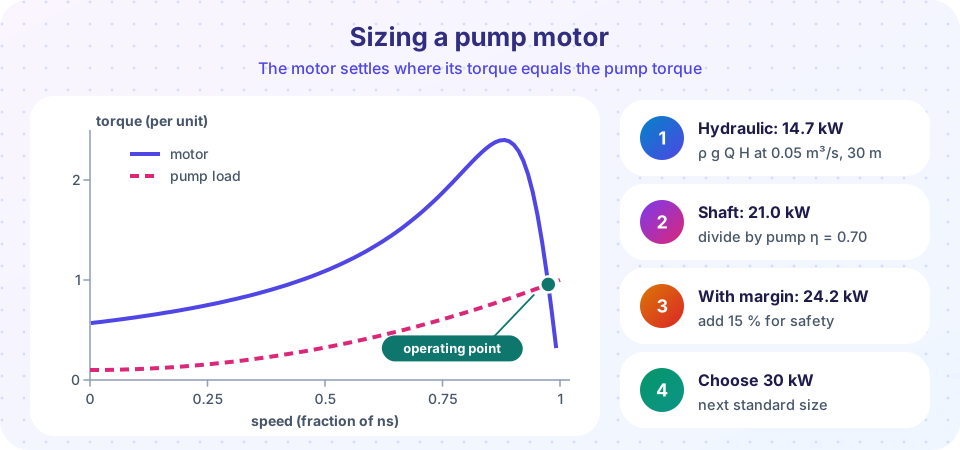
Add a 15 % margin for wear, uncertainty in the head and a fall in voltage: 21.0 × 1.15 = 24.2 kW. Standard IEC ratings near this are 22 kW and 30 kW. The 22 kW motor is too small for 24.2 kW, so choose 30 kW. The load factor is 21.0 / 30 = 70 %, which sits in the high-efficiency part of the motor's curve (see the lesson on maximum efficiency).
For a 4-pole 50 Hz motor the rated speed is a little under 1500 rpm; take 1475 rpm (a slip of 1.7 %). The rated torque is 30 000 / (2π × 1475 / 60) = 194 N·m.
Step 4: does it start the pump?
A centrifugal pump presents a torque that grows with the square of speed, roughly T_L = T0 + k n², with a small break-away torque (assume 10 % of its full-speed torque) at standstill. Any induction motor easily exceeds that. The starting method is then chosen from the supply side: direct-on-line would draw five to eight times the rated current; star-delta limits it to a third and still gives 0.3 to 0.7 of rated torque, plenty for a pump started with the discharge valve closed. The figure shows the operating point where the motor curve meets the load curve, at a slip of a few percent.
Step 5: electrical data
At 70 % load, assume an efficiency of 93 % and a power factor of 0.84 (typical for this size, but check the data sheet of the actual motor). Then
P_in = 21.0 / 0.93 = 22.6 kW
I = P_in / (√3 × 400 V × 0.84) ≈ 38.8 A
The cable and the protection are sized from the motor's rated current (around 55 A at 30 kW), not from this running value.
Step 6: would a drive pay?
If demand is usually only 80 % of the flow, a valve wastes energy by throttling. A VFD slows the pump instead: by the affinity laws the power falls to 0.8³ = 51 % (when the system curve is mainly friction). The program below estimates the annual saving for 6000 hours a year; the assumed price and the assumed throttled power are only for the example.
Common misconceptions
"Choose the rating equal to the shaft power." You also need margin and a standard size, and you must check starting and thermal limits.
"The nearest rating below is fine if the pump rarely runs flat out." A motor that is overloaded for years loses insulation life quickly.
"A drive always saves energy." It saves where the load torque falls with speed (fans, pumps); on a constant-torque load the saving is small.
Try it
First, the sizing calculator: change the flow, head and efficiency, and let the code pick a standard rating.
Press Run (or Ctrl + Enter) to see the result here.
Program input · what you'd type while the program runs
Type the answers before you press Run, one per line. Each time the program reads a line (with input()), it gets the next line from this box.
Second, the operating point and the energy saving of a drive.
Press Run (or Ctrl + Enter) to see the result here.
Program input · what you'd type while the program runs
Type the answers before you press Run, one per line. Each time the program reads a line (with input()), it gets the next line from this box.
Check your understanding
Quick check · 5 questions
of 5 answered You scored / 5 · perfect!
-
1. A pump lifts 0.02 m³/s of water through a head of 20 m. The hydraulic power is about
P = ρ g Q H = 1000 × 9.81 × 0.02 × 20 = 3924 W ≈ 3.9 kW. -
2. The pump efficiency is 0.7 and the hydraulic power is 14.7 kW. The shaft power is
Pshaft = 14.7 / 0.7 = 21.0 kW. -
3. The required motor power with margin is 24.2 kW. Which standard rating do you choose from 22 kW and 30 kW?
The motor must cover at least the required power, so choose the next size up: 30 kW. -
4. Why does star-delta starting usually suit a centrifugal pump?
A centrifugal pump starts with a small break-away torque that rises with n², so the reduced torque is sufficient. -
5. Running a pump at 80 % speed with a drive needs about what fraction of full-speed power (affinity law)?
Power goes with n³: 0.8³ = 0.512.
Summary
P_hydraulic = ρ g Q H; divide by pump efficiency for the shaft power.- Add a margin, pick the next standard motor rating and check the load factor.
- Check starting: a centrifugal pump needs little torque at standstill, so star-delta or a soft starter works.
- A drive saves energy because pump power falls with the cube of speed.
Next: Practice problem set
Track your progress
Create a free account to tick off lessons and pick up where you left off on any device.
of Electrical Machines lessons completed