


















Lesson 5 of 45 · Getting Started
Chapter 1 Review: Getting Started
Review chapter 1 of Electrical Machines: energy conversion, Faraday and Lorentz laws, losses, ratings and efficiency, with a recap table and a ten-question quiz.
You now have the toolkit that every later chapter uses: energy balance, the two electromagnetic laws and the accounting of losses. This review pulls the chapter together in one picture, one table and one calculator, then tests you with ten questions.
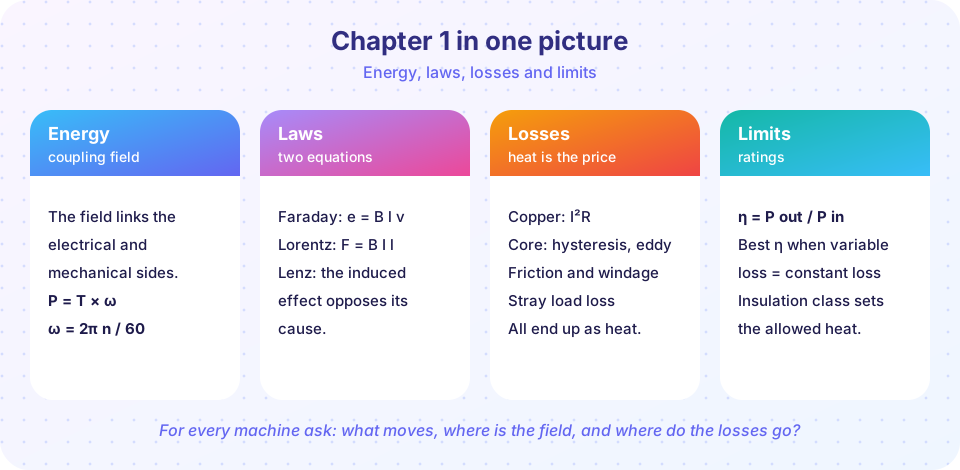
What you will learn
- How the four lessons of the chapter fit together.
- Which formulas to know by heart before chapter 2.
- How to check your understanding with mixed problems.
The chapter at a glance
| Lesson | Big idea | Formulas |
|---|---|---|
| Course map | What the course covers and how to study a machine | five-step method |
| Energy conversion | A magnetic field couples electrical and mechanical sides | P_in = P_out + losses, P = T ω, ω = 2πn/60 |
| Faraday and Lorentz | Motion makes voltage, current in a field makes force | e = B l v, F = B I l, e = N B A ω sin ωt, F v = e I |
| Ratings, losses, efficiency | Heat limits ratings; losses are copper, core, mechanical, stray | η = P_out/P_in, x_opt = √(P_c/P_v) |
Common misconceptions
"The coupling field supplies energy." It only stores and transfers it; the energy comes from the supply or the prime mover.
"Efficiency and power factor are the same thing." Efficiency compares real power out to real power in. Power factor (later chapters) describes the phase of current, not losses.
Try it
Press Run (or Ctrl + Enter) to see the result here.
Program input · what you'd type while the program runs
Type the answers before you press Run, one per line. Each time the program reads a line (with input()), it gets the next line from this box.
Check your understanding
Quick check · 10 questions
of 10 answered You scored / 10 · perfect!
-
1. A motor takes 5.5 kW and delivers 4.95 kW. What is its efficiency?
η = 4.95 / 5.5 = 0.90. -
2. A shaft with 25 N·m of torque turns at 960 rpm. Approximately what is the mechanical power?
ω = 2π × 960/60 = 100.5 rad/s, so P = 25 × 100.5 ≈ 2513 W. -
3. What is the induced emf in a 0.6 m conductor moving at 8 m/s across a 0.5 T field?
e = 0.5 × 0.6 × 8 = 2.4 V. -
4. A 30 A current flows in a 0.25 m conductor perpendicular to a 0.4 T field. The force is:
F = 0.4 × 30 × 0.25 = 3 N. -
5. Lenz's law says the induced current...
That opposition is what makes a generator need mechanical power. -
6. Which loss depends mainly on the square of the current?
Copper loss is I²R. -
7. A machine has constant losses of 0.5 kW and a full-load variable loss of 2.0 kW. At what load fraction is its efficiency highest?
x = √(0.5/2.0) = √0.25 = 0.5. -
8. An insulation system rated class F can withstand a maximum winding temperature of:
Class A is 105 °C, B 130 °C, F 155 °C and H 180 °C. -
9. Why can a magnetic machine be smaller than an electric-field machine of the same power?
At 1 T a magnetic field stores about 400 kJ/m³, thousands of times more than the strongest practical electric field in air. -
10. In a sliding-bar generator, mechanical power F·v equals electrical power e·I. This is a direct consequence of:
Because the force B I l and the emf B l v both come from the same field coupling, power in equals power out in the lossless bar.
Summary
- A machine converts energy through a magnetic field:
P_in = P_out + losses, andP = T ω. - Faraday's law gives voltage (
e = B l v), the Lorentz force gives force (F = B I l), and Lenz's law keeps energy conserved. - Losses are copper, core, mechanical and stray; all become heat and cap the rating.
- Efficiency peaks where variable loss equals constant loss.
Track your progress
Create a free account to tick off lessons and pick up where you left off on any device.
of Electrical Machines lessons completed