


















Lesson 8 of 45 · Magnetic Circuits
The B-H Curve, Hysteresis and Core Losses
Understand saturation, the hysteresis loop, remanence and coercivity, soft and hard magnetic materials, eddy currents, laminations and how core loss scales with frequency and flux.
The last lesson treated iron as a simple material with a fixed permeability. Real iron is more interesting, and more troublesome. Its permeability changes with the field, it remembers where it has been, and every time the magnetization reverses it warms up. These behaviors explain why transformer cores are made of thin insulated sheets, why permanent magnets exist, and why a transformer built for 60 Hz may overheat at 50 Hz.
What you will learn
- How B responds to H: saturation, permeability and the first magnetization curve.
- What the hysteresis loop tells you: remanence, coercivity and loss.
- The difference between soft and hard magnetic materials.
- How eddy currents arise and why laminations reduce them.
- How core loss scales with frequency, flux density and lamination thickness.
Key terms
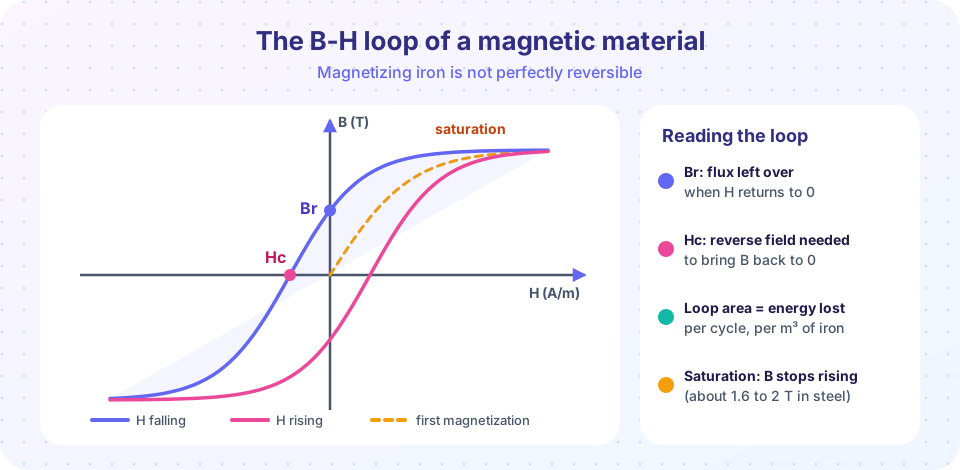
Saturation: the level of B above which adding more H gives hardly any more B.
Remanence (Br): the flux density left in the material when H returns to zero.
Coercivity (Hc): the reverse field needed to bring B back to zero.
Hysteresis loss: energy converted to heat as the material's magnetic domains flip back and forth.
Eddy currents: circulating currents induced in the iron by the changing flux.
The B-H relationship
In vacuum B = μ0 H, a straight line. In a ferromagnetic material, B = μ0 (H + M) where M is the magnetization of the material. Inside iron are tiny regions called domains, each magnetized in its own direction. A growing external field makes the favorable domains expand and finally rotates the remaining ones into line with the field. When all domains point the same way, M cannot increase any more: the material is saturated, and B continues to grow only at the slow air-like rate μ0 H.
So the curve has three regions: a gentle start, a steep middle where μr is large (many thousands for good steel), and a knee around 1.5 to 1.8 T for silicon steel, after which it flattens. Machines are usually designed to run close to the knee: high enough to use the iron well, low enough to avoid heavy saturation.
Soft and hard materials
- Soft magnetic materials (silicon steel, nickel-iron alloys, soft ferrites) have a narrow loop: small
Hc, little loss. They are used for transformers and machine cores. - Hard magnetic materials (ferrite magnets, alnico, neodymium-iron-boron, samarium-cobalt) have a fat loop: large
Hcand largeBr. They keep their magnetization and serve as permanent magnets in motors and generators.
The hysteresis loop
When H is cycled up and down, B does not retrace its path; the falling branch lies above the rising one. At H = 0 the material still has the flux Br. To bring B to zero you must apply a reverse field -Hc.
The area enclosed by the loop has the dimensions of energy per unit volume:
(A/m) × (T) = (A/m)(Wb/m²) = J/m³
Each cycle dissipates W_h joules per cubic meter. At frequency f and core volume V:
P_h = W_h × f × V
Worked example. A loop area of 400 J/m³, a core volume of 0.002 m³ and f = 50 Hz give P_h = 400 × 50 × 0.002 = 40 W.
An empirical rule (the Steinmetz equation) captures the dependence on peak flux density:
P_h = k_h × f × B_max^n (n is about 1.6 to 2 for common steels)
Eddy currents
Faraday's law applies to the iron itself: the alternating flux induces circulating voltages in the core, and since iron conducts, currents flow in closed loops perpendicular to the flux. These eddy currents dissipate I²R heat. For a sheet of thickness t the loss per volume follows:
P_e = k_e × f² × B_max² × t²
The loss grows with the square of frequency, flux density and thickness. Two measures cut it:
- Lamination. Build the core from thin sheets (typically 0.2 to 0.5 mm) insulated from each other by a coating. Halving the thickness cuts the eddy loss to a quarter.
- Silicon steel. Adding about 3 % silicon raises the resistivity of the iron, which lowers the eddy currents (and also lowers hysteresis loss).
For high frequencies (switched-mode power supplies, radio) even thin laminations are not enough, so soft ferrites (ceramics that are insulators) or powdered-iron cores take over.
Total core loss
P_core = P_h + P_e
Manufacturers publish the specific core loss of electrical steel as watts per kilogram at a given flux density and frequency (for example, at 1.5 T and 50 Hz). Typical values run from about 1 W/kg for grain-oriented steel up to several W/kg for non-oriented grades used in rotating machines. Always check the datasheet for your grade.
Worked example: scaling a core loss
A transformer core loses 12 W at 50 Hz and B_max = 1.2 T: 8 W hysteresis and 4 W eddy. Keep B_max fixed and raise the frequency to 60 Hz:
- Hysteresis scales with
f:8 × 60/50 = 9.6 W. - Eddy scales with
f²:4 × (1.2)² = 5.76 W. - Total:
15.36 W, up from 12 W.
Now return to 50 Hz and use laminations half as thick: the eddy loss drops to 4 / 4 = 1 W and the total to 9 W.
Why frequency and flux are linked
Chapter 3 will show that at a fixed supply voltage the peak flux is inversely proportional to frequency (V ≈ 4.44 f N Φmax). A transformer designed for 60 Hz and connected to the same voltage at 50 Hz therefore sees a flux 20 % higher. Its iron moves toward saturation, the magnetizing current soars, and it may overheat, which is why such transformers carry a frequency rating.
Common misconceptions
"Hysteresis loss comes from friction in the wires." It happens inside the iron; it is the energy needed to reverse the domain walls, and it exists with no current in any wire except the exciting one.
"Laminations stop the flux." They are insulated along the sheets, and flux runs in the plane of the sheets. They block the eddy current paths that would go across the stack.
"A wide loop is always bad." For a transformer core yes. For a permanent magnet a wide loop (large Hc) is exactly what you want.
Try it
Press Run (or Ctrl + Enter) to see the result here.
Program input · what you'd type while the program runs
Type the answers before you press Run, one per line. Each time the program reads a line (with input()), it gets the next line from this box.
Press Run (or Ctrl + Enter) to see the result here.
Program input · what you'd type while the program runs
Type the answers before you press Run, one per line. Each time the program reads a line (with input()), it gets the next line from this box.
Check your understanding
Quick check · 5 questions
of 5 answered You scored / 5 · perfect!
-
1. What does the area inside a B-H loop represent?
∮ H dB has units of J/m³; this is the hysteresis energy dissipated each cycle. -
2. Which material would you choose for a permanent magnet?
A permanent magnet must resist demagnetization, which needs a wide loop (large Hc). -
3. By what factor does eddy loss change if lamination thickness is halved (same f and B)?
P_e is proportional to t², so half the thickness gives one quarter of the loss. -
4. A core has 10 W hysteresis and 5 W eddy loss at 50 Hz. Same B at 100 Hz: what is the total core loss?
Hysteresis doubles to 20 W, and eddy loss grows by 2² = 4 times to 20 W, so the total is 40 W. -
5. Why is a transformer designed for 60 Hz at risk on a 50 Hz supply of the same voltage?
Φmax ∝ V/f, so lowering f by one sixth raises flux by 20 % and the magnetizing current rises sharply.
Summary
Bsaturates at about 1.6 to 2 T in common steels; permeability is not constant.- The hysteresis loop has remanence
Brand coercivityHc; its area is the energy lost per cycle per m³. - Eddy loss scales as
f² B² t²; laminations and silicon steel reduce it. - Core loss
P_core = P_h + P_egrows with frequency and flux, and flux depends on voltage and frequency.
Track your progress
Create a free account to tick off lessons and pick up where you left off on any device.
of Electrical Machines lessons completed