


















Lesson 33 of 45 · Special Motors and Drives
Stepper, brushless DC and servo motors
Learn how stepper motors move in fixed angles, how brushless DC motors commutate electronically, and how servo systems use feedback, with step-angle and torque-speed calculations.
Some jobs ask a motor to do more than spin. A 3D printer must put its nozzle at an exact point, a drone must change speed in milliseconds, and a robot joint must follow a path while resisting disturbances. The motors that do this share a trait: electronics decide when each winding carries current.
This lesson covers three families. Stepper motors turn a fixed angle for every pulse. Brushless DC (BLDC) motors replace the brushes with electronic switches. Servo systems wrap a motor in a feedback loop so that it tracks a command.
What you will learn
- How to calculate step angle, speed and resolution of a stepper motor, and what microstepping does.
- How a brushless DC motor is commutated and how
Kt,Keand resistance set its torque-speed line. - What a servo loop is and why feedback matters.
- How to choose between the three families.
Key terms
Step angle: the rotation for one pulse, 360° / steps per revolution.
Holding torque: the torque a stepper can resist at standstill with the windings energized.
Commutation: switching the current from one winding to the next at the right rotor angle.
Back-EMF E = Ke ω: the voltage the spinning magnets induce in the stator windings.
Encoder: a sensor that reports shaft angle as digital pulses.
Stepper motors
A stepper has a toothed rotor (permanent-magnet or hybrid) and stator windings, usually two phases. Energizing the phases in sequence pulls the rotor from one stable position to the next. In a common hybrid stepper the rotor has 50 teeth and each full step moves a quarter of a tooth pitch, so one revolution takes 200 steps: a step angle of 360° / 200 = 1.8°.
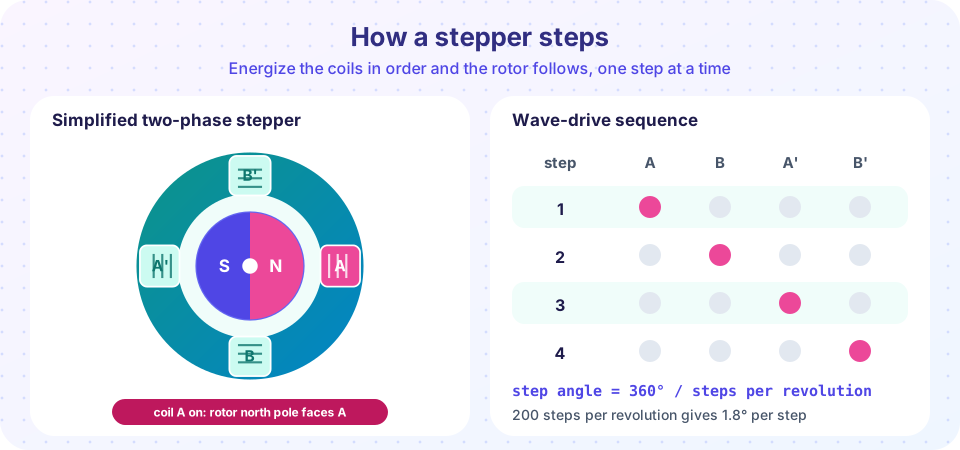
The drive can sequence the coils in different ways:
| Mode | What happens | Steps per revolution (200-step motor) |
|---|---|---|
| Wave drive | One phase at a time | 200 |
| Full step | Two phases at a time, more torque | 200 |
| Half step | Alternate one phase and two phases | 400 |
| Microstepping | Phase currents follow sine and cosine values | 1600 or more |
Microstepping makes motion smoother and quieter and lowers resonance, but the torque available to move to each intermediate position is smaller than at a full step, so the true accuracy is lower than the number of microsteps suggests.
Speed is a counting problem: rev/s = pulses per second / steps per revolution. At 2000 pulses per second in full-step mode, a 200-step motor makes 10 rev/s, which is 600 rpm. The winding inductance limits how fast the current can build, so torque falls as the pulse rate rises. A stepper normally runs open loop without sensors, which is cheap, but it can lose steps if overloaded or if it passes through a resonance. It holds position with full current even at rest, which wastes power and makes heat.
Brushless DC motors
A BLDC motor reverses the construction of a brushed DC motor: the magnets are on the rotor and the windings are on the stator, so no brushes are needed. A controller with six power switches (a three-phase bridge) energizes two of the three phases at a time, in a six-step pattern, using Hall sensors or the back-EMF to find the rotor position. Each phase pair conducts for 120 electrical degrees. The torque ripple is small and the efficiency is high, often 85 to 90 % or more.
In the DC-equivalent model, which is accurate enough for design, the motor obeys
V  = I R + Ke ω         voltage balance
T  = Kt I               torque
and in SI units Kt (N·m per A) equals Ke (V·s per rad). The no-load speed is ω0 = V / Ke and the stall torque is Tstall = Kt V / R. The torque-speed relation is a straight line between those two points. The mechanical output power peaks at half the stall torque and half the no-load speed, at P = ω0 · Tstall / 4.
Take Kt = Ke = 0.05, R = 0.5 Ω, V = 24 V. Then ω0 = 480 rad/s (about 4580 rpm) and Tstall = 2.4 N·m. At a 0.5 N·m load the current is 0.5 / 0.05 = 10 A and the speed is (24 − 10 × 0.5) / 0.05 = 380 rad/s (3630 rpm), giving 190 W at the shaft for 240 W electrical input.
PMSM (permanent-magnet synchronous motors) are close relatives with a sinusoidal back-EMF and are driven with sinusoidal currents (see the lesson on vector control).
Servo systems
A servo is a system, not a motor type. A controller compares a commanded position or speed with a measured one and corrects the difference. The usual structure is nested: a fast current loop (torque), a velocity loop around it, and a position loop on the outside. An encoder (incremental or absolute) or a resolver gives the feedback. The motor itself is normally a PMSM/BLDC or a brushed DC motor. Feedback gives what a stepper cannot: it knows when it is off target and fights disturbances, so it can run at high speed with full torque and low heating at rest. It costs more and needs tuning.
Common misconceptions
"A stepper motor always knows its position." Only if no steps were lost. Without feedback, an overload silently shifts the zero.
"Brushless means no commutation." The commutation moves from the brushes to the electronics.
"More microsteps means more accuracy." It means smoother motion; accuracy is limited by the motor and load.
Try it
The first demo steps a motor by hand. Pick a mode and press a button; the readout shows the angle and the step count after each action.
The second program is the DC-equivalent model of a BLDC motor. It prints the key numbers and draws the torque-speed line with the power curve.
Press Run (or Ctrl + Enter) to see the result here.
Program input · what you'd type while the program runs
Type the answers before you press Run, one per line. Each time the program reads a line (with input()), it gets the next line from this box.
Check your understanding
Quick check · 5 questions
of 5 answered You scored / 5 · perfect!
-
1. A stepper motor has 200 steps per revolution. What is its step angle in full-step mode?
360° / 200 = 1.8°. -
2. The same stepper in half-step mode is driven at 1600 pulses per second. What is its speed?
Half step gives 400 steps per revolution: 1600 / 400 = 4 rev/s = 240 rpm. -
3. What replaces the brushes and commutator in a brushless DC motor?
A three-phase bridge energizes the windings in sequence, using Hall sensors or back-EMF to find the rotor angle. -
4. A BLDC motor has Ke = 0.05 V·s/rad and runs from 24 V with negligible resistance. Its no-load speed is about
ω0 = V / Ke = 24 / 0.05 = 480 rad/s (about 4580 rpm). -
5. What does a servo system have that an open-loop stepper does not?
Feedback lets a servo correct errors and resist disturbances, where an open-loop stepper cannot know if it lost a step.
Summary
- Step angle is
360° / steps per revolution; speed ispulse rate / steps per revolution. - Microstepping smooths motion but does not give proportional accuracy.
- A BLDC motor is commutated electronically; in the DC model
V = I R + Ke ω,T = Kt I, andKt = Kein SI. - A servo is a motor plus feedback loops; it costs more than a stepper but tracks and holds under load.
Track your progress
Create a free account to tick off lessons and pick up where you left off on any device.
of Electrical Machines lessons completed