


















Lesson 1 of 45 · Getting Started
Course Map: Electrical Machines
See how the Electrical Machines course fits together: transformers, DC machines, induction and synchronous motors, drives, testing and projects, with a study plan.
Almost everything that moves in a modern city is pushed by an electrical machine. Trains, lifts, pumps, fans, washing machines, hard-disk spindles, wind turbines and the giant generators in power stations are all machines that trade electrical energy for mechanical energy, or the other way round. Transformers are close cousins: they have nothing that moves, but they use the same physics to carry power from one voltage level to another.
This course explains how those machines work, how to model them with simple equivalent circuits, and how to predict their speed, torque, losses and efficiency with real numbers. You will not need to memorize dozens of unrelated formulas. A small set of ideas (magnetic fields, Faraday's law, the force on a current-carrying conductor, and power balance) keeps coming back in new costumes.
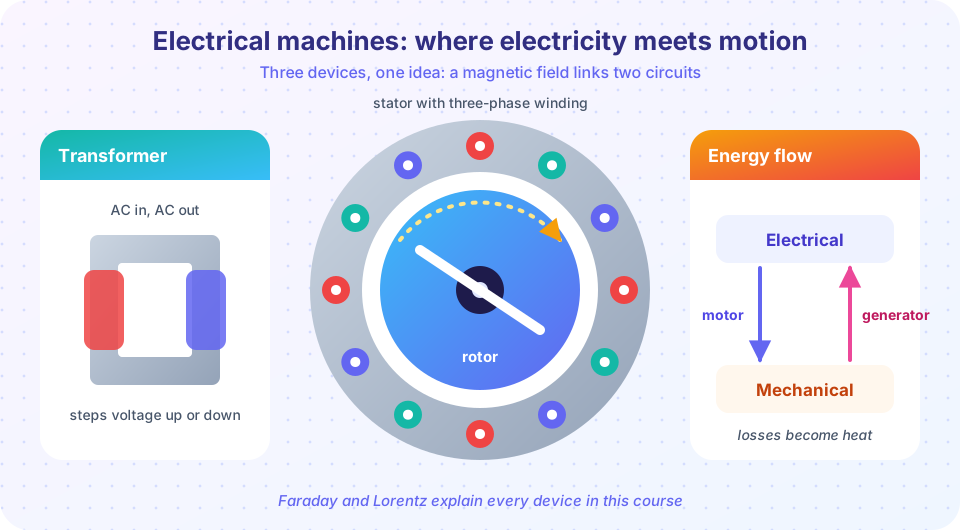
What you will learn
- What the course covers and the order in which the ideas build on each other.
- What you should already know, and where to refresh it on this site.
- How to study a machine: model it, put numbers in, check the energy balance.
- How the nine chapters connect to real applications.
Key terms
Electrical machine: a device that converts energy between electrical and mechanical form (motor or generator), or transfers electrical energy between circuits (transformer).
Stator: the stationary part of a rotating machine.
Rotor: the rotating part, mounted on the shaft.
Torque: the twisting effect that a motor produces on its shaft, measured in newton-meters (N·m).
Efficiency: output power divided by input power.
Who this course is for
The course suits students of electrical, mechanical and mechatronics engineering, technicians who work with motors and drives, and curious learners who want to know what is inside the machines around them. We follow an international approach: SI units throughout, and both 50 Hz and 60 Hz systems are used in examples.
You need three things before you start:
- Basic circuit analysis: Ohm's law, series and parallel circuits, power
P = V × I. If this is shaky, work through Circuit Analysis first. - Basic magnetism: magnetic field, flux, the idea of a coil. A short refresher is in lesson 2 of this chapter, and a fuller treatment is in Electricity and Magnetism.
- Sinusoids and phasors: an AC voltage
v = Vm sin(ωt), RMS values, and the idea that a phasor is a rotating arrow. You only need a working feel for them.
The nine chapters
Foundations first
- Getting Started
- Magnetic Circuits
Machines without motion
- Transformers
- DC Machines
The AC workhorses
- Induction Motors
- Synchronous Machines
Applications
- Special Motors and Drives
- Efficiency and Testing
- Projects and Practice
This lesson belongs to the first half of the course (chapters 1 to 4), which builds the base: the energy and force laws, magnetic circuits, transformers and DC machines. The second half moves to three-phase AC machines and the electronics that control them.
How the pieces connect
Magnetic circuits (chapter 2) are the language of every machine: a transformer is two coils on one magnetic circuit, and a DC machine is a magnetic circuit with a gap that rotates. Transformers (chapter 3) are the simplest case of an equivalent circuit, the modeling trick that you will reuse for the induction motor and the synchronous generator. DC machines (chapter 4) teach the cleanest relationship between voltage, speed and torque, which you will need again when you meet drives.
How to study a machine
For each machine you will repeat the same five steps. After two or three machines they become automatic.
- Picture it. Where is the magnetic field, which winding carries current, what moves?
- Write the two laws. Voltage from Faraday's law, force or torque from the Lorentz force.
- Build the equivalent circuit. Resistors and inductors that stand for copper loss, leakage flux and the magnetizing current.
- Balance the power. Input power minus every loss equals output power.
- Check units and sanity. Does the answer have the right unit, and is the efficiency below 100%?
A first look at power balance
Every machine obeys one bookkeeping rule: energy is conserved, so power in equals power out plus losses. The first example in the Try it section plots an illustrative 7.5 kW motor. The numbers are made up to show the idea, they are not measurements of a specific motor.
Common misconceptions
"A motor makes energy." It does not. A motor with an output of 7.5 kW needs more than 7.5 kW of electrical input; the difference leaves as heat.
"Generators and motors are different machines." Most machines can work either way. A DC machine pushed by an engine acts as a generator, and the same machine fed from a battery acts as a motor.
"Transformers belong to another subject." They are electrical machines in the broad sense, and the same flux and equivalent-circuit ideas explain them.
Try it
Press Run (or Ctrl + Enter) to see the result here.
Program input · what you'd type while the program runs
Type the answers before you press Run, one per line. Each time the program reads a line (with input()), it gets the next line from this box.
Check your understanding
Quick check · 4 questions
of 4 answered You scored / 4 · perfect!
-
1. A motor takes 10 kW from the supply and delivers 8.5 kW to the shaft. Where does the other 1.5 kW go?
Energy is conserved, so the difference is losses: resistive heating, core losses and friction. -
2. Which part of a rotating machine is stationary?
Stator means stationary. The rotor rotates with the shaft. -
3. Which pair of laws explains how almost every machine in this course works?
Faraday's law gives the induced voltage and the Lorentz force gives the force on a current in a field. -
4. Why does the course teach transformers before rotating machines?
A transformer has no motion, so the same flux and equivalent-circuit ideas can be learned without extra complication.
Summary
- Electrical machines convert energy between electrical and mechanical form, or move electrical energy between circuits.
- A few ideas (magnetic fields, Faraday's law, the Lorentz force and power balance) recur in every chapter.
- Study each machine with the same five steps: picture, laws, equivalent circuit, power balance, sanity check.
- Efficiency is always below 100%; the missing power is losses that become heat.
Track your progress
Create a free account to tick off lessons and pick up where you left off on any device.
of Electrical Machines lessons completed