


















Lesson 3 of 45 · Getting Started
The Two Laws: Faraday and Lorentz
Learn the two laws behind every electrical machine: Faraday's law for induced voltage, the Lorentz force on a current, Lenz's law and why e times I equals F times v.
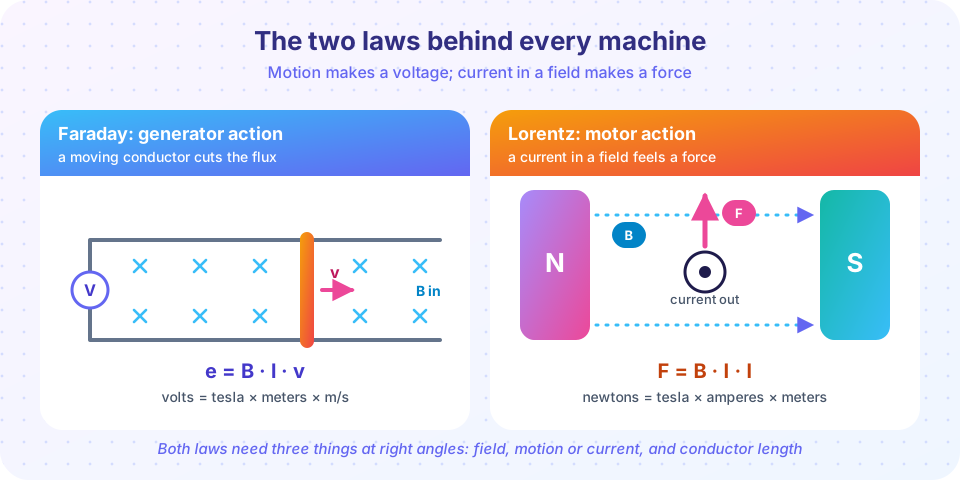
Two short equations explain nearly every machine in this course. One says that a conductor moving through a magnetic field has a voltage induced in it. The other says that a conductor carrying current in a magnetic field feels a force. The first is generator action, the second is motor action, and a real machine does both at once.
If you remember only one lesson from this chapter, make it this one. The later chapters on transformers, DC motors, induction motors and synchronous machines keep returning to e = B l v and F = B I l.
What you will learn
- Faraday's law in its flux-linkage form and its moving-conductor form.
- The Lorentz force on a conductor and how its direction is found.
- How Lenz's law makes the energy balance work.
- Why a spinning coil produces an alternating voltage.
Key terms
Magnetic flux density (B): the strength of the field, in tesla (T). One tesla is one weber per square meter.
Flux (Φ): the amount of field passing through an area, in webers (Wb): Φ = B × A when the field is perpendicular to the area.
Flux linkage (λ): the flux multiplied by the number of turns, λ = N Φ.
Electromotive force (emf, e): the voltage induced by a changing flux linkage.
Lenz's law: the induced effect opposes the change that causes it.
Faraday's law: change of flux makes a voltage
When the flux linked by a coil changes, a voltage appears across the coil:
e = - dλ/dt = - N dΦ/dt
The minus sign is Lenz's law: if you let the induced voltage drive a current, that current creates a field that opposes the change in flux. Remove the sign and you would get a perpetual motion machine, since every small change in flux would reinforce itself.
There are two ways to change the flux linkage: change the field itself (as in a transformer, where the field is alternating), or move the conductor relative to the field (as in most rotating machines).
The moving-conductor form
For a straight conductor of length l moving with speed v across a uniform field B, all three at right angles:
e = B × l × v (V = T × m × m/s)
Worked example. A bar 0.5 m long moves at 10 m/s through a field of 0.8 T. The induced emf is 0.8 × 0.5 × 10 = 4.0 V. If the motion makes an angle with the field, only the perpendicular components count, and the general form is e = l · (v × B).
The Lorentz force: current in a field feels a force
A conductor of length l carrying current I in a field B experiences a force:
F = B × I × l × sin θ
where θ is the angle between the field and the conductor. In machines the conductor is almost always perpendicular to the field, so sin θ = 1. The direction is perpendicular to both the current and the field. A handy memory aid is Fleming's left-hand rule: first finger for field, second finger for current, thumb gives the force. (The right-hand version with the same fingers gives the induced voltage in generator action.)
Worked example. The same 0.5 m conductor carries 20 A in a 0.8 T field. The force is 0.8 × 20 × 0.5 = 8 N.
From force to torque
In a rotating machine many conductors sit at a radius r from the axis. Each pushes the rotor with a tangential force; the torque is force times radius.
Worked example. A rotor of radius 0.10 m has 40 active conductors, each 0.30 m long, under a field of 0.8 T and carrying 10 A. One conductor: F = 0.8 × 10 × 0.30 = 2.4 N. All forty: 96 N. Torque: T = 96 × 0.10 = 9.6 N·m.
Both laws at once
A conductor that carries current while it moves in a field has both effects. Take a generator: the sliding bar of the figure moves right at speed v against a load resistance R.
- The motion induces
e = B l v. - The emf drives a current
I = e / Rthrough the bar. - That current in a field feels a force
F = B I l, and by Lenz's law it points against the motion.
The mechanical power you must supply to keep the bar moving is F × v. The electrical power the bar delivers is e × I. Substitute:
F × v = (B I l) × v = I × (B l v) = I × e
They are identical. This is the energy conversion of the previous lesson, derived from two simple laws: the force on the conductor and the voltage in the conductor are two views of the same coupling.
Numbers. With B = 0.8 T, l = 0.5 m, v = 10 m/s and a total circuit resistance of 2 Ω: e = 4 V, I = 2 A, F = 0.8 N, F v = 8 W and e I = 8 W.
A coil spinning in a field
Now rotate a coil of N turns and area A at angular speed ω in a uniform field. The flux linkage is λ = N B A cos(ωt), so:
e = - dλ/dt = N B A ω sin(ωt)
The voltage is a sinusoid with peak Em = N B A ω. This is how an alternator makes AC, and it is the reason mains electricity is sinusoidal.
Worked example. N = 100, B = 0.5 T, A = 0.02 m², f = 50 Hz (ω = 314.16 rad/s): Em = 100 × 0.5 × 0.02 × 314.16 = 314.2 V, and the RMS value is Em / √2 = 222.1 V.
Common misconceptions
"A conductor sitting still in a steady field has a voltage." Faraday's law needs a change of flux linkage. No motion and no change means no emf.
"The induced current helps the motion." It always opposes it (Lenz). That is why generators become harder to turn as you draw more current.
"F = B I l holds at any angle." Only the component of the field perpendicular to the conductor counts: use B I l sin θ.
Try it
Press Run (or Ctrl + Enter) to see the result here.
Program input · what you'd type while the program runs
Type the answers before you press Run, one per line. Each time the program reads a line (with input()), it gets the next line from this box.
Press Run (or Ctrl + Enter) to see the result here.
Program input · what you'd type while the program runs
Type the answers before you press Run, one per line. Each time the program reads a line (with input()), it gets the next line from this box.
Check your understanding
Quick check · 5 questions
of 5 answered You scored / 5 · perfect!
-
1. A conductor 0.4 m long moves at 5 m/s perpendicular to a 1.2 T field. What emf is induced?
e = B l v = 1.2 × 0.4 × 5 = 2.4 V. -
2. Why does a generator become harder to turn when the load current increases?
More current means a larger opposing force, so more mechanical power is needed: F v = e I. -
3. A conductor carries 15 A at an angle of 30° to a 0.6 T field. The conductor length in the field is 0.2 m. What is the force?
F = B I l sin θ = 0.6 × 15 × 0.2 × 0.5 = 0.9 N. -
4. What is the peak emf of a coil with N = 200, B = 0.4 T, A = 0.01 m² turning at ω = 100 rad/s?
Em = N B A ω = 200 × 0.4 × 0.01 × 100 = 80 V. -
5. In the sliding-bar generator, which two quantities are always equal?
F v = (B I l) v = I (B l v) = I e, which is energy conservation in the bar.
Summary
- Faraday:
e = -dλ/dt; for a moving conductore = B l v. - Lorentz:
F = B I l sin θ; torque is force times radius. - Lenz's law makes the induced current oppose the motion, which guarantees
F v = e I. - A coil rotating at
ωin a uniform field producese = N B A ω sin ωt.
Track your progress
Create a free account to tick off lessons and pick up where you left off on any device.
of Electrical Machines lessons completed