


















Lesson 39 of 45 · Efficiency, Testing and Applications
Motor selection and duty
Choose a motor by load torque type, duty (S1, S2, S3), insulation class and temperature rise, enclosure and starting needs, with an rms-power duty-cycle calculation.
A motor is never selected by power alone. A 15 kW motor that works for years on a steady pump may burn out in weeks on a crusher that starts under load twenty times an hour, and a 15 kW motor sized for a day-long conveyor may be wasteful for a hoist that runs ten seconds in a minute. The load, the duty cycle, the environment and the supply all matter.
This lesson gives you a checklist for choosing a motor and the one formula you need for varying loads.
What you will learn
- The common load torque types and how they shape the choice.
- What the duty types S1, S2 and S3 mean and how insulation class and temperature rise relate to life.
- How to find an equivalent continuous power for a cyclic load.
- What else to check: starting, enclosure, altitude and ambient temperature, supply and drive.
Key terms
Duty type: the standard description of the load pattern over time (continuous, short-time, intermittent).
Insulation class: the maximum winding temperature the insulation system is rated for (A 105 °C, B 130 °C, F 155 °C, H 180 °C).
Temperature rise: the winding temperature above the ambient; the rated rise is measured at full load.
Service factor: a multiplier allowing continuous overload within the thermal limit (for example 1.15).
IP code: ingress protection rating of the enclosure; IP55 is dust-protected and withstands water jets.
Start with the load
Find out how the load torque changes with speed, because the motor must provide at least that torque at every speed.
| Load type | Torque against speed | Examples |
|---|---|---|
| Constant torque | T fixed, P ∝ n |
Conveyors, hoists, positive-displacement pumps, compressors |
| Variable (square-law) torque | T ∝ n², P ∝ n³ |
Centrifugal fans and pumps |
| Constant power | T ∝ 1/n |
Winders, machine-tool spindles at high speed |
| High inertia | Long acceleration time | Large fans, centrifuges, flywheels |
The required shaft power is P = T ω. For a lift, P = m g v / η (mass, gravity, speed and the efficiency of the mechanism). Always include the efficiency of belts, gears and the driven machine. Then pick the nearest standard rating at or above the result, such as 7.5, 11, 15, 18.5, 22 or 30 kW, with 10 to 15 % margin for uncertainty.
Duty types
The IEC standard names the pattern of load and rest. The three you meet first:
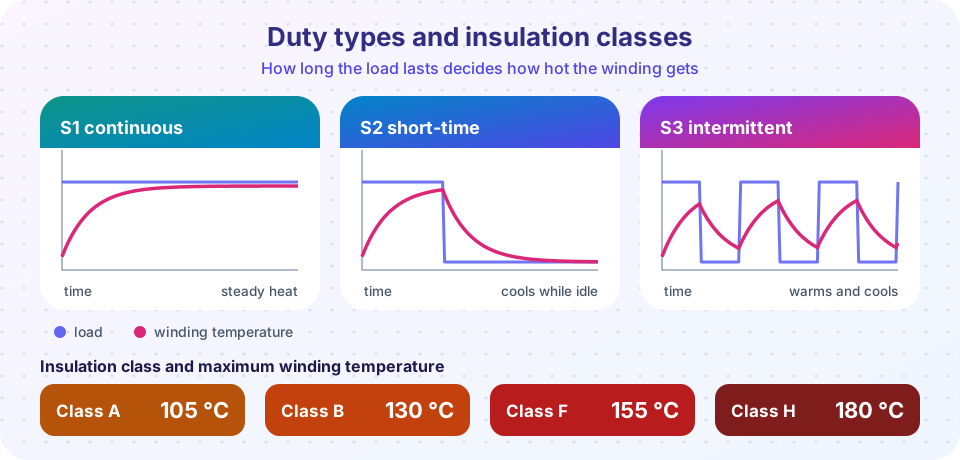
- S1, continuous. The load lasts long enough for the temperature to reach a steady value. This is the default rating on a nameplate.
- S2, short-time. The load runs for a stated time (10, 30, 60 or 90 minutes) and the machine then rests until it has cooled to ambient. A short-time rating can be higher than the S1 rating.
- S3, intermittent periodic. Repeated cycles of load and rest, quoted with a cyclic duration factor such as 40 %. The starting current has no important effect on the temperature. S4 to S9 add starting, braking and variable load.
Thermal limits
The motor's power is limited by temperature, not by torque. Heat comes from the losses; cooling carries it away; the steady winding temperature is the ambient plus the temperature rise. The insulation classes allow these maximum winding temperatures: A 105 °C, B 130 °C, F 155 °C, H 180 °C. At a 40 °C ambient the usual rated temperature rises (by the resistance method) are about 60 K for A, 80 K for B, 105 K for F and 125 K for H. Many motors are built with class F insulation but rated for class B rise, which leaves a thermal reserve and a longer life. A rule of thumb says that each 10 °C of extra continuous temperature roughly halves the life of the insulation.
Operating conditions change the limit. The standard assumes an ambient of at most 40 °C and an altitude of at most 1000 m. Above that the thinner air cools less, so the output must be derated; follow the manufacturer's curve (a common rule is about 1 % per 100 m above 1000 m).
An equivalent power for cyclic loads
For a varying load, the heating follows the squared load, so the rms power over a cycle is a good first estimate of the continuous rating needed:
P_rms = √( Σ Pi² ti / Σ ti )
A self-ventilated motor cools worse at standstill (its fan stops), so during rest the time is counted as a fraction of its true value (often one third to one quarter). Check separately that the peak torque stays below about 70 to 80 % of the pull-out torque to leave a margin for voltage dips.
The rest of the checklist
- Starting: is the starting torque higher than the load torque all the way up? The acceleration time is roughly
t = J ωs / (Tmotor − Tload)using average values; a long time overheats the rotor. - Supply: voltage, frequency, three- or single-phase, and whether a drive will control it (inverter-duty motors have reinforced insulation).
- Speed: the number of poles sets the synchronous speed; most motors are 4-pole.
- Enclosure and cooling: TEFC (totally enclosed fan cooled) with IP55 suits dusty or wet locations; open drip-proof (IP23) suits clean rooms.
- Mounting and frame: the IEC frame size fixes the shaft height and dimensions; foot or flange mounting must match the machine.
- Efficiency class: IE3 or better for continuous duty, because energy dominates the cost.
Common misconceptions
"A bigger motor is always safer." An oversized motor runs at low load with poor efficiency and power factor and costs more to start.
"The nameplate power is the shaft power at any duty." It applies for the stated duty type, usually S1.
"Overload is fine if the torque is available." Temperature, not torque, usually decides how long an overload can last.
Try it
Compute the equivalent rms power for a cycle and compare it with the peak. The cycle is 15 kW for 40 s, 5 kW for 30 s and rest for 30 s.
Press Run (or Ctrl + Enter) to see the result here.
Program input · what you'd type while the program runs
Type the answers before you press Run, one per line. Each time the program reads a line (with input()), it gets the next line from this box.
Next, the acceleration time of a high-inertia load. The motor torque and load torque are averages over the speed range.
Press Run (or Ctrl + Enter) to see the console output here.
No output.
Check your understanding
Quick check · 5 questions
of 5 answered You scored / 5 · perfect!
-
1. Which load type has power proportional to the cube of speed?
For centrifugal fans and pumps T ∝ n² and P ∝ n³. -
2. Which duty type describes load for a stated time followed by a rest long enough to cool to ambient?
S2 is short-time duty. S1 is continuous and S3 is intermittent periodic duty. -
3. A winding has class F insulation. What maximum winding temperature does the class allow?
Class A 105 °C, B 130 °C, F 155 °C, H 180 °C. -
4. A cyclic load has P² t sums of 9750 kW²·s over an effective time of 100 s. The rms power is about
P_rms = √(9750 / 100) = √97.5 ≈ 9.9 kW. -
5. A motor is used at 2500 m altitude and 40 °C ambient. What should you do?
Thinner air cools less, so the allowed output is reduced above 1000 m.
Summary
- Choose a motor from the load (torque against speed), the duty (S1, S2, S3), the environment and the supply.
- Temperature sets the limit: insulation classes A 105, B 130, F 155, H 180 °C; about 10 °C extra halves the life.
- For cyclic loads use the rms power, with reduced cooling at rest for self-ventilated motors.
- Check starting torque and time, enclosure, altitude, efficiency class and whether a drive is used.
Next: Chapter review
Track your progress
Create a free account to tick off lessons and pick up where you left off on any device.
of Electrical Machines lessons completed