


















Lesson 7 of 45 · Magnetic Circuits
Reluctance and Magnetic Circuits
Solve magnetic circuits step by step: Ampere's law, MMF, reluctance, air gaps and fringing, with worked examples for linear and saturating iron cores.
Design questions about magnetic cores almost always take one of two forms. Given a coil and a core, how much flux results? Or, given the flux you want, how much current must the coil carry? Both are solved with the magnetic circuit method, and both give surprising answers the first time you see the effect of a small air gap.
This lesson builds the method from Ampère's law, then works two full examples: one with constant permeability, one with a realistic saturating curve.
What you will learn
- How
H,B,Φ, MMF and reluctance relate to each other. - How to find the current needed for a given flux, and the flux produced by a given current.
- Why the air gap dominates the ampere-turn budget and how fringing changes it.
- How to handle a saturating core with a B-H table.
Key terms
Magnetic field strength (H): the field produced by the current, in amperes per meter (A/m).
Flux density (B): the resulting field in the material, in tesla; B = μ H.
Ampère's circuital law: the line integral of H around a closed path equals the enclosed current: ∮ H·dl = N I.
Fringing: the outward bulging of flux at an air gap, which makes the effective gap area larger than the iron cross-section.
Magnetic circuit: a closed path of flux, treated as reluctances in series and parallel.
From Ampère's law to the reluctance equation
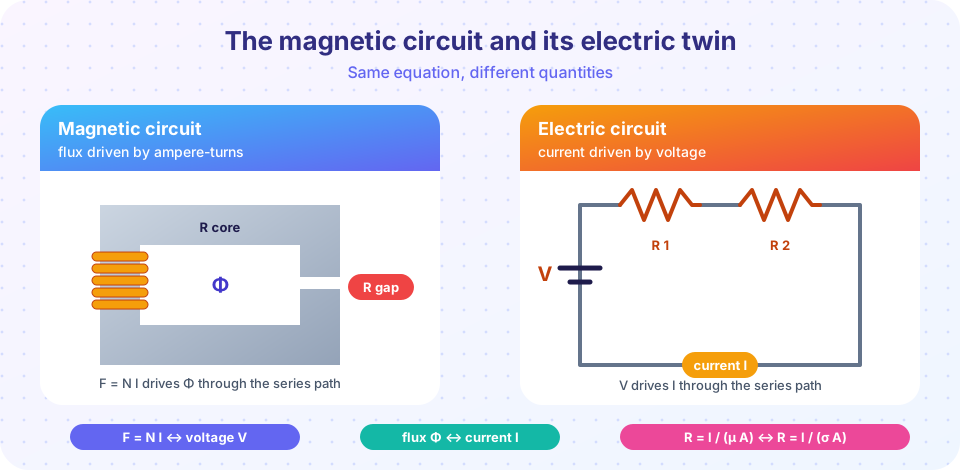
A coil with N turns carrying current I is the source. Choose a closed path along the center of the core. Ampère's law says the sum of H × length around that path equals the enclosed current N I. For a core with a section of iron and an air gap:
H_c × l_c + H_g × l_g = N I
where l_c is the mean iron path length and l_g the gap length. Replace H by B / μ, and B by Φ / A:
N I = Φ × ( l_c / (μ_c A_c) + l_g / (μ0 A_g) ) = Φ × (R_c + R_g)
This is the magnetic version of Ohm's law with two series resistors. A few remarks:
- Same flux everywhere in a series path (no leakage), but different
Bif the areas differ. - In air
μ = μ0 = 4π × 10⁻⁷ H/m. In ironμ = μ0 μr, withμrfrom a few hundred to many thousands. - Reluctances in series add. Parallel paths combine like parallel conductances.
Worked example 1: a core with constant permeability
A core has mean path length l_c = 0.40 m, uniform cross-section A = 4 cm² = 4×10⁻⁴ m², constant μr = 2000, and a gap l_g = 1 mm. The coil has N = 500 turns. How much current gives B = 1.0 T in the gap? Ignore fringing and leakage.
- Flux:
Φ = B A = 1.0 × 4×10⁻⁴ = 4×10⁻⁴ Wb. - Core reluctance:
R_c = 0.40 / (4π×10⁻⁷ × 2000 × 4×10⁻⁴) = 3.98×10⁵ A/Wb. - Gap reluctance:
R_g = 1×10⁻³ / (4π×10⁻⁷ × 4×10⁻⁴) = 1.99×10⁶ A/Wb. - Total:
R = 2.39×10⁶ A/Wb. - MMF:
F = Φ R = 4×10⁻⁴ × 2.39×10⁶ = 955 A. - Current:
I = F / N = 955 / 500 = 1.91 A.
Notice the shares: the gap needs R_g / R = 83 % of the ampere-turns, although it is only 1 mm out of 401 mm of the path. Air is that much "more resistive" than iron.
What this means for design. If you remove the gap, the same flux needs only about 160 ampere-turns, so transformer cores are built without gaps, while inductors that must carry large DC currents without saturating deliberately include a gap.
Fringing
At a gap the flux bulges outward. A common correction increases each gap dimension by the gap length: for a square core of side a the effective area is (a + g)². With a = 2 cm and g = 1 mm the area is 4.41 cm² instead of 4.00 cm², about 10 % more. The gap reluctance falls by roughly that percentage, so for the same flux the current is slightly lower. Fringing matters when the gap is not small compared to the core dimensions.
Worked example 2: a saturating core
Real iron is not linear. Replace the constant μr by a B-H table. The table below is illustrative, typical of non-oriented electrical steel, not a datasheet:
| B (T) | 0 | 0.45 | 0.90 | 1.25 | 1.50 | 1.70 | 1.85 | 1.98 |
|---|---|---|---|---|---|---|---|---|
| H (A/m) | 0 | 50 | 100 | 200 | 400 | 1000 | 3000 | 10000 |
Because the problem gives B, the procedure is direct (no iteration):
- Find
Hin the iron from the table for the givenB. - Core MMF:
H_c × l_c. - Gap MMF:
B l_g / μ0. - Add, then divide by
N.
For B = 1.5 T: H_c = 400 A/m, so core MMF = 400 × 0.40 = 160 A. Gap: 1.5 × 10⁻³ / (4π×10⁻⁷) = 1194 A. Total 1354 A, so I = 2.71 A.
For B = 1.0 T: interpolating gives H_c ≈ 129 A/m, core MMF 51 A, gap 796 A, total 847 A, so I = 1.69 A.
Going from 1.0 T to 1.5 T needs 60 % more current (2.71 against 1.69 A), not 50 %. At higher B the iron itself takes a growing share, and beyond about 1.8 T it takes most.
The reverse problem
If the current is given and you want the flux, H_c is unknown. You then solve the equation H_c l_c + B l_g/μ0 = N I together with the B-H curve: draw the straight line (the gap's "load line") and find where it crosses the curve, or iterate. The Python example below does this by bisection.
Parallel paths
A three-leg core (a centre leg carrying the coil, two outer legs) splits the flux: the centre flux Φ1 equals Φ2 + Φ3, and each outer leg sees the same MMF drop. This is the exact analog of a current divider. The same idea reappears in the shell-type transformer.
Common misconceptions
"The gap is tiny, so it can be ignored." Never ignore it: in example 1 it takes 83 % of the ampere-turns.
"μr of iron is a constant." It falls dramatically as the iron saturates. Constant μr is a good approximation only well below the knee of the curve.
"Flux density is the same in the gap and in the iron." It is, only if the areas are equal and there is no fringing or leakage.
Try it
Press Run (or Ctrl + Enter) to see the result here.
Program input · what you'd type while the program runs
Type the answers before you press Run, one per line. Each time the program reads a line (with input()), it gets the next line from this box.
Press Run (or Ctrl + Enter) to see the result here.
Program input · what you'd type while the program runs
Type the answers before you press Run, one per line. Each time the program reads a line (with input()), it gets the next line from this box.
Check your understanding
Quick check · 5 questions
of 5 answered You scored / 5 · perfect!
-
1. A coil has 200 turns and carries 3 A. What is the MMF?
F = N I = 200 × 3 = 600 ampere-turns. -
2. A core of length 0.5 m, area 5 cm² and μr = 1000 has what reluctance (approximately)?
R = l/(μ0 μr A) = 0.5 / (4π×10⁻⁷ × 1000 × 5×10⁻⁴) = 7.96×10⁵ A/Wb. -
3. Why does a 1 mm air gap in a 0.4 m iron core take most of the MMF?
μ of air is thousands of times smaller than that of the iron, so each millimeter of gap needs as many ampere-turns as meters of iron. -
4. In the saturating example, B = 1.5 T needs H = 400 A/m in a 0.40 m iron path. What is the MMF of the iron?
MMF = H × l = 400 × 0.40 = 160 A. -
5. What does fringing do to the effective gap area?
The flux bulges outward at the gap, so the effective area is larger than the core cross-section.
Summary
- Ampère's law gives
H_c l_c + H_g l_g = N I; withH = B/μit becomesN I = Φ (R_c + R_g). R = l / (μ A); series reluctances add, and the gap in air usually dominates.- For a given
B, readHfrom the B-H table; for a given current, iterate or use the load-line intersection. - Fringing makes the gap area, and therefore the gap permeance, larger than a naive calculation suggests.
Track your progress
Create a free account to tick off lessons and pick up where you left off on any device.
of Electrical Machines lessons completed