


















Lesson 26 of 45 · Induction Motors
Chapter review: induction motors
Review the induction motor chapter with a one-picture summary, a recap table of every key formula and a ten-question quiz that mixes all the lessons.
You have now followed an induction motor from the three-phase supply to the shaft: a rotating field, slip, an equivalent circuit, a torque curve and ways to start and steer the machine. This page collects the chapter on one picture and one table, then tests it.
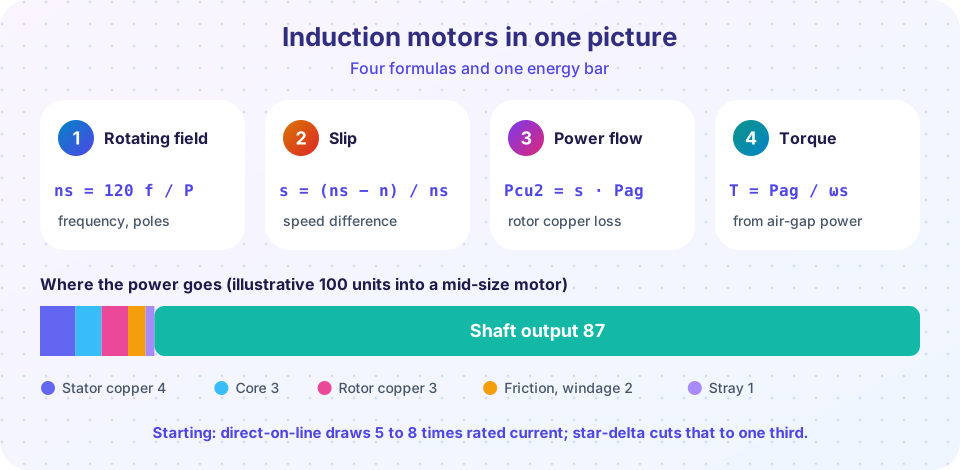
Recap table
| Idea | Formula or rule | Remember |
|---|---|---|
| Synchronous speed | ns = 120 f / P |
4 poles at 50 Hz: 1500 rpm |
| Slip | s = (ns − n) / ns |
2 to 6 % at full load |
| Rotor frequency | f2 = s f |
1 to 3 Hz at full load on 50 Hz |
| Air-gap power | Pag = 3 I2'² R2' / s |
what crosses the air gap |
| Rotor copper loss | Pcu2 = s · Pag |
grows with slip |
| Mechanical power | Pmech = (1 − s) · Pag |
before friction and windage |
| Torque | T = Pag / ωs |
no need for the rotor speed |
| Pull-out torque | Tmax ∝ V², independent of R2' |
2 to 3 times rated torque |
| Pull-out slip | sm ∝ R2' |
rotor resistance moves the peak |
| Star-delta start | current and torque both ÷ 3 | for light starts |
| Reversal | swap two supply leads | reverses phase sequence |
Try it
A nameplate reads 4 poles, 50 Hz, 1460 rpm and 7.5 kW. This small calculator checks the numbers you can derive from it. Change the values and compare.
Press Run (or Ctrl + Enter) to see the console output here.
No output.
Check your understanding
Quick check · 10 questions
of 10 answered You scored / 10 · perfect!
-
1. A 6-pole induction motor runs from a 50 Hz supply at 960 rpm. Its slip is
ns = 120 × 50 / 6 = 1000 rpm, so s = (1000 − 960) / 1000 = 0.04. -
2. What kind of field do balanced three-phase stator currents produce?
Three windings 120° apart with currents 120° apart produce a field of 1.5 Bm that rotates at synchronous speed. -
3. The air-gap power of a motor is 12 kW at 5 % slip. The mechanical power (before friction) is
Pmech = (1 − s) Pag = 0.95 × 12 kW = 11.4 kW; the other 0.6 kW is rotor copper loss. -
4. Which statement about pull-out torque is correct?
Tmax = 3 Vth² / (2 ωs [Rth + √(Rth² + (Xth + X2')²)]) contains no R2'. -
5. Which starting method reduces both current and torque to one third of the direct value?
In star the phase voltage is 1/√3 of the delta value, so current and torque both fall by a factor of three. -
6. In the equivalent circuit, what happens to R2'/s as the motor goes from standstill to no load?
At s = 1 the term equals R2'. As s approaches 0 it becomes very large, so the rotor current falls to a small value. -
7. What is the main drawback of controlling speed with extra rotor resistance?
The extra resistance dissipates a share of the air-gap power roughly equal to the slip. -
8. A motor has a full-load slip of 3 % on a 60 Hz supply. The rotor current frequency is
f2 = s f = 0.03 × 60 = 1.8 Hz. -
9. Why is the starting current so much larger than the rated current?
With s = 1 the rotor branch impedance is low, so the stator current is typically 5 to 8 times the rated value. -
10. A conveyor motor must be reversed. What is the simplest change in a three-phase supply?
Swapping two leads reverses the phase sequence and therefore the direction of the rotating field.
Summary
- The stator makes a rotating field; the rotor follows it at slip
s. - Power flow:
Pag → s · Pagas rotor copper loss and(1 − s) · Pagas mechanical power; torque isPag / ωs. - The torque curve has a stable region at low slip and a peak at
sm;Tmax ∝ V². - Starting and speed control are all about trading voltage, frequency and rotor resistance against torque and current.
Track your progress
Create a free account to tick off lessons and pick up where you left off on any device.
of Electrical Machines lessons completed