


















Lesson 35 of 45 · Special Motors and Drives
Chapter review: special motors and drives
Review single-phase, universal, stepper, brushless DC and servo motors and variable-frequency drives with a comparison table, a recap and a ten-question quiz.
This chapter left the world of the plain three-phase motor. You met machines that start from a single phase, machines that move by counting pulses, machines that replace brushes with electronics, and the drives that give AC motors an adjustable speed. The table below is your map.
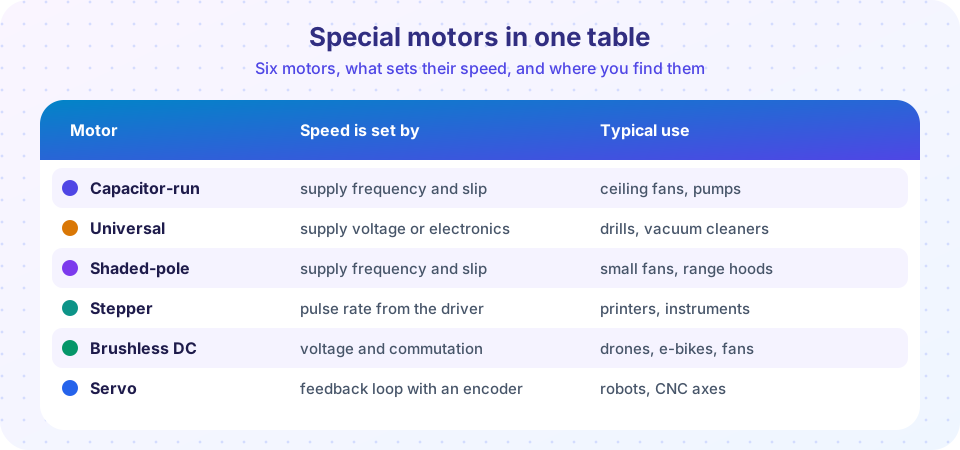
Recap table
| Idea | Rule | Remember |
|---|---|---|
| Single-phase field | Pulsating = two counter-rotating fields | zero torque at standstill |
| Capacitor-start | Capacitor in the auxiliary winding, switched out at about 75 % speed | strong start |
| Capacitor-run | Capacitor stays in | quiet, efficient, weaker start |
| Shaded-pole | Copper ring delays flux | tiny and cheap |
| Universal | Series commutator motor, T ∝ I² |
high speed, runs on AC and DC |
| Stepper | step angle = 360° / steps per rev |
open loop can lose steps |
| BLDC | V = I R + Ke ω, T = Kt I |
electronic commutation |
| Servo | Motor + feedback loops | tracks and holds under load |
| VFD | Rectifier, DC link, PWM inverter | V/f constant to base speed |
| Vector control | Clarke/Park, id = flux, iq = torque |
DC-like torque response |
Try it
Match each requirement to a motor. A short checklist function can print the recommendation and the reason. Change the inputs and see how the answer changes.
Press Run (or Ctrl + Enter) to see the console output here.
No output.
The second exercise is pure arithmetic: speeds and angles that appear again and again in exam questions.
Press Run (or Ctrl + Enter) to see the result here.
Program input · what you'd type while the program runs
Type the answers before you press Run, one per line. Each time the program reads a line (with input()), it gets the next line from this box.
Check your understanding
Quick check · 10 questions
of 10 answered You scored / 10 · perfect!
-
1. Why can a single-phase induction motor with only a main winding not start on its own?
The two counter-rotating fields give equal and opposite torques at standstill. -
2. Which motor has the highest starting torque among single-phase induction types?
A capacitor-start motor typically gives three to four times rated torque at start. -
3. A universal motor's speed when its load is removed completely
A series motor has no natural speed limit without load. -
4. A stepper motor has 400 steps per revolution (half-step mode). One pulse moves the shaft
360° / 400 = 0.9°. -
5. In the DC model of a BLDC motor, what is the stall torque?
At standstill there is no back-EMF, so I = V/R and T = Kt I = Kt V / R. -
6. What is the main advantage of a servo system over an open-loop stepper?
Feedback tells the controller the actual position or speed, so it can correct a lost step or a load disturbance. -
7. A 6-pole motor on a drive runs at 40 Hz. Its synchronous speed is
ns = 120 × 40 / 6 = 800 rpm. -
8. Why is constant V/f used below base speed?
Flux is proportional to V/f; holding it constant keeps torque capability constant and avoids saturation. -
9. Running a fan at 70 % of full speed needs about what fraction of full power?
Fan power goes with the cube of speed: 0.7³ ≈ 0.34. -
10. In field-oriented control, which current produces torque?
iq is the torque-producing component; id sets the flux.
Summary
- Single-phase motors need a second phase to start; capacitor-start gives the strongest start.
- Steppers count pulses, BLDC motors commutate electronically, servos add feedback.
- Drives set speed through frequency, keeping
V/fconstant to base speed, and vector control gives fast torque control. - Pumps and fans save energy with speed because power goes with the cube of speed.
Next: Chapter overview: efficiency, testing and applications
Track your progress
Create a free account to tick off lessons and pick up where you left off on any device.
of Electrical Machines lessons completed