


















Lesson 18 of 45 · DC Machines
EMF, Torque and Commutation
Derive the DC machine EMF and torque equations E = K Phi omega and T = K Phi Ia, compare lap and wave windings, and understand armature reaction, interpoles and commutation.
Two equations describe every DC machine. One gives the voltage induced in the armature, the other the torque produced by the armature current. Both have the same constant K and both are proportional to the main flux Φ. Once you can use them you can predict almost everything about generators and motors in the next two lessons.
This lesson derives them, works through a full numerical example, and then looks at the two practical effects that make a real DC machine harder than the ideal one: armature reaction and the commutation of coil current.
What you will learn
- The lap and wave armature windings and the number of parallel paths.
- The EMF equation
E = P Z Φ n / (60 A)and its formE = K Φ ω. - The torque equation
T = K Φ Iafrom the power balance. - What armature reaction does and how interpoles fix commutation.
Key terms
Poles (P): the number of main poles of the machine.
Conductors (Z): the total number of active conductors on the armature.
Parallel paths (A): the number of parallel paths between the brushes; lap winding has A = P, wave winding has A = 2.
Machine constant (K): K = P Z / (2π A) for flux in webers, speed in rad/s.
Armature reaction: the effect of the armature's own magnetic field on the main flux.
Armature windings
The armature conductors are connected to form coils, and the coils to the commutator segments. Two basic schemes exist:
- Lap winding: each coil is connected to adjacent commutator segments. The number of parallel paths equals the number of poles,
A = P. Suited to high currents at lower voltages. - Wave winding: the coil ends go to segments about two pole pitches apart, so the winding wraps around the armature like a wave. There are always two parallel paths,
A = 2. Suited to higher voltages at lower currents.
With Z conductors and A parallel paths, each path has Z/A conductors in series, and the brush voltage is that of one path.
The EMF equation
Each conductor, in one revolution, cuts the flux of every pole: P × Φ webers. One revolution takes 60/n seconds (speed n in rpm), so the average voltage per conductor is:
e = (P Φ) / (60 / n) = P Φ n / 60
Multiply by the Z/A conductors in series per path:
E = P Φ Z n / (60 A)
With the angular speed ω = 2π n / 60:
E = K Φ ω where K = P Z / (2π A)
The torque equation
Electrical power developed in the armature is P_dev = E Ia. It equals the mechanical power developed, P_dev = T ω. Hence:
T = E Ia / ω = K Φ Ia = P Z Φ Ia / (2π A)
This developed torque is the torque at the armature; the shaft torque is a little smaller because of friction and windage. In words: the torque is proportional to flux and armature current, and the voltage is proportional to flux and speed. Because the same K appears in both, the machine works equally well as a motor or a generator.
Worked example
A 4-pole machine has a lap winding (A = 4) with Z = 400 conductors and flux per pole Φ = 25 mWb. It turns at n = 1200 rpm.
- EMF:
E = 4 × 0.025 × 400 × 1200 / (60 × 4) = 200 V. - Machine constant:
K = 4 × 400 / (2π × 4) = 63.66, soK Φ = 1.592 V·s/rad. - Check:
ω = 125.66 rad/s,E = 1.592 × 125.66 = 200 V. ✓ - With
Ia = 50 A:T = 1.592 × 50 = 79.6 N·m. - Power:
E Ia = 10 000 WandT ω = 79.6 × 125.66 = 10 000 W. ✓
Rewiring the same armature as a wave winding (A = 2) halves the parallel paths, so the same machine would give 400 V at the same speed and flux, but with half the rated current.
Armature reaction
When the armature carries current, its own conductors create a magnetic field, perpendicular to the main field. Two effects follow:
- Cross-magnetizing effect: the armature field adds to the main flux under one half of each pole and subtracts under the other half. The flux distribution is distorted, and the magnetic neutral axis shifts from the geometric one in the direction of rotation (generator) or against it (motor).
- Demagnetizing effect: because of saturation of the iron, the added flux in one half of the pole does not compensate for the loss in the other half, so the total flux per pole falls. A smaller
ΦlowersEin a generator and raises the speed of a motor.
A third consequence is poor commutation: with the neutral axis shifted, the coil short-circuited by the brush is not in the neutral zone and carries an induced voltage, causing sparks.
Commutation
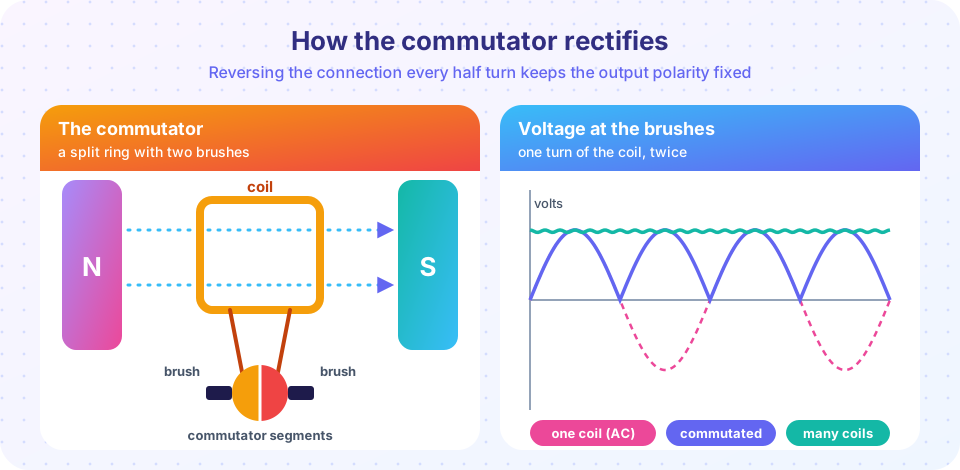
As the armature turns, a coil passes under the brush and its current must reverse from +Ia/A to -Ia/A in the very short time that the brush shorts it, typically a millisecond or less. Because the coil has inductance, the current resists the change, and a reactance voltage L di/dt appears. If the reversal is not complete when the segment leaves the brush, the remaining energy appears as a spark.
Remedies:
- Interpoles (commutating poles): small narrow poles on the neutral axis, wound in series with the armature so they scale with the load. They produce a flux that induces a voltage in the shorted coil opposing the reactance voltage. For a generator, an interpole has the same polarity as the next main pole in the direction of rotation; for a motor, the same polarity as the preceding main pole. They also cancel the cross-magnetizing effect locally.
- Compensating windings: conductors in slots in the pole faces carrying armature current in the opposite direction. They cancel armature reaction completely under the pole. Used in large, fast-changing or heavy-duty machines.
- Brush selection and position: carbon grades with the right resistance help the current reverse smoothly.
Common misconceptions
"EMF depends on current." E = K Φ ω depends on flux and speed, not on current. In a motor E is the back-EMF that opposes the supply.
"Lap and wave windings have different formulas." The equation is the same; only A differs.
"Armature reaction is a loss." It is not an I²R loss but it reduces the flux and so the performance, and it can cause sparking.
Try it
Press Run (or Ctrl + Enter) to see the result here.
Program input · what you'd type while the program runs
Type the answers before you press Run, one per line. Each time the program reads a line (with input()), it gets the next line from this box.
Press Run (or Ctrl + Enter) to see the result here.
Program input · what you'd type while the program runs
Type the answers before you press Run, one per line. Each time the program reads a line (with input()), it gets the next line from this box.
Check your understanding
Quick check · 5 questions
of 5 answered You scored / 5 · perfect!
-
1. A 6-pole lap-wound armature has 600 conductors and Φ = 20 mWb at 1000 rpm. What is the generated EMF?
A = 6 for lap, so E = 6 × 0.02 × 600 × 1000 / (60 × 6) = 200 V. -
2. The same armature is wave-wound (A = 2) with the same flux and speed. The EMF becomes:
E = 6 × 0.02 × 600 × 1000 / (60 × 2) = 600 V: three times larger, with one third of the current capacity. -
3. A machine has K Φ = 2.0 V·s/rad and Ia = 30 A. What is the developed torque?
T = K Φ Ia = 2.0 × 30 = 60 N·m. -
4. What does armature reaction do to the total flux per pole when the iron is saturated?
The flux added under one pole tip is less than the flux removed under the other, because the iron saturates. -
5. What is the purpose of interpoles?
They induce a commutating emf in the short-circuited coil, helping the current reverse sparklessly.
Summary
E = P Φ Z n / (60 A) = K Φ ωwithK = P Z / (2π A); lapA = P, waveA = 2.T = E Ia / ω = K Φ Ia: torque depends on flux and armature current.- Armature reaction distorts and weakens the flux and shifts the neutral axis.
- Interpoles and compensating windings keep commutation sparkless.
Next: DC Generators
Track your progress
Create a free account to tick off lessons and pick up where you left off on any device.
of Electrical Machines lessons completed