


















Lesson 44 of 45 · Projects and Practice
Cheat sheet: electrical machines formulas
A one-page recap of the key formulas for induction motors, synchronous machines, drives, efficiency and testing, with units, typical values and two small calculators.
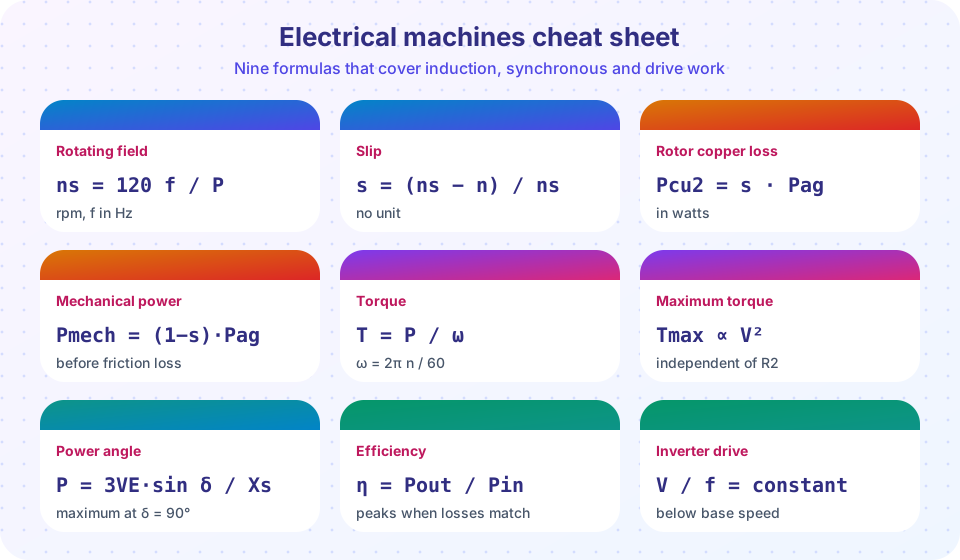
When you revise, you do not want to hunt through a dozen lessons for one equation. This page puts the key results of chapters 5 to 8 on one poster and one table, with units and typical numbers. Keep it next to you while you solve the practice problems.
What you will learn
- The formulas you need most, with units.
- Typical value ranges for sanity checks.
- How to convert between the units that appear on nameplates.
Formulas by chapter
Induction motors
| Quantity | Formula | Units |
|---|---|---|
| Synchronous speed | ns = 120 f / P |
rpm, Hz |
| Slip | s = (ns − n) / ns |
none |
| Rotor frequency | f2 = s f |
Hz |
| Air-gap power | Pag = 3 I2'² R2' / s |
W |
| Rotor copper loss | Pcu2 = s · Pag |
W |
| Mechanical power | Pmech = (1 − s) · Pag |
W |
| Torque | T = Pag / ωs = Pmech / ωm |
N·m |
| Pull-out torque | Tmax = 3 Vth² / (2 ωs [Rth + √(Rth² + (Xth + X2')²)]) |
N·m |
| Pull-out slip | sm = R2' / √(Rth² + (Xth + X2')²) |
none |
| Star-delta start | current and torque both ÷ 3 |
Synchronous machines
| Quantity | Formula | Units |
|---|---|---|
| Generated EMF | E = 4.44 kw f Φ Nph |
V |
| Frequency | f = P n / 120 |
Hz |
| Equivalent circuit | E = V + I (Ra + jXs) (generator) |
V |
| Regulation | (E − V) / V |
% |
| Power angle | P = 3 V E sin δ / Xs |
W |
Special motors and drives
| Quantity | Formula | Units |
|---|---|---|
| Step angle | 360° / steps per revolution |
degrees |
| BLDC | V = I R + Ke ω, T = Kt I, Ke = Kt in SI |
V, N·m |
| Stall torque | Kt V / R |
N·m |
V/f control |
V / f = constant up to base speed |
V/Hz |
| Affinity laws | flow ∝ n, head ∝ n², power ∝ n³ |
|
| Clarke and Park | id = flux, iq = torque |
A |
Efficiency, testing and selection
| Quantity | Formula | Units |
|---|---|---|
| Efficiency | η = Pout / (Pout + losses) |
% |
| Maximum efficiency | x = √(Pc / Pcu) |
fraction of load |
| No-load test | Pcore + Pfw = P0 − 3 I0² R1, Xm ≈ X0 − X1 |
W, Ω |
| Blocked-rotor test | Rbr = Pbr / (3 Ibr²), Zbr = (Vbr / √3) / Ibr |
Ω |
| Transformer OC / SC | Rc = V0² / P0; Req = Psc / Isc² |
Ω |
| RMS duty power | √(Σ Pi² ti / Σ ti) |
kW |
| Pump hydraulic power | ρ g Q H |
W |
Typical values
| Quantity | Typical range |
|---|---|
| Full-load slip of a medium induction motor | 2 to 6 % |
| Efficiency, 10 kW and larger | 88 to 96 % |
| Full-load power factor | 0.8 to 0.9 |
| Direct starting current | 5 to 8 times rated |
| Pull-out torque | 2 to 3 times rated |
| Rated load angle of a synchronous machine | 20° to 30° |
| Insulation class temperatures | A 105, B 130, F 155, H 180 °C |
Try it
A nameplate calculator converts the units you meet most often: horsepower and kilowatts, rpm and rad/s, torque and power.
Press Run (or Ctrl + Enter) to see the console output here.
No output.
The second tool applies the formulas to any nameplate: enter the speed, power and supply, and it reports slip, torque and the approximate losses.
Press Run (or Ctrl + Enter) to see the result here.
Program input · what you'd type while the program runs
Type the answers before you press Run, one per line. Each time the program reads a line (with input()), it gets the next line from this box.
Check your understanding
Quick check · 5 questions
of 5 answered You scored / 5 · perfect!
-
1. Which formula gives the rotor copper loss of an induction motor?
Rotor copper loss is the fraction s of the air-gap power. -
2. In SI units the BLDC constants Kt (N·m/A) and Ke (V·s/rad) are
Energy conservation forces Kt = Ke when both are in SI units. -
3. Which of these is a sensible full-load power factor for a medium induction motor?
Medium induction motors typically run at 0.8 to 0.9 at full load. -
4. A motor delivers 15 kW at 1455 rpm. Its shaft torque is about
T = 15000 / (2π × 1455 / 60) = 15000 / 152.4 ≈ 98.5 N·m. -
5. Which relation holds below base speed for a variable-frequency drive?
Keeping V/f constant keeps the flux constant.
Summary
- The key formulas for chapters 5 to 8 fit on one page: speed, slip, power flow, torque, power angle, drives, efficiency and tests.
- Typical values (slip 2 to 6 %, pf 0.8 to 0.9, starting 5 to 8 times) give you quick sanity checks.
- Keep units straight: rpm and rad/s, W and kW, phase and line voltages.
Next: Further study
Track your progress
Create a free account to tick off lessons and pick up where you left off on any device.
of Electrical Machines lessons completed