


















Lesson 22 of 45 · Induction Motors
Chapter overview: induction motors
A map of the induction motor chapter: how a rotating magnetic field turns a rotor that has no electrical connection, and what slip, torque and starting mean.
If you walk through a factory, a water plant or a shopping center, most of the machines that spin are driven by the same kind of motor: the three-phase induction motor. It has no brushes, no slip rings and no magnets on the rotor. You connect three wires to the stator and the shaft turns. This chapter explains why that works and how to calculate what it does.
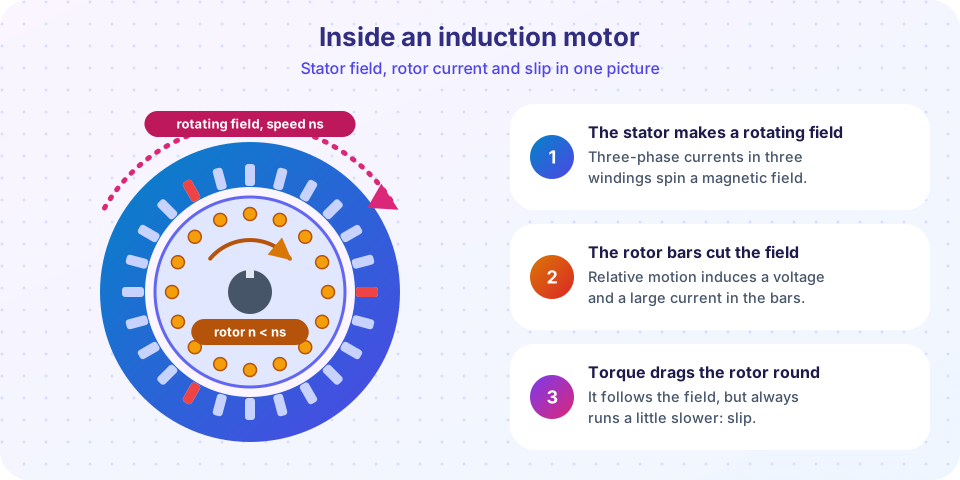
The key idea is simple to state. Three-phase currents in the stator create a magnetic field that rotates. That field cuts the rotor bars, induces currents in them, and the force between those currents and the field produces torque. The rotor chases the field but never quite catches it. That small difference in speed is called slip, and almost everything interesting about the motor depends on it.
What you will learn
- How three-phase windings create a field of constant size that rotates at synchronous speed.
- What slip is and why an induction motor must run below synchronous speed to make torque.
- How to model one phase of the motor as an equivalent circuit and follow the power through it.
- How the torque-speed curve looks, and how starting methods and speed control change it.
The chapter in slides
Stator field
Lesson 2 builds the rotating field from three sine waves.
Slip and power
Lesson 3 draws the equivalent circuit.
Torque and starting
Lesson 4 compares the methods.
Lessons in this chapter
- The rotating magnetic field: three coils, three currents, one turning field, and the speed formula
ns = 120 f / P. - Slip and the equivalent circuit: the per-phase circuit, power flow and a worked example with real numbers.
- Torque, starting and speed control: the torque-speed curve, why starting current is large, and how to start and steer the motor.
- Chapter review: one picture, one table and ten questions.
Try it
Synchronous speed depends only on supply frequency and the number of poles. Print the table you will meet again and again.
Press Run (or Ctrl + Enter) to see the result here.
Program input · what you'd type while the program runs
Type the answers before you press Run, one per line. Each time the program reads a line (with input()), it gets the next line from this box.
Slip is a ratio, so it has no unit. Change the measured speed and see how the number moves.
Press Run (or Ctrl + Enter) to see the console output here.
No output.
Summary
- An induction motor needs no electrical connection to its rotor: the rotor current is induced.
- The stator creates a rotating field; the rotor follows it at a slightly lower speed.
- The difference is slip,
s = (ns − n) / ns, typically 2 to 6 % at full load. - The chapter moves from the field, to the circuit model, to torque, starting and control.
Track your progress
Create a free account to tick off lessons and pick up where you left off on any device.
of Electrical Machines lessons completed