


















Lesson 36 of 45 · Efficiency, Testing and Applications
Chapter overview: efficiency, testing and applications
A map of the chapter on losses, efficiency, no-load and blocked-rotor tests, duty types and motor selection: how engineers measure and choose electrical machines.
An electric motor is among the most efficient machines ever built: a mid-size induction motor turns 90 % or more of its electrical input into shaft power. But motors are so numerous, and run for so many hours, that the last few percent are worth billions in electricity. Over its life a motor can cost many times its purchase price in energy.
So engineers ask three practical questions. Where do the losses go, and how can I calculate efficiency? How do I find the circuit parameters of a machine I cannot open? And which machine, of which size and type, should I pick for this load? This chapter answers all three.
What you will learn
- The four main losses in a rotating machine and in a transformer, and how to compute efficiency.
- When a machine runs at its highest efficiency.
- How the no-load and blocked-rotor tests give the equivalent circuit parameters.
- How duty types, insulation classes and load types guide motor selection.
The chapter in slides
Losses
Lesson 2 adds the efficiency formula.
Tests
Lesson 3 turns meter readings into a circuit.
Selection
Lesson 4 closes the loop with sizing.
Lessons in this chapter
- Losses and efficiency: the loss types, the efficiency formula and the load of maximum efficiency.
- Testing motors and transformers: no-load, blocked-rotor, open-circuit and short-circuit tests with a worked calculation.
- Motor selection and duty: duty types, thermal limits, load torque types and derating.
- Chapter review: one page and ten questions.
Try it
Efficiency is output over input. This tiny calculator reports the losses a given efficiency implies, which shows why 1 % matters at large power.
Press Run (or Ctrl + Enter) to see the console output here.
No output.
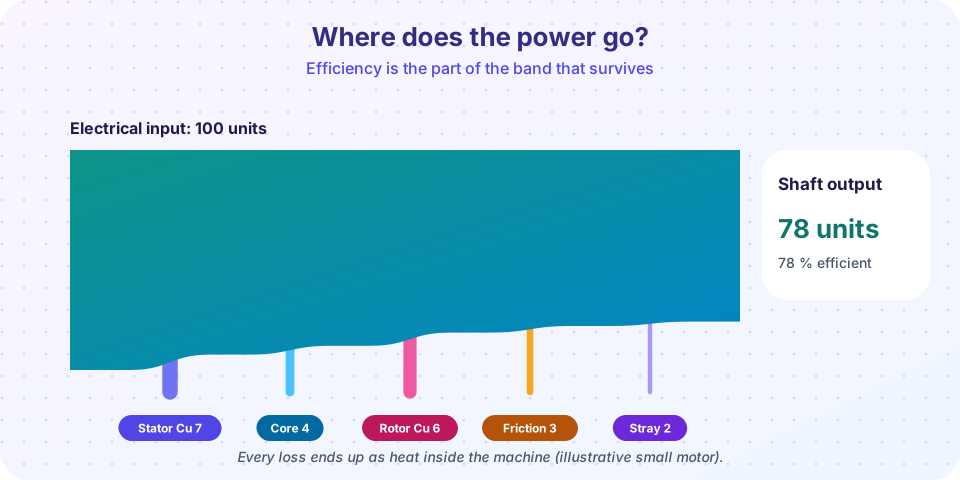
The second program follows the power through an illustrative small motor and prints a loss budget.
Press Run (or Ctrl + Enter) to see the result here.
Program input · what you'd type while the program runs
Type the answers before you press Run, one per line. Each time the program reads a line (with input()), it gets the next line from this box.
Summary
- Motors are efficient, but energy cost over a long life dwarfs the purchase price.
- This chapter covers losses and efficiency, parameter testing, and selection by duty and load.
Next: Losses and efficiency
Track your progress
Create a free account to tick off lessons and pick up where you left off on any device.
of Electrical Machines lessons completed