


















Lesson 6 of 45 · Magnetic Circuits
Magnetic Circuits: The Big Picture
Meet the magnetic circuit: flux, magnetomotive force and reluctance, and why iron cores with small air gaps are the foundation of transformers and rotating machines.
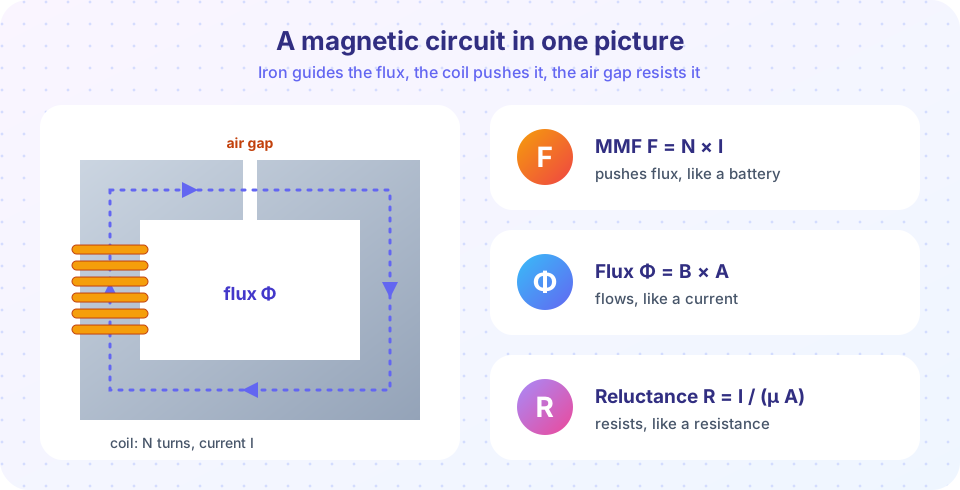
Open any transformer, motor or generator and you will find the same ingredients: a coil of copper wire and a body of iron. The coil creates a magnetic field, and the iron guides it to where it is needed. Engineers call this arrangement a magnetic circuit, and they analyze it with a method borrowed from electric circuits.
This chapter gives you the method. Once you can find the flux in a core, the current needed to produce it, and the energy and force that result, you can read the rest of the course with confidence.
What you will learn
- What a magnetic circuit is and why machines use iron cores.
- The three key quantities: magnetomotive force, flux and reluctance.
- Where the chapter goes next, lesson by lesson.
Key terms
Magnetomotive force (MMF): the "push" that drives flux, F = N × I, measured in ampere-turns.
Flux (Φ): the total magnetic field through a cross-section, in webers.
Reluctance (R): how strongly a path resists flux, in ampere-turns per weber.
Permeability (μ): how easily a material carries flux; μ = μ0 μr.
Air gap: a short gap in the iron path, such as between the rotor and the stator.
Why machines are built around iron
A coil on its own, in air, makes a field that spreads out in all directions and is weak. Wrap the same coil around an iron core and the flux stays inside the iron: soft magnetic iron is typically hundreds to thousands of times more permeable than air, so the same current produces far more flux, and nearly all of it is guided along the core.
That guidance is what lets a transformer link two coils tightly, and what lets the field of a motor concentrate in the narrow gap where the force is produced.
Chapter 2 in five steps
Losses and energy
Force
The analogy that does the work
The magnetic circuit equation has exactly the same form as Ohm's law:
Electric:  V = I × R
Magnetic:  F = Φ × R_m        (F = N I,  R_m = l / (μ A))
| Electric circuit | Magnetic circuit |
|---|---|
Voltage V (volts) |
MMF F = N I (ampere-turns) |
Current I (amperes) |
Flux Φ (webers) |
Resistance R = l / (σ A) |
Reluctance R_m = l / (μ A) |
Conductivity σ |
Permeability μ |
Series paths add their reluctances; parallel paths add their permeances (the reciprocals). Be careful, though: the analogy is a calculating trick, not a physical identity. Flux is not a flow of anything, no energy is dissipated in a reluctance carrying a steady flux, and the permeability of iron changes with the flux level. Chapter 2's third lesson explains that last point.
What each lesson covers
- This lesson gives the overview.
- Reluctance and magnetic circuits solves series circuits with air gaps and finds the current needed for a given flux.
- The B-H curve, hysteresis and core losses explains saturation, the hysteresis loop and eddy currents.
- Inductance, stored energy and force turns the circuit into
L,W = ½ L i²and the pull of an electromagnet. - Chapter review pulls it together with ten questions.
Common misconceptions
"Flux is like current flowing in iron." Nothing flows. Flux is a field quantity, and steady flux dissipates no energy; only changing flux causes losses.
"The more iron the better." Iron saturates. Beyond about 1.6 to 2 tesla for common electrical steel, adding current gives almost no extra flux.
"A tiny gap does not matter." A one-millimeter air gap in a core 40 cm long can account for most of the required ampere-turns, as the next lesson shows with numbers.
Try it
Press Run (or Ctrl + Enter) to see the result here.
Program input · what you'd type while the program runs
Type the answers before you press Run, one per line. Each time the program reads a line (with input()), it gets the next line from this box.
Check your understanding
Quick check · 5 questions
of 5 answered You scored / 5 · perfect!
-
1. What is the unit of magnetomotive force?
MMF is N × I, so ampere-turns (strictly amperes, with turns counted as a pure number). -
2. Which electric-circuit quantity corresponds to magnetic flux?
MMF corresponds to voltage, flux to current and reluctance to resistance. -
3. Why is iron used in the core?
High permeability keeps the flux in the core and gives much more flux for the same ampere-turns. -
4. Which statement about the analogy is true?
The analogy helps calculation, but steady flux is a field state, not a flow, and dissipates no power. -
5. Two reluctances 100 and 300 A·t/Wb form a series path. What is the total?
Series reluctances add, like series resistances: 100 + 300 = 400.
Summary
- A magnetic circuit is an iron path, usually with a small air gap, that carries the flux a coil produces.
F = N I = Φ R_m, withR_m = l / (μ A): the same form as Ohm's law.- Iron guides flux and multiplies it; saturation limits how far this can be pushed.
- The rest of the chapter covers reluctance calculations, hysteresis and eddy losses, and inductance, energy and force.
Track your progress
Create a free account to tick off lessons and pick up where you left off on any device.
of Electrical Machines lessons completed