


















Lesson 2 of 45 · Getting Started
Energy Conversion: Motors and Generators
Understand how electrical machines convert energy: the coupling field, power equals torque times angular speed, motor and generator action, with worked examples.
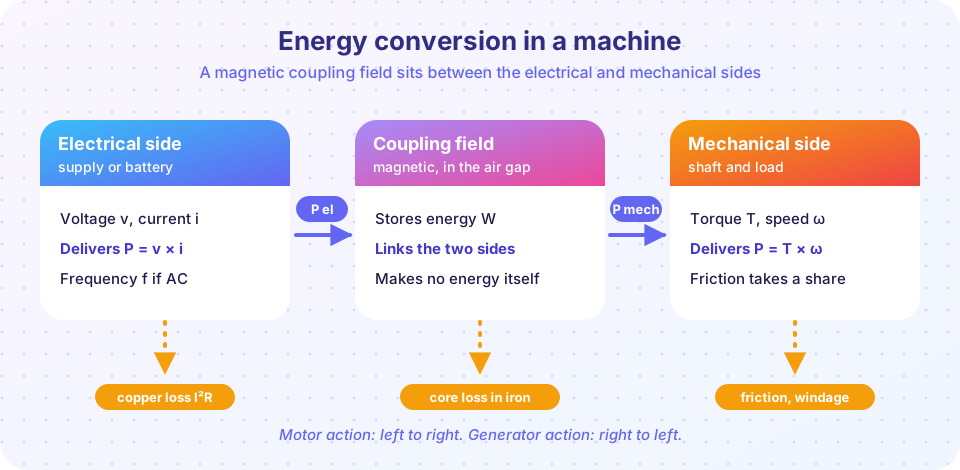
Every electrical machine is a translator. On one side is electrical energy, described by voltage and current. On the other side is mechanical energy, described by torque and speed. In between sits a magnetic field that makes the translation possible. Once you see this three-part picture, a motor, a generator and even a transformer become variations on one theme.
In this lesson you will follow the energy through a machine, learn the one equation that links torque, speed and power, and see why motors and generators are really the same device used in opposite directions.
What you will learn
- How energy is conserved when electrical energy becomes mechanical energy.
- Why magnetic fields, and not electric fields, are used to couple the two sides.
- How to use
P = T × ωand convert between rpm and rad/s. - The difference between motor action and generator action.
Key terms
Coupling field: the magnetic field that links the electrical and mechanical sides of a machine.
Angular speed (ω): how fast the shaft turns, in radians per second.
Torque (T): the twisting action on the shaft, in newton-meters.
Motor action: electrical power in, mechanical power out.
Generator action: mechanical power in, electrical power out.
The energy balance
Energy cannot be created or destroyed, so a machine must obey a balance. In words, for a motor:
electrical energy in = mechanical energy out
                     + increase of energy stored in the field
                     + energy lost as heat
In steady operation the stored field energy does not change over time, so the middle term disappears. Dividing by time turns energy into power:
P_in = P_out + P_losses
The coupling field is a middleman. It takes energy from one side, holds some of it for a moment, and hands it to the other side. Over a full cycle of steady operation, the field returns every joule it borrowed.
Why a magnetic field?
You could imagine machines that use electric fields (charged plates attracting each other). They exist, but they are tiny. The reason is energy density. The energy stored per cubic meter of a field is:
magnetic:  w = B² / (2 μ0)
electric:  w = ε0 E² / 2
At B = 1 T in air, w ≈ 398 kJ/m³. The strongest electric field air can hold before it breaks down is roughly 3 MV/m, which gives only about 40 J/m³. The magnetic field stores around ten thousand times more energy in the same volume, so a magnetic machine can be far smaller for the same power. Iron makes the difference even larger, because it lets you reach high flux density with little current.
Power, torque and speed
For anything that rotates, the mechanical power is torque times angular speed:
P = T × ω        (W = N·m × rad/s)
ω = 2π n / 60    (n in revolutions per minute)
Notice that power is not the same as torque. A tractor and a racing car can have equal power with very different torque, because one runs slowly and the other quickly.
Worked example: a motor on the bench
A motor turns at n = 1500 rpm and the torque on its shaft is 50 N·m.
- Angular speed:
ω = 2π × 1500 / 60 = 157.08 rad/s. - Power:
P = 50 × 157.08 = 7854 W, about7.85 kW. - In mechanical horsepower (1 hp = 745.7 W):
7854 / 745.7 ≈ 10.5 hp.
Worked example: a lift
A lift raises 1000 kg at 1.5 m/s. Lifting power is force times velocity: P = m g v = 1000 × 9.81 × 1.5 = 14,715 W, or 14.7 kW. If the motor and gearing together are 88 % efficient, the electrical input must be 14.715 / 0.88 = 16.7 kW. The electrical supply has to be sized for the input, not only for the useful output.
Gears trade speed for torque
An ideal gearbox keeps power constant, so if it divides the speed by 10 it multiplies the torque by 10. That is why a small fast motor with a gearbox can turn a slow heavy load. Real gearboxes lose a few percent as heat.
Motor action and generator action
Look again at the chain in the picture. Arrows point from the electrical side to the mechanical side when the machine is a motor. Reverse the arrows and the same hardware is a generator: an engine or turbine supplies mechanical power, and the machine delivers electrical power.
| Motor action | Generator action | |
|---|---|---|
| Energy in | Electrical | Mechanical |
| Energy out | Mechanical | Electrical |
| Torque of the machine | Drives the load | Opposes the prime mover |
| Typical example | Lift motor | Wind turbine generator |
Many drives switch roles during use. A train motor becomes a generator when the train brakes, returning energy to the supply or to a resistor. This is called regenerative braking.
Common misconceptions
"More torque always means more power." Power is torque times speed. A motor holding a load stationary produces torque but no mechanical power at all (ω = 0).
"The magnet supplies the energy in a motor." The energy comes from the electrical supply. A permanent magnet only provides the field that couples the two sides.
"rpm can go straight into P = T × ω." The formula needs radians per second. Convert first with ω = 2πn/60.
Try it
Press Run (or Ctrl + Enter) to see the result here.
Program input · what you'd type while the program runs
Type the answers before you press Run, one per line. Each time the program reads a line (with input()), it gets the next line from this box.
Press Run (or Ctrl + Enter) to see the result here.
Program input · what you'd type while the program runs
Type the answers before you press Run, one per line. Each time the program reads a line (with input()), it gets the next line from this box.
Check your understanding
Quick check · 5 questions
of 5 answered You scored / 5 · perfect!
-
1. A shaft turns at 3000 rpm with a torque of 20 N·m. What is the mechanical power, approximately?
ω = 2π × 3000 / 60 = 314.2 rad/s, so P = 20 × 314.2 ≈ 6283 W, about 6.3 kW. -
2. In steady operation, what happens to the energy stored in the coupling field over time?
The field borrows and returns energy. In steady state its stored energy does not change, so P_in = P_out + losses. -
3. Why are magnetic fields preferred to electric fields in machines?
At 1 T a magnetic field stores about 398 kJ/m³, thousands of times more than the strongest practical electric field in air. -
4. A machine driven by a wind turbine and delivering power to a grid is in which mode?
Mechanical power in and electrical power out is generator action. -
5. An ideal gearbox reduces speed by a factor of 4. What happens to the shaft torque?
Power is conserved in an ideal gearbox, so slower means more torque: T × ω stays constant.
Summary
- A machine moves energy between electrical and mechanical form through a magnetic coupling field; in steady state
P_in = P_out + losses. - Magnetic fields store thousands of times more energy per volume than practical electric fields, so machines are magnetic.
- Mechanical power is
P = T × ω, withω = 2πn/60. - Motor action and generator action are the same physics with the energy flowing in opposite directions.
Track your progress
Create a free account to tick off lessons and pick up where you left off on any device.
of Electrical Machines lessons completed