


















Lesson 42 of 45 · Projects and Practice
Practice problem set
Twelve practice problems on induction motors, alternators, synchronous motors, transformers, steppers, BLDC motors, drives and duty cycles, with a method and a checker program.
You learn machines by calculating with them. This page gives twelve problems that cover chapters 5 to 8 and a method that works for every one. Try each problem on paper first. The first program checks your numbers, and the quiz at the end tests five of the results.
What you will learn
- A five-step method for machine problems.
- How to practice the formulas of induction, synchronous and special machines in numbers.
- How to sanity check an answer against typical values.
A method that always works
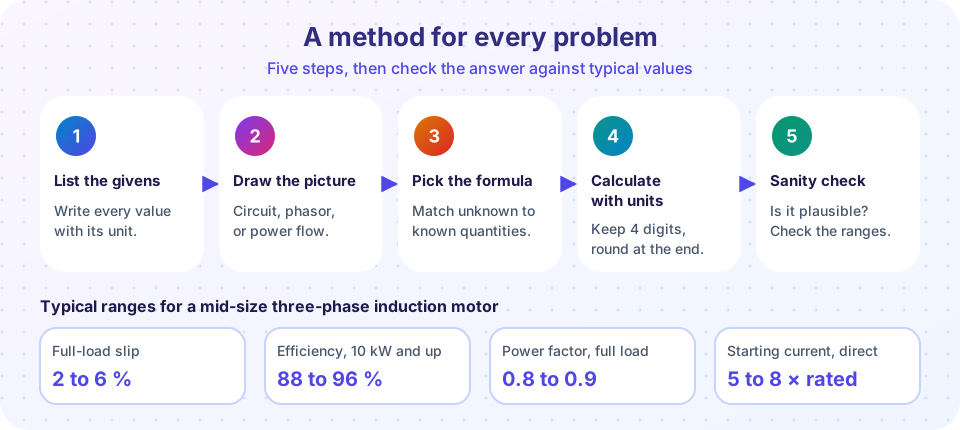
- List the givens with units and the quantity you are asked for.
- Draw the picture: an equivalent circuit, a phasor diagram or a power-flow diagram.
- Pick the formula that links the unknown to the givens. Use
Pcu2 = s · PagandPmech = (1 − s) · Pagfor motor power flow,E = V + I (Ra + jXs)for alternators, andP = 3 V E sin δ / Xsfor synchronous motors. - Calculate with units. Keep at least four digits and round only at the end.
- Sanity check. Typical slips are 2 to 6 %, efficiencies of medium motors 88 to 96 %, full-load power factors 0.8 to 0.9. If your answer is far outside, look for an error.
The problems
Induction motors
- A 6-pole, 60 Hz induction motor runs at 1140 rpm. Find the synchronous speed, the slip and the rotor frequency.
- A motor takes 18 kW. The stator copper loss is 0.9 kW and the core loss is 0.4 kW. At a slip of 0.035 find the air-gap power, the rotor copper loss and the mechanical power.
- A 4-pole, 50 Hz motor has an air-gap power of 16.7 kW. Find the air-gap torque.
- The pull-out torque of a motor is 250 N·m at 400 V. What is it if the voltage drops to 360 V?
- Direct-on-line starting draws 150 A and gives 120 N·m. What are the line current and the torque with star-delta starting?
Synchronous machines
- A star-connected alternator has
V = 6350 Vper phase,Ra = 0.4 Ω,Xs = 8 Ω, and carries 100 A at 0.8 lagging. FindEand the regulation. - A synchronous motor has
V = 3810 VandE = 5000 Vper phase,Xs = 12 Ωand a load angle of 25°. Find the power it delivers (neglect resistance).
Efficiency and transformers
- A 50 kVA transformer has an iron loss of 0.4 kW and a full-load copper loss of 1.6 kW. At what load fraction is its efficiency highest, and what is the efficiency at that load at 0.9 power factor?
Special motors and drives
- A 1.8° stepper runs in half-step mode at 3000 pulses per second. What is its speed in rpm?
- A BLDC motor has
Kt = Ke = 0.04in SI units,R = 0.8 Ωand runs on 12 V. Find the stall torque and the no-load speed. - A 6-pole motor is driven at 40 Hz by a VFD that keeps
V/fconstant from 400 V at 50 Hz. Find the synchronous speed and the output voltage.
Duty
- A motor carries 10 kW for 20 s and 4 kW for 40 s in a repeated cycle with no rest. What is the rms power?
Try it
Run the checker after you have solved the problems by hand. Compare each result with yours; if they differ, check the units first, then the formula.
Press Run (or Ctrl + Enter) to see the result here.
Program input · what you'd type while the program runs
Type the answers before you press Run, one per line. Each time the program reads a line (with input()), it gets the next line from this box.
Now try your own variations. This helper solves problem 2 for any data so you can practice with new numbers and see how each loss changes the shaft power.
Press Run (or Ctrl + Enter) to see the console output here.
No output.
Check your understanding
Quick check · 5 questions
of 5 answered You scored / 5 · perfect!
-
1. Problem 1: what is the rotor frequency?
ns = 1200 rpm, s = 0.05, so f2 = 0.05 × 60 = 3 Hz. -
2. Problem 4: what is the pull-out torque at 360 V?
Tmax is proportional to V²: 250 × 0.9² = 202.5 N·m. -
3. Problem 8: at what load fraction is the transformer's efficiency highest?
x = √(0.4 / 1.6) = 0.5. -
4. Problem 9: what is the speed of the stepper?
Half step gives 400 steps per revolution: 3000 / 400 = 7.5 rev/s = 450 rpm. -
5. Problem 11: what is the drive's output voltage at 40 Hz (V/f constant)?
V = 400 × 40 / 50 = 320 V.
Summary
- Use the five-step method: givens, picture, formula, units, sanity check.
- Keep the power-flow identities handy:
Pcu2 = s · Pag,Pmech = (1 − s) · Pag,T = Pag / ωs. - For synchronous and special machines the key formulas are
E = V + I (Ra + jXs),P = 3 V E sin δ / Xs, step angle360° / N, andV/fconstant.
Next: Glossary
Track your progress
Create a free account to tick off lessons and pick up where you left off on any device.
of Electrical Machines lessons completed