


















Lesson 17 of 45 · DC Machines
DC Machines: The Big Picture
Meet the DC machine: stator poles, armature, commutator and brushes, the four excitation types and where DC motors and generators are still used today.
The DC machine was the first practical electric motor and the first practical generator. For about a century it ran trams, lifts, steel mills and ships because it offered something no other machine could: smooth, wide-range control of speed and torque with simple equipment. Today most new drives use AC machines with electronics, but millions of DC machines still turn in cars, toys, tools and traction systems, and the DC machine remains the best way to learn the relationship between voltage, speed and torque.
What you will learn
- The main parts of a DC machine and what each one does.
- Why a commutator is needed and what it does.
- The four classic types: separately excited, shunt, series and compound.
- Where DC machines are used and how they are being replaced.
Key terms
Field winding: the winding on the stator poles that creates the main flux.
Armature: the rotor with its winding, in which the voltage is induced and the torque produced.
Commutator: a ring of copper segments, insulated from each other, connected to the armature coils.
Brushes: carbon blocks that slide on the commutator and connect the rotating armature to the outside circuit.
Interpoles: small extra poles between the main poles that improve commutation.
The parts
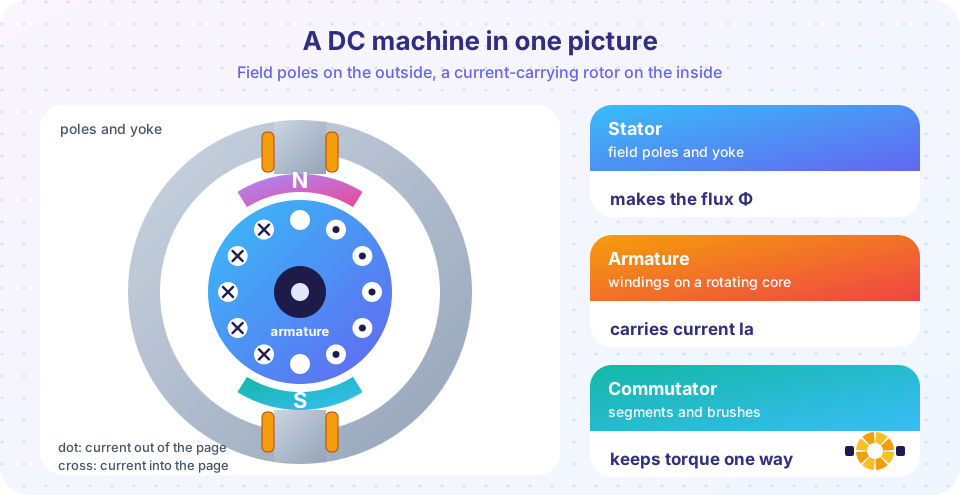
- Yoke (frame): the cast or rolled steel ring that carries the flux between poles and supports the machine.
- Poles and pole shoes: laminated or solid iron projections that carry the field windings and spread the flux across the air gap.
- Field winding: copper coils on the poles. A current
Ifin them sets the fluxΦ. - Armature core: a cylinder of insulated iron laminations (to limit eddy currents) with slots on its surface.
- Armature winding: coils of copper in the slots, connected to the commutator segments. This carries the armature current
Ia. - Commutator: many copper segments separated by mica insulation, mounted on the shaft.
- Brushes and brush holders: carbon (or carbon-graphite) blocks held against the commutator by springs.
The machine in the picture has two poles; larger machines have four, six or more poles, which multiplies the number of parallel paths in the armature.
Why a commutator?
By Faraday's law the voltage induced in an armature coil rotating in a magnetic field is alternating: the coil side passes a north pole, then a south pole. The commutator is a mechanical switch that reverses the connection of the coil to the brushes exactly when the coil voltage reverses. The result is a unidirectional voltage at the brushes, which makes the machine a DC generator.
The same trick works in motors: the current in each conductor is reversed as the conductor passes from a north pole to a south pole, so every conductor keeps being pushed the same way and the torque never reverses. In both cases the brushes sit on the neutral axis, where the coil sides are between the poles and no voltage is induced.
Four classic types
Series and compound
Plus the permanent magnet type
Types by excitation
| Type | Field connection | Typical character |
|---|---|---|
| Separately excited | Own DC supply | Flexible, easiest to control |
| Shunt | Across the armature | Nearly constant speed |
| Series | In series with the armature | Very high starting torque, speed varies widely |
| Compound | Shunt and series fields together | Compromise: strong start, steadier speed |
| Permanent magnet (PMDC) | Magnets, no field winding | Small, efficient, common in low-power uses |
Where DC machines are used
- Small PMDC motors: car window lifts, wipers, fans, toys, tools, robots.
- Traction and cranes: series and compound motors on older trains, trams and cranes, because of high starting torque.
- Rolling mills and paper machines: where fine speed control was valued. Many are now replaced by AC drives.
- Generators: historically for electroplating, welding and battery charging. Almost all generators in power systems are now AC.
Modern alternatives, such as the brushless DC motor and the AC induction motor with a variable-speed drive (chapter 7), avoid the brushes, whose wear and sparking limit the life and speed of DC machines and demand maintenance.
Common misconceptions
"A DC machine contains a DC voltage in the armature." The voltage in each coil is actually alternating; the commutator rectifies it mechanically.
"The brushes are the electrical contacts that carry the field current." The field winding is on the stator. The brushes carry the armature current.
"A DC machine only works from DC." Series motors (universal motors) work on both AC and DC because the current and flux reverse together.
Try it
Press Run (or Ctrl + Enter) to see the result here.
Program input · what you'd type while the program runs
Type the answers before you press Run, one per line. Each time the program reads a line (with input()), it gets the next line from this box.
Check your understanding
Quick check · 5 questions
of 5 answered You scored / 5 · perfect!
-
1. What is the job of the commutator in a DC generator?
The coil voltage alternates; the commutator reverses the connection at the right moment, rectifying the output mechanically. -
2. Which winding carries the armature current?
The field winding is on the stator and sets the flux; the armature winding on the rotor carries Ia. -
3. A series DC motor has its field winding:
By definition a series machine carries the armature current through its field coils. -
4. Why is the armature core laminated?
The rotating iron passes under alternating poles, so its flux alternates and laminations cut eddy-current heating. -
5. Where are the brushes placed ideally?
At the neutral axis the induced voltage in the coil being switched is zero, giving sparkless commutation.
Summary
- A DC machine has a stator with poles and a field winding, a rotor (armature) with its winding, a commutator and brushes.
- The commutator reverses coil connections so that the brush voltage (generator) or torque (motor) keeps one direction.
- Types by excitation: separately excited, shunt, series, compound, and permanent magnet.
- DC machines are being replaced by AC drives and brushless motors, but remain common in small, traction and special uses.
Track your progress
Create a free account to tick off lessons and pick up where you left off on any device.
of Electrical Machines lessons completed