


















Lesson 10 of 45 · Magnetic Circuits
Chapter 2 Review: Magnetic Circuits
Review magnetic circuits: MMF, reluctance, air gaps, B-H curve, hysteresis and eddy losses, inductance, stored energy and electromagnet force, with a ten-question quiz.
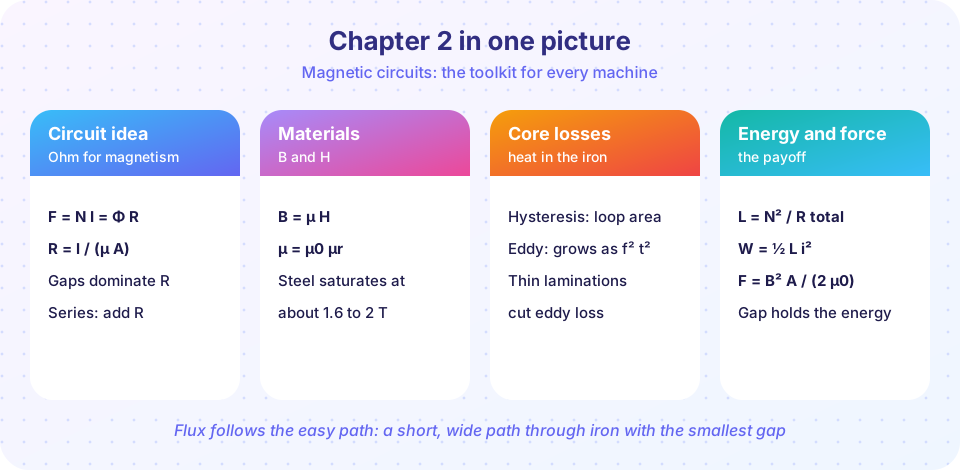
This chapter gave you the language of magnetic design: ampere-turns pushing flux through reluctances, iron that saturates and wastes energy, and a field that stores energy and pulls on iron. Transformers and machines are applications of these ideas, so it is worth making sure they are solid before you move on.
What you will learn
- How the four lessons connect.
- The formulas to carry forward into chapter 3.
- Which mistakes to avoid when solving magnetic-circuit problems.
The chapter at a glance
| Lesson | Big idea | Key results |
|---|---|---|
| Overview | Iron guides flux like wires guide current | F = N I = Φ R, analogy table |
| Reluctance and circuits | Solve series circuits; gap dominates | R = l/(μA), H_c l_c + H_g l_g = N I |
| B-H curve and losses | Saturation, hysteresis, eddy currents | P_h ∝ f B^n, P_e ∝ f² B² t² |
| Inductance, energy, force | L, stored energy, pull |
L = N²/R, W = ½ L i², F = B²A/(2μ0) |
A five-step recipe for any magnetic-circuit problem
- Sketch the flux path and divide it into sections of uniform area and material.
- Compute (or look up)
BandHin each section. - Multiply
Hby length for each section to get the MMF drops. - Add the drops: the sum is
N I. - Check the result: is the iron near saturation, and does the gap carry the share you expect?
Common misconceptions
"A magnetic circuit dissipates power in its reluctance." Steady flux costs nothing in the circuit (the coil's I²R is a separate loss). Only changing flux creates losses.
"Constant μr is always safe." Check against the knee of the curve; if B is above about 1.5 T for steel, use the table.
Try it
Press Run (or Ctrl + Enter) to see the result here.
Program input · what you'd type while the program runs
Type the answers before you press Run, one per line. Each time the program reads a line (with input()), it gets the next line from this box.
Check your understanding
Quick check · 10 questions
of 10 answered You scored / 10 · perfect!
-
1. A 250-turn coil carries 4 A. The MMF is:
F = N I = 250 × 4 = 1000 ampere-turns. -
2. A flux of 3 × 10⁻⁴ Wb flows through a path of area 5 cm². What is B?
B = Φ/A = 3×10⁻⁴ / 5×10⁻⁴ = 0.6 T. -
3. Which statement about an air gap is correct?
μ of air is far lower than the iron's, so the gap raises the total reluctance and lowers L. -
4. What happens to the eddy loss if lamination thickness doubles?
P_e ∝ t², so doubling t multiplies the loss by 4. -
5. A B-H loop is wide with large Hc. The material is best suited to:
Large coercivity means the magnetization is hard to remove: a permanent magnet. -
6. Total reluctance 4×10⁵ A/Wb and N = 200. What is L?
L = N²/R = 40000 / 4×10⁵ = 0.1 H. -
7. For the inductor above carrying 3 A, the stored energy is:
W = ½ L I² = 0.5 × 0.1 × 9 = 0.45 J. -
8. A pole face of area 20 cm² has B = 1.2 T. The pull on one gap face is about:
F = B²A/(2μ0) = 1.44 × 2×10⁻³ / (2 × 4π×10⁻⁷) ≈ 1146 N. -
9. Which loss depends on the frequency raised to the power two (at fixed B)?
P_e ∝ f² B² t²; hysteresis loss grows only linearly with f. -
10. Why do gapped inductors keep a constant inductance to higher currents?
With most of the reluctance in air, the total reluctance changes little as the iron nears saturation.
Summary
F = N I = Φ R,R = l/(μ A); series reluctances add and the gap dominates.- Iron saturates and shows hysteresis; core loss is
P_h + P_e, reduced by laminations and silicon steel. L = N²/R,W = ½ L i²,F = B²A/(2μ0)per gap face.- These tools let you analyze a transformer in chapter 3 as a pair of coils on a shared magnetic circuit.
Track your progress
Create a free account to tick off lessons and pick up where you left off on any device.
of Electrical Machines lessons completed