


















Lesson 2 of 47 · Getting Started
What is behavioral economics?
Learn what behavioral economics is, how it differs from the standard model, and the three limits (rationality, willpower, self-interest) it adds to economics.
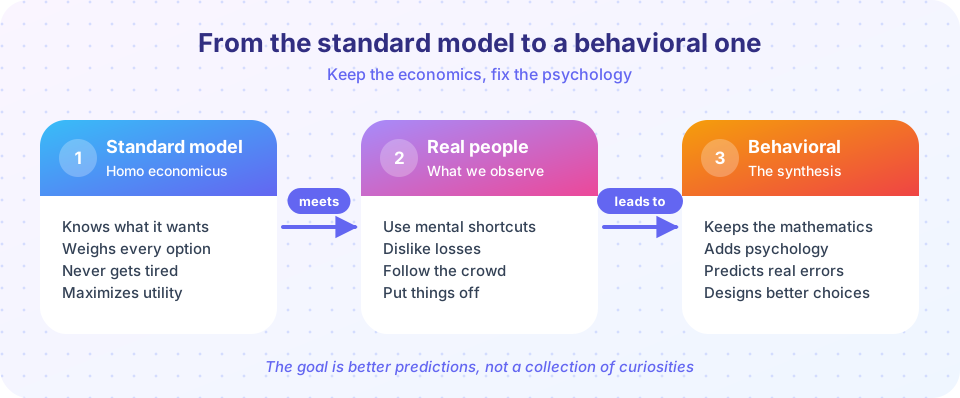
Economics has long worked with a clean picture of a decision maker: someone who knows what they want, weighs every option, and picks the best one. That picture makes mathematics easy and often gives good predictions for large groups and competitive markets. But it can fail badly for individual choices about saving, health, debt, insurance and fairness.
Behavioral economics is the study of how real psychology (limited attention, emotion, habit, social context) shapes economic decisions. It does not throw economics away. It keeps the tools of economics (models, incentives, equilibrium, careful data work) and replaces unrealistic assumptions with assumptions that fit the evidence.
What you will learn
- How the standard (neoclassical) model describes a decision maker.
- The three "bounds" Thaler and others use to organize behavioral economics.
- Why a better psychology can change predictions, not just add color.
- Three well-known examples: memberships, defaults and fairness.
Key terms
Neoclassical (standard) model: people have stable, consistent preferences and choose what maximizes their utility, given prices and information.
Utility: a number that represents how much a person values an outcome; choosing "the best" means choosing the highest utility.
Normative: about how people should choose according to a standard such as logic or probability.
Descriptive: about how people do choose, as observed.
Behavioral economics aims to make economic models more descriptively accurate while staying rigorous.
The standard model in four assumptions
The textbook decision maker is sometimes called Homo economicus. A compact way to state the model is four assumptions.
- Stable, well-defined preferences. You can rank any two options, and the ranking does not depend on how options are described.
- Unlimited cognition. You can compute the best option, however complicated the problem.
- Rational beliefs. You update beliefs about uncertain events correctly, using probability rules.
- Own-payoff focus. You care about your own material outcomes. (Economists often weaken this one, but it is the default.)
Under these assumptions, the theory gives sharp predictions. Raise a price and people buy less. Offer a better deal and more people sign up. These predictions often hold on average. The problem is the cases where they do not, and where the failures follow a pattern.
Three bounds: a useful organizing idea
In a classic 2000 paper, Sendhil Mullainathan and Richard Thaler summarized behavioral economics as relaxing three "bounds" in the standard model.
- Bounded rationality. People have limited time, attention and memory, so they use shortcuts (Chapter 2 and Chapter 3).
- Bounded willpower. People's actions do not always match their long-term goals; we procrastinate and overspend (Chapter 5).
- Bounded self-interest. People care about fairness, reciprocity and other people's outcomes (Chapter 6).
Chapter 4 adds a fourth theme that cuts across these: how people value outcomes as gains and losses relative to a reference point.
Three examples
1. The gym membership
Imagine a gym offers a flat membership for $60 a month or a pass for $10 per visit. A rational planner who expects six or more visits a month should pick the membership, and one who expects fewer should pay per visit. A well-known study by Stefano DellaVigna and Ulrike Malmendier (2006) looked at the contracts of members of real health clubs. Many of those who chose flat-rate contracts attended so rarely that they would have paid less with a pay-per-visit option. One reading is that people overestimate their future self-control. Researchers debate details, but the example shows how a behavioral model (people are overly optimistic about their future selves) predicts something the standard model does not.
2. Defaults
When people are automatically enrolled in a retirement plan (with the right to opt out), participation is much higher than when they must sign up. Madrian and Shea (2001) documented a large jump in participation after a company switched to automatic enrollment. For a person with stable preferences, the paperwork should be irrelevant. In practice, inertia and attention matter, so the default changes outcomes. This idea leads to the "nudge" movement in Chapter 7.
3. Fairness
In the ultimatum game (first studied by Werner Güth and colleagues in 1982), one person proposes how to split a sum, and a second person accepts or rejects. If rejected, both get nothing. A purely self-interested responder should accept any positive offer, because something beats nothing. Yet in many studies, responders reject offers that feel unfair, and proposers anticipate that and offer substantial shares. People pay to punish unfairness, and the standard model's fourth assumption is too narrow. We return to this in Chapter 6.
Why a better psychology changes predictions
It is tempting to think behavioral economics merely adds footnotes. In fact it can change policy. If you believe people read and optimize every contract, you would regulate by disclosure. If you believe attention is scarce and defaults matter, you would also design defaults carefully. If you believe loss aversion is strong, you would expect resistance to reforms framed as losses, even when the average person gains.
Common misconceptions
- "Behavioral economics says people are stupid." No. Most shortcuts are smart given limits on time and information. The field studies systematic departures from a benchmark, not general incompetence.
- "It replaces economics." No. It is a part of economics, uses the same methods, and often agrees with the standard model, especially where stakes are high, feedback is quick and markets are competitive.
- "Every bias is a mistake to eliminate." Not necessarily. Some biases are the cost of otherwise useful rules of thumb.
Try it
The first demonstration is a break-even calculator for the gym example. The numbers are made up to teach the logic; they are not data from the study.
Press Run (or Ctrl + Enter) to see the result here.
Program input · what you'd type while the program runs
Type the answers before you press Run, one per line. Each time the program reads a line (with input()), it gets the next line from this box.
The second demonstration is a simple model of defaults. We assume that a fixed share of people actively choose and everyone else accepts whatever the default is. The 30% figure is an assumption chosen to show the logic, not a measured value.
Press Run (or Ctrl + Enter) to see the console output here.
No output.
Check your understanding
Quick check · 5 questions
of 5 answered You scored / 5 · perfect!
-
1. Which is a normative statement?
Normative statements say how people should choose by some standard. The other two describe observed behavior. -
2. Which of these is NOT one of the three 'bounds' in Mullainathan and Thaler's summary?
The three bounds are rationality, willpower and self-interest. Income is an ordinary economic variable, not a bound on the model of the decision maker. -
3. In the ultimatum game, why is a rejection of a small positive offer puzzling for the standard model?
A purely self-interested responder should take any positive amount over nothing. Rejection shows that fairness matters to many people. -
4. A company switches to automatic enrollment in its savings plan and participation rises sharply. What does this suggest?
If preferences are stable and attention is unlimited, paperwork should not matter. The jump points to inertia and limited attention, though it does not show that the standard model is useless. -
5. Which statement about behavioral economics is most accurate?
The field keeps formal models but changes assumptions to match evidence.
Summary
- The standard model assumes stable preferences, unlimited cognition, rational beliefs and own-payoff focus.
- Behavioral economics relaxes these: bounded rationality, bounded willpower, bounded self-interest.
- Memberships, defaults and the ultimatum game are classic illustrations.
- The goal is better predictions and better design, not a list of human flaws.
- Many effects shrink where stakes are high, feedback is quick and competition is strong.
Track your progress
Create a free account to tick off lessons and pick up where you left off on any device.
of Behavioral Economics lessons completed