


















Lesson 23 of 47 · Time and Risk Preferences
Chapter 5 Overview: Time and Risk Preferences
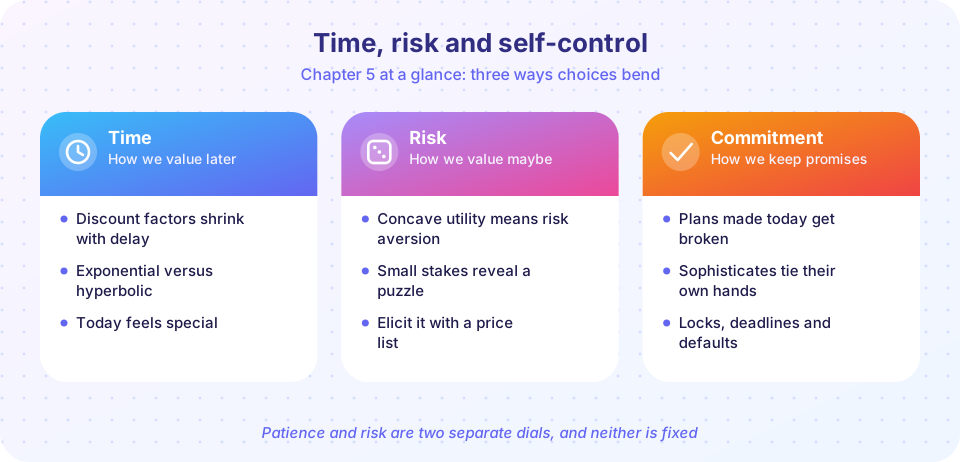
A map of chapter 5: how people trade off now against later, how they handle uncertainty, and why plans made today so often get broken tomorrow.
Almost every important decision you make has two hidden dials. The first is time: how much you value a benefit that arrives later compared with one that arrives now. The second is risk: how you feel about outcomes that might not happen. Saving for retirement turns both dials at once, because you give up money today (time) for a payoff that is uncertain (risk). Standard economics gave each dial a tidy mathematical form. This chapter shows what the tidy forms get right, where people systematically depart from them, and what that means for saving, health and self-control.
What you will learn
- Why economists model patience with a discount factor and what "time consistent" means.
- How the three lessons of this chapter fit together.
- The difference between impatience, risk aversion and self-control problems.
- A first look at the numbers in a discounting calculation.
Key terms
Discounting: valuing a future benefit at less than its face value because it arrives later.
Time consistency: a plan that you still want to follow when the moment to act arrives.
Risk aversion: preferring a sure amount to a gamble with the same expected value.
Commitment device: a choice made today that limits your own future options.
The big picture
Two dials
The standard model
What people do
Evidence, not stereotypes
Why these dials matter
Think about a few ordinary choices. You can take a job with a bigger paycheck now or training that pays off in five years. You can start a gym habit or put it off one more week. You can keep your savings in a bank account or in shares that fluctuate. Each choice compares outcomes at different dates, outcomes with different chances, or both.
In the textbook model, a person has a single discount rate and a single attitude toward risk. Both are stable features of the person, like height. The behavioral approach asks whether that is true. Two broad findings run through this chapter. First, people discount the near future far more steeply than the distant future, so a choice that looks wise from a distance can look different in the moment. Second, measured risk attitudes depend on the size of the stakes, the way the choice is described and the context, so one number cannot summarize them.
Where the chapter goes
| Lesson | What you will learn |
|---|---|
| Discounting and impatience | The discounted utility model, exponential versus hyperbolic discounting, and why the shape of the curve matters |
| Present bias and commitment | The beta-delta model, preference reversals, naive versus sophisticated people and commitment devices |
| Risk attitudes in practice | Utility curvature, certainty equivalents, Rabin's calibration argument and how experiments measure risk |
| Chapter 5 review | One-picture summary and a ten-question quiz |
Common misconceptions
"Impatient people are irrational." Wanting money sooner can be perfectly sensible: you might need it, you might not live to enjoy it, or prices might rise. The puzzle is not impatience itself but impatience that changes with the timing of the choice.
"Risk aversion and impatience are the same trait." Studies that measure both find they are only weakly related, and each depends on how it is measured.
"Behavioral economics says people are stupid." The field describes systematic patterns and tests them. Most of its models keep the idea that people pursue their goals, and add realistic features such as the pull of the present.
Try it
First, a patience dial. Move the slider to change the yearly discount rate and watch how much a payment of 1,000 is worth today at different delays. This is a calculator that applies the standard formula, not a measurement of anyone's preferences.
Second, the numbers behind one entry: what is 1,000 received in five years worth today at three different discount rates?
Press Run (or Ctrl + Enter) to see the result here.
Program input · what you'd type while the program runs
Type the answers before you press Run, one per line. Each time the program reads a line (with input()), it gets the next line from this box.
Check your understanding
Quick check · 4 questions
of 4 answered You scored / 4 · perfect!
-
1. What does it mean for a plan to be time consistent?
A time-consistent plan does not get reversed by the planner's own later preferences. -
2. Which pair of ideas does this chapter treat as two separate dials?
Time preference (how you weigh later against now) and risk attitude (how you weigh uncertain against sure) are measured and modeled separately. -
3. A person needs money urgently and prefers 100 now to 110 next week. Is this necessarily irrational?
Preferring sooner money is a matter of taste or need. Behavioral economics focuses on patterns such as reversals of the same choice when it moves into the future. -
4. What is a commitment device?
Locking money in an account or setting a binding deadline are examples.
Summary
- Choices over time and under risk are modeled by a discount factor and a utility function.
- The standard model treats both as stable traits; the evidence shows patience depends on timing and risk attitudes on stakes and framing.
- Present bias leads to broken plans, and commitment devices are one response.
- The next three lessons build the tools: discounting, present bias, then risk.
Track your progress
Create a free account to tick off lessons and pick up where you left off on any device.
of Behavioral Economics lessons completed