


















Lesson 33 of 47 · Nudges and Choice Architecture
Chapter 7 Overview: Nudges and Choice Architecture
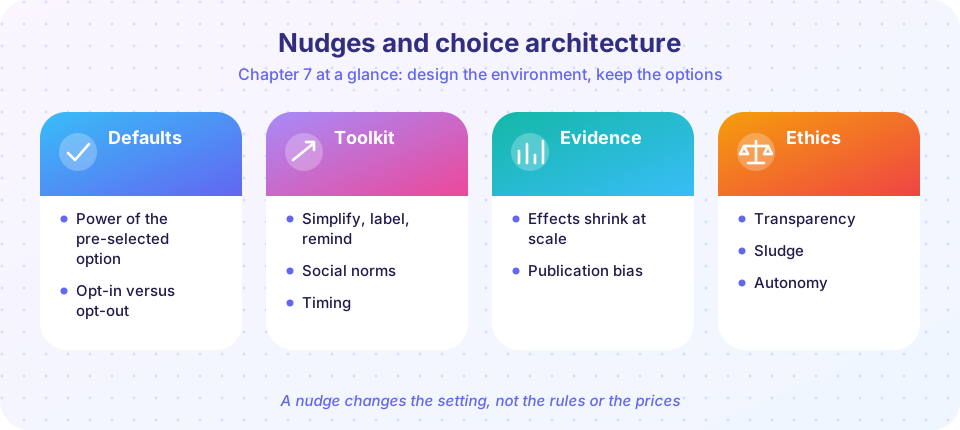
A map of chapter 7: what a nudge is, how defaults and choice architecture shape behavior, what the evidence says about effect sizes, and where the ethical lines lie.
Every choice is made in some setting: a form with boxes already ticked or not, a menu with items in a certain order, a letter with a certain wording. There is no neutral way to present options, so someone is always the choice architect. Richard Thaler and Cass Sunstein argued in their 2008 book Nudge that, since a design must exist anyway, we might design it to help people reach their own goals. This chapter introduces that idea, shows the strongest tool (the default), surveys other tools, and then asks harder questions about how large the effects really are and what limits a nudger should respect.
What you will learn
- The Thaler and Sunstein definition of a nudge and the idea of libertarian paternalism.
- How the chapter's lessons fit together.
- Why a nudge is different from a mandate, a ban or a financial incentive.
- A simple model in which easier choices lead to higher take-up.
Key terms
Nudge: any aspect of the choice architecture that alters people's behavior in a predictable way without forbidding options or significantly changing their economic incentives.
Choice architecture: the way options are organized and presented.
Libertarian paternalism: steering people toward choices that make them better off, as judged by themselves, while preserving freedom to choose otherwise.
Default: the option that takes effect if the person does nothing.
Sludge: excessive friction that makes it harder to do something beneficial.
The big picture
What is a nudge?
The toolkit
The reality check
Test before you trust
Why nudges became popular
Traditional policy has two main levers: rules (mandates, bans) and incentives (taxes, subsidies, payments). Both work but have costs. Rules limit freedom and can be unpopular; incentives can be expensive. Nudges promise a third lever that is cheap, preserves choice and exploits what behavioral research has learned about attention, effort and habit. Governments took note: the UK Cabinet Office created the Behavioural Insights Team in 2010, and many countries and agencies set up similar units.
A nudge is not a ban (the cafeteria still sells cake), not a big tax (a tiny fee on plastic bags is borderline, while a ban is not a nudge) and not information alone, although clearer information can be part of a design. The test from Thaler and Sunstein is that the intervention should be "easy and cheap to avoid".
Where the chapter goes
| Lesson | What you will learn |
|---|---|
| Defaults and inertia | Why defaults are powerful, retirement saving and organ donation evidence, and the limits of defaults |
| The choice architecture toolkit | The EAST framework, social norms, reminders, simplification and choice overload |
| Evidence, ethics and sludge | Effect sizes at scale, publication bias, manipulation concerns and boosts |
| Chapter 7 review | One-picture summary and a ten-question quiz |
Common misconceptions
"A nudge is any attempt to change behavior." A nudge works through the design of the choice, not through a ban or a large incentive.
"Nudges always work." Effect sizes vary and are often small, as the third lesson shows.
"Nudges are manipulative by nature." Some designs exploit weaknesses and are manipulative; others make information clearer and decisions easier. Transparency and easy opt-out help distinguish them.
Try it
First, a sorting exercise. Decide for each intervention whether it is a nudge under the Thaler and Sunstein definition. The answers rely on the definition in this lesson, and some real cases are borderline.
Second, a simple model of why easier choices raise take-up. Each person gets a benefit from acting (spread around 100 with some variation) and has to pay an effort cost; she acts only if the benefit exceeds the cost. The distribution is an assumption chosen to illustrate the point.
Press Run (or Ctrl + Enter) to see the result here.
Program input · what you'd type while the program runs
Type the answers before you press Run, one per line. Each time the program reads a line (with input()), it gets the next line from this box.
Check your understanding
Quick check · 4 questions
of 4 answered You scored / 4 · perfect!
-
1. Which of these is a nudge?
A default keeps all options available and does not change prices; the others are mandates or incentives. -
2. What does libertarian paternalism mean?
The approach combines guidance with freedom of choice. -
3. Why can there be no neutral choice architecture?
Any presentation of options influences behavior, so someone is always designing the choice. -
4. What is sludge?
Sludge is the opposite of a helpful nudge: it makes good actions harder to complete.
Summary
- A nudge changes behavior by changing the choice architecture while preserving options and costs.
- Defaults, simplification, social norms and timing are the main tools; they are covered in the next lessons.
- Effect sizes at scale are often smaller than in early studies, and designers have ethical responsibilities.
- Lower friction raises take-up even when preferences are unchanged.
Next: Defaults and inertia
Track your progress
Create a free account to tick off lessons and pick up where you left off on any device.
of Behavioral Economics lessons completed