


















Lesson 28 of 47 · Social Preferences and Fairness
Chapter 6 Overview: Social Preferences and Fairness
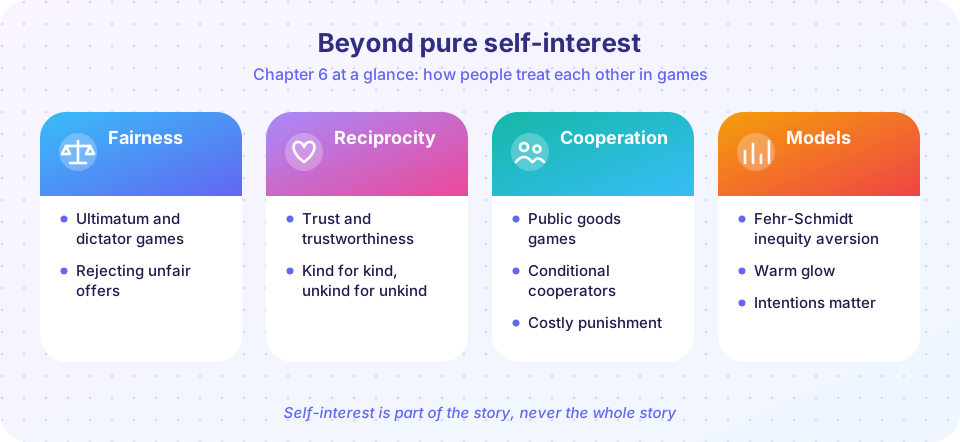
A map of chapter 6: how experiments on fairness, trust and cooperation show that people care about others, and how economists model that concern.
The textbook economic agent cares only about her own material payoff. Give her a pie to split with a stranger and she keeps as much as she can. Give her a team project and she lets the others do the work. Real people do not always behave this way: they share, they punish unfairness even at a cost, they trust strangers, and they sometimes cooperate when it does not pay. This chapter uses short, carefully designed experimental games to study those behaviors and the models built to explain them.
What you will learn
- Why economists use simple games to study fairness, trust and cooperation.
- What "other-regarding preferences" means and what it does not mean.
- How the three lessons of the chapter fit together.
- What a money-only prediction looks like, as a baseline for comparison.
Key terms
Social (other-regarding) preference: a concern for the payoffs or intentions of other people, beyond one's own payoff.
Experimental game: a simple, structured interaction with real, small stakes, used to observe choices under controlled conditions.
Subgame-perfect prediction: the outcome predicted when every player maximizes her own money and expects others to do the same.
Reciprocity: responding kindly to kind actions and unkindly to unkind ones.
The big picture
The money-only baseline
What experiments show
How we model it
Different models, different predictions
Why games?
Field data on fairness are messy: a firm that pays its staff more than it must might be generous, or might be buying effort, or might be avoiding turnover. A game strips the situation down so that one motive can be tested at a time. The most famous design, the ultimatum game, was introduced by Werner Güth, Rolf Schmittberger and Bernd Schwarze in 1982. One player proposes how to divide a sum, the other accepts or rejects. If she rejects, both get nothing. Because rejecting a positive offer costs the responder money, any rejection reveals that she values something besides her own payoff.
Games are small and artificial on purpose. That is a strength (clean tests) and a weakness (do the results travel to real markets?). The lessons here keep both sides in view.
Where the chapter goes
| Lesson | What you will learn |
|---|---|
| Ultimatum and dictator games | The money-only prediction, what people actually do, cross-cultural evidence, and why dictator-game giving is fragile |
| Trust and public goods | The trust game, public goods games, conditional cooperators, punishment and the debate over confusion |
| Inequity aversion and other models | The Fehr-Schmidt model, reciprocity, warm glow and how to compare them |
| Chapter 6 review | One-picture summary and a ten-question quiz |
Common misconceptions
"Social preferences mean people are altruists." Many people are conditional: generous when others are, selfish when they can hide it, and punitive toward those they see as unfair. The evidence shows a mix of types.
"Experiments prove humans are fundamentally fair." Results depend on framing, anonymity, stakes and culture. Small changes to the game can make giving collapse.
"Self-interest is refuted." Self-interest remains an important motive. The finding is that it is not the only one.
Try it
First, compute the minimum offer that a responder with a simple inequity-averse preference will accept in a 10-coin ultimatum game. The responder's utility from accepting s is s − α × (10 − 2s) when s < 5, where α measures dislike of being behind; she accepts when it is at least 0. This is a calculator for a model, not data.
Press Run (or Ctrl + Enter) to see the result here.
Program input · what you'd type while the program runs
Type the answers before you press Run, one per line. Each time the program reads a line (with input()), it gets the next line from this box.
Second, play the responder yourself. You see a series of offers out of 10 coins; accept or reject each one and the page shows the lowest offer you accepted. It is a demonstration of the format and says nothing about your character.
Check your understanding
Quick check · 4 questions
of 4 answered You scored / 4 · perfect!
-
1. What does a rejection of a positive offer in the ultimatum game show?
Rejecting means giving up money, so the responder must care about fairness, spite or something else beyond payoff. -
2. Why do economists use simple games instead of field data?
Control lets researchers vary one feature, such as who benefits, and observe the change in choices. -
3. Which is a correct statement about social preferences?
Evidence points to a mix of types and strong context effects. -
4. A responder with α = 1 accepts any offer of at least about what, out of 10?
The threshold is 10α/(1+2α) = 10/3 ≈ 3.33.
Summary
- The standard model assumes self-interest; games provide clean tests of that assumption.
- Rejecting a positive offer, or giving away money, shows concern for something besides own payoff.
- The chapter covers fairness games, trust and public goods, and models of inequity aversion and reciprocity.
- Results depend on context, so no single story fits every game.
Track your progress
Create a free account to tick off lessons and pick up where you left off on any device.
of Behavioral Economics lessons completed