


















Lesson 30 of 47 · Social Preferences and Fairness
Trust, Reciprocity and Public Goods
Learn the trust game and public goods game, why contributions start high and decay, how conditional cooperators and costly punishment work, and the confusion debate.
Splitting a pie between two people is one thing. Cooperating in a group is harder, because everyone gains from what the group produces but each person is tempted to let the others pay. Whether it is a shared office kitchen, a village irrigation canal or global emissions, the logic is the same: the group does best if all contribute, yet each person does best by contributing less. Two experimental games, the trust game and the public goods game, capture this tension and show what people do when self-interest and the common good pull apart.
What you will learn
- How the trust game separates trust from trustworthiness.
- How to compute payoffs in a public goods game and why free riding is the money-only prediction.
- What the evidence says about conditional cooperators, decay of contributions and costly punishment.
- Why some researchers think part of the cooperation is confusion, not kindness.
Key terms
Trust game: a sender chooses how much of an endowment to send; the amount is multiplied (typically tripled); a receiver chooses how much to return.
Public goods game: each group member chooses how much of an endowment to put in a common pot; the pot is multiplied and shared equally.
Marginal per capita return (MPCR): the share of each contributed unit that returns to the contributor, m / n.
Conditional cooperator: someone who contributes more when others contribute more.
Free rider: someone who benefits from the group's contributions without contributing.
The trust game
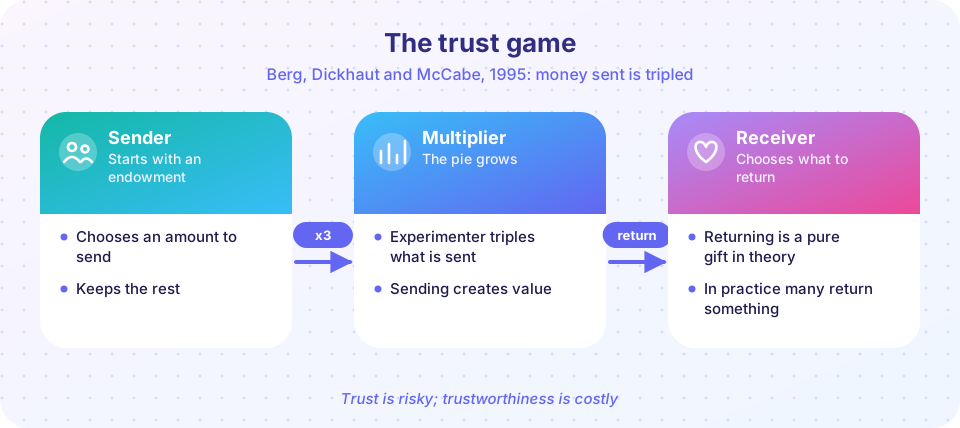
Joyce Berg, John Dickhaut and Kevin McCabe introduced the trust game in 1995. Both players start with an endowment (10 dollars in their original design). The sender decides how much to send. Whatever she sends is tripled before it reaches the receiver. The receiver then chooses how much, if anything, to return.
The money-only prediction, again by backward induction: a receiver has no reason to return anything, since the game ends and the sender cannot punish her. The sender, anticipating this, sends nothing. Yet both lose out, because sending creates value (the tripled money).
What happens? On average, senders send about half of their endowment, and receivers, on average, return roughly what was sent (about break-even for the sender, though with big differences across individuals). Later meta-analyses covering many replications and thousands of participants found similar patterns across countries, with variation in how much is sent and returned.
Two distinct motives are tangled together:
- Trust is the sender's willingness to take a risk, and may involve a belief that the receiver will reciprocate, or simply a dislike of unequal outcomes or a taste for giving.
- Trustworthiness is the receiver's decision to return money when she could keep it. It is the reciprocity part of the game.
To tell trust from altruism, researchers compare the trust game with a version in which a computer or a random draw sets the return. If senders send as much when the "receiver" is a lottery with the same odds, then the amount sent measures risk tolerance, not trust in a person. Many studies find that betrayal risk, the risk of being let down by a person, is something people dislike over and above ordinary risk.
The public goods game
Suppose four people each have 20 tokens. Each chooses a contribution c_i. The total in the pot is multiplied by m = 1.6 and divided equally among all four. Your payoff is
payoff_i = 20 − c_i + (1.6 / 4) × (c_1 + c_2 + c_3 + c_4)
The MPCR is 1.6 / 4 = 0.4. Each token you contribute costs you 1 and returns you only 0.4. So you should contribute nothing, whatever the others do. But if everybody contributes 20, each receives 1.6 × 80 / 4 = 32, which is more than the 20 of everyone free riding. If three people contribute 20 and one free rides, the pot is 60 × 1.6 = 96, each person gets 24 from the pot, so contributors earn 24 and the free rider earns 20 + 24 = 44. The temptation is large: free riding pays 20 more.
Two conditions define a public goods dilemma: m / n < 1 (so contributing is individually costly) and m > 1 (so contributing is collectively efficient).
What people do
A survey by John Ledyard (1995) summarized many experiments. In the first round, people typically contribute somewhere between 40 and 60 percent of their endowment, far above zero. When the same group repeats the game, average contributions decay across rounds, though usually not all the way to zero. If the game restarts, contributions bounce back up.
Two explanations compete.
- Conditional cooperation. Urs Fischbacher, Simon Gächter and Ernst Fehr (2001) asked people how much they would contribute for each possible average contribution of the others. Roughly half of the participants matched their contributions to the others' average (conditional cooperators), and about a third contributed nothing in any case (free riders). Because most conditional cooperators match slightly less than the average, contributions drift down each round: they react to the free riders, and the free riders never react to anyone.
- Learning and confusion. In early rounds some people do not understand the payoff structure. James Andreoni (1995) compared the standard game with a version built to remove any reason for kindness and concluded that a good share of cooperation reflected confusion, and Maxwell Burton-Chellew and Stuart West (2013) found that people contributed in similar ways when playing with computers, not people. Defenders of social preferences respond that behavior changes sensibly when the context changes, and that confusion cannot account for the response to punishment.
Punishment
Ernst Fehr and Simon Gächter (2000) allowed participants, after seeing others' contributions, to pay a cost to reduce another player's earnings. The money-only prediction is that nobody will pay to punish, because it is costly and the benefit is shared. In fact people did punish low contributors, and when punishment was available contributions were sustained at high levels instead of decaying. A second finding from this work: even in one-shot interactions with strangers, people punished.
Benedikt Herrmann, Christian Thöni and Gächter (2008) ran the game in 16 cities around the world and found that punishment is not always constructive. In some societies, a lot of punishment was antisocial, aimed at people who contributed more than average, and in those places punishment did not raise cooperation. Culture and norms of civic cooperation shape what punishment does.
Common misconceptions
"Public goods experiments prove people are cooperative." They show that many people start by cooperating but that cooperation erodes when others free ride; a substantial part of the population is conditional.
"The decline in contributions is due to people learning to be selfish." Part may be disappointment with others, part learning the payoff structure. Telling these apart is the point of careful experiments.
"Punishment always helps." It can sustain cooperation but is costly, and antisocial punishment can destroy it.
Try it
First, simulate a repeated public goods game with an assumed mix of types: 30 percent free riders, 50 percent conditional cooperators who match the others' last-round average minus one token, and 20 percent who choose at random. The mix is an assumption chosen to illustrate the decay pattern, not data.
Press Run (or Ctrl + Enter) to see the result here.
Program input · what you'd type while the program runs
Type the answers before you press Run, one per line. Each time the program reads a line (with input()), it gets the next line from this box.
Second, an explorer for the payoff arithmetic. Choose your own contribution and what the other three give on average, and see your payoff, the group's total and what free riding would have earned.
Check your understanding
Quick check · 5 questions
of 5 answered You scored / 5 · perfect!
-
1. In the trust game, why is sending money a risk?
The receiver has no enforceable obligation to return anything, so sending exposes the sender to betrayal. -
2. In the public goods game with 4 players and m = 1.6, what is the MPCR?
m / n = 1.6 / 4 = 0.4: each token contributed returns 0.4 to the contributor. -
3. Why does free riding pay, yet universal contribution is efficient?
Contributing costs the contributor more than it returns (m/n below 1), but the group gains more than the cost (m above 1). -
4. What explains the decay of contributions in repeated public goods games, according to the conditional cooperation view?
Each round they react to a lower average caused partly by free riders, so the average falls. -
5. What did Herrmann, Thöni and Gächter (2008) find about punishment?
Antisocial punishment of high contributors was common in some societies, weakening the benefit of punishment.
Summary
- The trust game separates trust (risk taken by the sender) from trustworthiness (return by the receiver); money-only theory predicts neither.
- The public goods game is a dilemma when
m / n < 1 < m; people start well above zero but contributions erode. - Conditional cooperators explain much of the decay; confusion and learning explain part of it, and the balance is debated.
- Costly punishment can sustain cooperation, but its effects depend on culture and can include antisocial punishment.
Track your progress
Create a free account to tick off lessons and pick up where you left off on any device.
of Behavioral Economics lessons completed