


















Lesson 17 of 47 · Prospect Theory and Framing
Chapter 4 overview: Prospect theory and framing
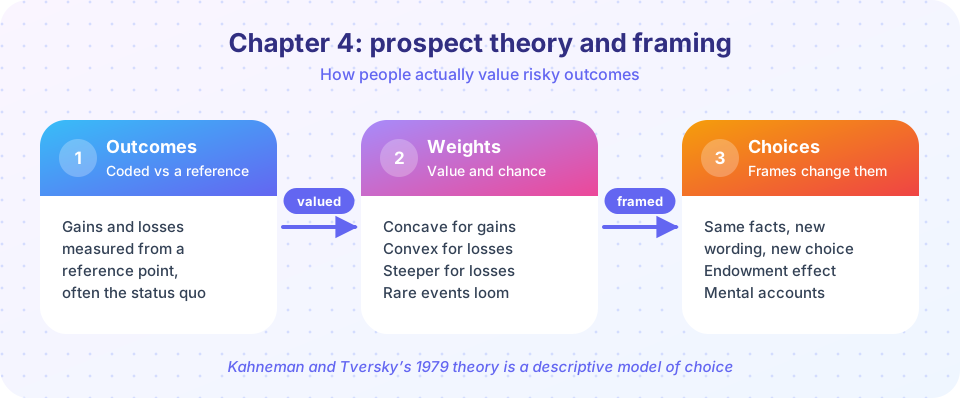
Overview of chapter 4: Kahneman and Tversky's prospect theory, loss aversion, probability weighting, framing effects, the endowment effect and mental accounting.
Chapter 2 showed that expected utility theory struggles with real choices. Chapter 3 showed that judgments rely on shortcuts. Chapter 4 brings those threads into a single, formal theory of how people choose between risky options: prospect theory, published by Daniel Kahneman and Amos Tversky in 1979.
The theory changes three things in the standard model. People evaluate outcomes as gains and losses from a reference point, not as final wealth. Losses hurt more than equal gains please (loss aversion). And probabilities are not used as stated: rare events get too much weight and common ones too little (probability weighting). From these pieces come many everyday effects: framing, the endowment effect and mental accounting.
What you will learn
- What prospect theory adds to expected utility.
- What each lesson in the chapter covers.
- How the chapter's ideas appear in markets, health and policy.
The three ingredients
The value function
Consequences
What is in this chapter
- The value function and loss aversion develops the S-shaped value function and the number 2.25.
- Probability weighting explains the inverse-S curve and the certainty effect.
- Framing effects covers the Asian disease problem and why identical outcomes can be chosen differently.
- Endowment effect and mental accounting covers the mug experiment and Thaler's accounting ideas.
- Chapter 4 review with a mixed quiz.
Key terms
Prospect: a gamble described by its possible outcomes and their probabilities.
Reference point: the level against which outcomes are judged as gains or losses.
Loss aversion: the tendency for a loss to count for more than an equal gain.
Probability weighting: transforming stated probabilities into decision weights.
Framing: the way a choice is described, which can change what people choose.
Descriptive, not normative
Prospect theory does not say how people should choose. It is a descriptive model that tries to match observed choices. Whether people should be loss averse is an open normative question. The theory has been influential because it organizes many puzzles at once and makes testable predictions, such as people being risk averse for gains but risk seeking for losses over moderate probabilities.
A word of caution is in order. The original 1979 version was later refined (Tversky and Kahneman, 1992, as cumulative prospect theory) to fix technical problems, and the size of loss aversion varies across studies and contexts. You will see both the elegance of the theory and the reasons for care about its parameters.
Try it
Check your understanding
Quick check · 4 questions
of 4 answered You scored / 4 · perfect!
-
1. Prospect theory is mainly a
It aims to match observed choices. -
2. Which is NOT one of prospect theory's main ingredients?
Prospect theory involves reference points, loss aversion, diminishing sensitivity and probability weighting. -
3. In what year was prospect theory published?
The original paper appeared in Econometrica in 1979; the cumulative version followed in 1992. -
4. A worker whose pay falls from $3,000 to $2,800 may feel
Outcomes are coded relative to the reference point, not as final wealth.
Summary
- Prospect theory modifies expected utility with reference points, loss aversion and probability weighting.
- The chapter covers the value function, probability weighting, framing, the endowment effect and mental accounting.
- The theory is descriptive and was refined into cumulative prospect theory in 1992.
- Parameters vary across studies, so treat numbers like 2.25 as typical, not universal.
Track your progress
Create a free account to tick off lessons and pick up where you left off on any device.
of Behavioral Economics lessons completed