


















Lesson 19 of 47 · Prospect Theory and Framing
Probability weighting
Learn how prospect theory transforms probabilities into decision weights, the certainty and possibility effects, the fourfold pattern of risk attitudes and its limits.
Buying a lottery ticket and buying insurance look like opposites: one takes a small chance of a big win, the other pays a sure amount to avoid a small chance of a big loss. Expected utility with a single curved utility function struggles to explain why many people do both. Prospect theory's second innovation, probability weighting, offers an explanation.
The idea is simple: people do not treat a probability of 5% as exactly 5% in their decisions. Very small chances are given too much weight, and moderate and large chances too little. In this lesson you will learn the shape of the weighting function, the pattern of risk attitudes it produces and the evidence that complicates the picture.
What you will learn
- What decision weights are and the shape of the weighting function.
- The certainty effect and the possibility effect.
- The fourfold pattern of risk attitudes, with a worked calculation.
- Why experience can reverse the pattern.
Key terms
Decision weight: the weight an outcome receives in a choice, written w(p), which differs from the stated probability p.
Certainty effect: a reduction from certainty to "almost certain" is felt more strongly than the same-sized drop elsewhere.
Possibility effect: moving from impossible to a small chance is felt more strongly than the same-sized rise elsewhere.
Fourfold pattern: risk seeking or averse depending on gains versus losses and high versus low probability.
Description-experience gap: different choices when probabilities are described than when they are learned from experience.
The weighting function
Tversky and Kahneman (1992) proposed this function:
w(p) = p^g / (p^g + (1 - p)^g)^(1/g)
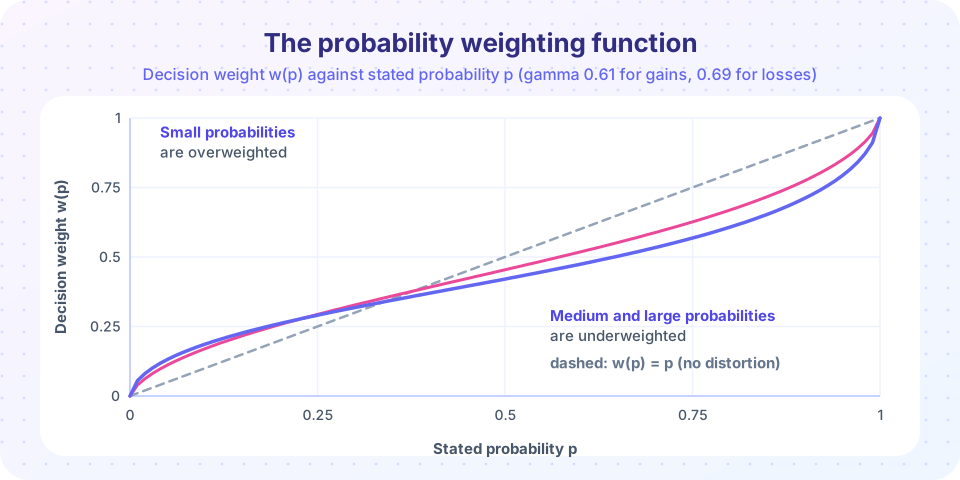
with g (gamma) around 0.61 for gains and 0.69 for losses in their estimates. It has an inverse-S shape: it lies above the diagonal for small probabilities and below it for medium and large ones, and it is steep near 0 and 1. Some values for gains (g = 0.61):
| Stated probability p | Decision weight w(p) |
|---|---|
| 1% | about 5.5% |
| 5% | about 13% |
| 50% | about 42% |
| 95% | about 79% |
| 99% | about 91% |
Two effects follow. The possibility effect: a 1% chance feels much more than 1%, which explains interest in lotteries and in buying warranties for rare events. The certainty effect: a 99% chance feels much less than certain, so people pay a premium for guaranteed outcomes. The Allais paradox (Chapter 2) is a certainty effect: A is a sure thing, B only 99% certain in the relevant sense.
A note on cumulative prospect theory. The 1992 version applies weights to cumulative probabilities (ranked from the best or worst outcome), which avoids certain technical problems such as violating dominance. For simple two-outcome gambles the intuition above is enough.
The fourfold pattern
Combine the value function and the weights, and a pattern of risk attitudes emerges, depending on whether outcomes are gains or losses, and whether the probability is high or low.
| Gains | Losses | |
|---|---|---|
| High probability | Risk averse (take the sure thing) | Risk seeking (gamble to avoid a sure loss) |
| Low probability | Risk seeking (lottery tickets) | Risk averse (insurance) |
Worked example
Compare a 5% chance of winning $10,000 with a sure $500 (equal expected values), using alpha = 0.88 and g = 0.61.
w(0.05)is about 0.132 andv(10000) = 10000^0.88, about 3,311, so the gamble is worth about0.132 x 3311 = 436.- The sure $500 is worth
500^0.88, about 237.
The gamble wins: risk seeking for low-probability gains.
Now a 95% chance of winning $10,000 versus a sure $9,500.
w(0.95)is about 0.79, so the gamble is worth0.79 x 3311 = 2,627.- The sure $9,500 is worth
9500^0.88, about 3,166.
The sure thing wins: risk averse for high-probability gains. Flip the signs and, with loss aversion applied, the pattern reverses for losses. A person with these preferences buys both lottery tickets and insurance.
Does experience change the picture?
Ralph Hertwig, Greg Barron, Elke Weber and Ido Erev (2004) pointed out the description-experience gap. When people are told the probabilities ("a 5% chance of $10,000"), they overweight rare events as above. When they learn probabilities by sampling outcomes, rare events are often underweighted: people have not seen the rare event happen in their sample, so it plays little role. In real life many risks (accidents, floods, side effects) are learned by experience, which can lead to underinsurance. The inverse-S is a description of choices from described probabilities, not a universal law.
Also, individual weighting functions vary. Some people show nearly linear weights; others show strong distortion. Cultural and domain differences exist, and estimates of gamma differ across studies.
Common misconceptions
- "Probability weighting means people cannot understand probabilities." Many people can state probabilities correctly. The point is that decisions treat them nonlinearly.
- "People always overweight rare events." Only when probabilities are described. From experience, rare events are often underweighted.
- "The weighting function is a fixed curve." It is a flexible family; parameters vary by person and domain.
Try it
First, compute the weights, the fourfold table and a plot of how much more (or less) than expected value a person would pay for a gamble.
Press Run (or Ctrl + Enter) to see the result here.
Program input · what you'd type while the program runs
Type the answers before you press Run, one per line. Each time the program reads a line (with input()), it gets the next line from this box.
Second, an interactive weighting function. Move the sliders to see how gamma and the probability change the decision weight. This is a demonstration of the formula above.
Check your understanding
Quick check · 5 questions
of 5 answered You scored / 5 · perfect!
-
1. The possibility effect means that
Moving from impossible to a small chance has an outsized impact on choices. -
2. In the fourfold pattern, people tend to be risk seeking for
Overweighting small chances of winning supports lottery-ticket purchases. -
3. Which pattern is consistent with buying insurance?
A small chance of a big loss is overweighted, so people pay to avoid it. -
4. What does the description-experience gap say?
Rare events may not appear in a small sample, so experience-based choices can neglect them. -
5. In the weighting function with gamma 0.61, a 95% chance is weighted about
Medium and large probabilities are underweighted, so w(0.95) is about 0.79.
Summary
- Decision weights w(p) transform stated probabilities: small ones are overweighted, medium and large ones underweighted.
- The certainty and possibility effects explain the Allais paradox and the appeal of both lotteries and insurance.
- The fourfold pattern: risk averse for high-probability gains and low-probability losses; risk seeking for low-probability gains and high-probability losses.
- The pattern describes choices from described probabilities; from experience, rare events can be underweighted.
Next: Framing effects
Track your progress
Create a free account to tick off lessons and pick up where you left off on any device.
of Behavioral Economics lessons completed