


















Lesson 11 of 47 · Heuristics and Biases
Chapter 3 overview: Heuristics and biases
Overview of chapter 3: how mental shortcuts like availability, representativeness and anchoring work, why they usually help, and when they cause predictable errors.
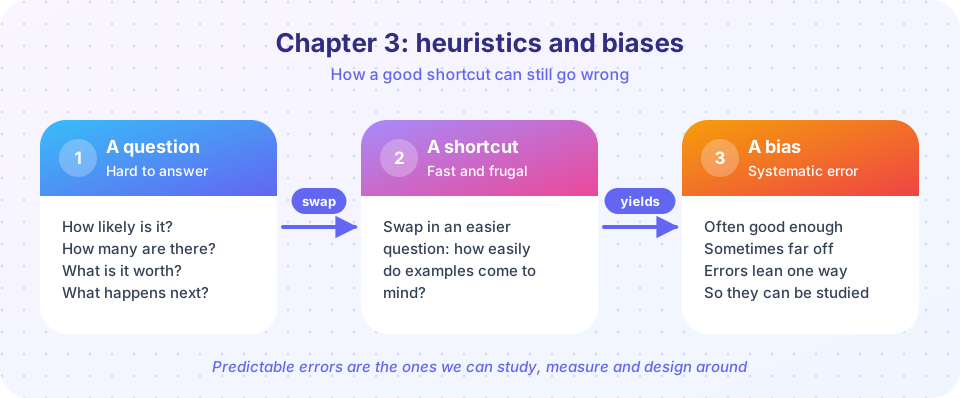
You make thousands of judgments a day: how long a task will take, whether a stranger is trustworthy, how likely it is to rain, what a used car is worth. You almost never compute these from scratch. You use rules of thumb. Most of the time they work well. Sometimes they fail, and when they do, they tend to fail in the same direction for many people.
Chapter 3 is about those shortcuts, called heuristics, and the systematic errors, called biases, that they can produce. It is the part of behavioral economics that grew directly out of the work of Daniel Kahneman and Amos Tversky.
What you will learn
- What a heuristic is and what makes a bias "systematic".
- What each lesson in the chapter covers.
- Why predictable errors are useful to study and design around.
The idea
Three classic shortcuts
Confidence
Handle with care
What is in this chapter
- System 1 and System 2 describes two modes of thinking and why intuition is fast and deliberate thought is slow.
- Availability and representativeness covers judging probability by ease of recall and by resemblance, including the Linda problem and base rates.
- Anchoring and adjustment shows how an irrelevant starting number pulls estimates toward it.
- Overconfidence and confirmation bias explains why we are sure more often than right and how we seek evidence that agrees with us.
- Chapter 3 review with a mixed quiz.
Key terms
Heuristic: a simple, quick rule for judgment or choice.
Bias: an error that leans in a predictable direction relative to a benchmark.
Attribute substitution: answering an easier question without noticing you have replaced the hard one.
Normative benchmark: the standard (such as probability theory) against which a judgment is compared.
Heuristics are not just flaws
Kahneman and Tversky's program showed that heuristics produce errors. Another research tradition, led by Gerd Gigerenzer, stresses that simple rules often work well in the environments where they are used. Both are right in their own territory. A rule can be efficient in the world where it evolved or was learned and still be misleading in a new situation such as a lottery, a political poll or a financial market. Throughout this chapter, keep two questions in mind: how well does the shortcut work on average? and when does it break?
Try it
The classic opener: a quick problem that tempts an intuitive answer.
Press Run (or Ctrl + Enter) to see the console output here.
No output.
Check your understanding
Quick check · 4 questions
of 4 answered You scored / 4 · perfect!
-
1. A heuristic is best described as
Heuristics trade accuracy for speed and effort. -
2. What makes a bias 'systematic'?
Predictable direction is what lets researchers study and design around the error. -
3. Attribute substitution means
People answer an easier question (such as how easily examples come to mind) in place of the one asked (how frequent is it?). -
4. In the bat and ball problem, what is the correct price of the ball?
If the ball is 5 cents, the bat is $1.05 and the total is $1.10.
Summary
- Heuristics are quick rules that substitute easier questions for harder ones.
- Their errors are systematic: predictable in direction.
- This chapter covers availability, representativeness, anchoring, overconfidence and confirmation bias.
- Heuristics are often efficient; the point is to know when they mislead.
Next: System 1 and System 2
Track your progress
Create a free account to tick off lessons and pick up where you left off on any device.
of Behavioral Economics lessons completed