


















Lesson 14 of 47 · Heuristics and Biases
Anchoring and adjustment
Learn the anchoring effect: how an irrelevant starting number pulls estimates, the classic experiments, why it happens, how robust it is, and how to reduce it.
Imagine you are shopping for a used car and the seller opens with a high price. Even if you know the number is inflated, your counteroffer is likely to be higher than if the seller had opened low. The first number acts like an anchor: it becomes the starting point for your thinking, and you adjust from it, usually not far enough.
Anchoring is one of the most robust findings in the study of judgment. It matters for negotiations, pricing, forecasting, courtroom sentencing and everyday estimation. In this lesson you will see the classic experiments, understand two explanations, and learn how to protect your own judgments.
What you will learn
- What anchoring is and the classic experiments that demonstrate it.
- Two explanations: insufficient adjustment and selective accessibility.
- How strong and general the effect is, and what the replication record shows.
- Practical ways to reduce anchoring.
Key terms
Anchor: an initial number that influences a later numerical judgment.
Adjustment: moving from the anchor toward what you believe is the right answer.
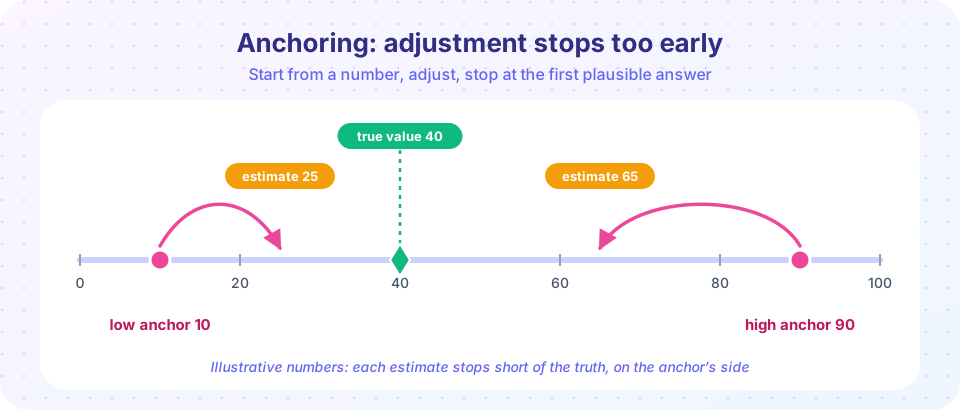
Insufficient adjustment: stopping too soon, so the estimate stays near the anchor.
Selective accessibility: the anchor makes anchor-consistent information come to mind more easily.
Coherent arbitrariness: the idea that valuations are anchored by arbitrary numbers but then behave consistently around them.
The classic experiments
The wheel of fortune. In their 1974 paper, Amos Tversky and Daniel Kahneman spun a rigged wheel that stopped at 10 or 65 and asked participants to say whether the percentage of African countries in the United Nations was higher or lower than that number, and then to estimate the percentage. Participants who saw 10 gave a median estimate of about 25%; those who saw 65 gave a median of about 45%. The wheel was obviously irrelevant, yet it shifted the answers.
Real estate. Gregory Northcraft and Margaret Neale (1987) gave real estate agents the same house to appraise, with different listing prices in the packet. The agents' appraisals moved toward the listing price, though they denied using it.
Sentencing. Birte Englich, Thomas Mussweiler and Fritz Strack (2006) had experienced judges roll a pair of loaded dice before sentencing in a case vignette. Judges who rolled a high number gave longer sentences than those who rolled a low number, even though they knew the dice were random.
Arbitrary valuations. Dan Ariely, George Loewenstein and Drazen Prelec (2003) asked students to write the last two digits of their Social Security number and then bid on products such as wine and chocolate. Those with higher digits bid more. Follow-up work by Fudenberg, Levine and Maniadis (2012) found that arbitrary anchors do move valuations, but that the pattern of results is less extreme than first claimed. The broad idea of anchoring is solid; the size depends on the task.
Why does it happen?
Two explanations are discussed, and both likely contribute.
- Insufficient adjustment. (Tversky and Kahneman) You start at the anchor and move toward the answer, stopping when you reach a value that seems plausible. Because adjustment is effortful and ends at the edge of the plausible range nearest the anchor, the estimate stays biased toward it. Nicholas Epley and Thomas Gilovich showed that people adjust more when they generate the anchor themselves and when they are motivated and unhurried.
- Selective accessibility. (Mussweiler and Strack) Considering whether the target is higher or lower than the anchor makes anchor-consistent features of the target easier to recall. If the anchor is high, you recall reasons the car is worth a lot.
Experiments that add time pressure, cognitive load or distraction generally increase anchoring, consistent with a role for effortful correction.
How robust is it?
Anchoring is among the best-replicated effects. The Many Labs project (Klein and colleagues, 2014), which ran several classic studies across many sites, found large anchoring effects for Tversky-and-Kahneman-style questions (for example the height of Mount Everest or the population of Chicago given a high or low anchor). Experts are affected too, though sometimes less than novices. The size varies with how relevant the anchor seems and how much the person knows.
Using and resisting anchors
- In negotiation, the first credible offer often anchors the final result. If you know the market well, making the first offer can help you. If you do not, prepare a target price and a walk-away price in advance.
- In pricing, a "list price" or "was" price anchors the sense of a deal. Regulators watch for misleading reference prices.
- To reduce anchoring, consider the opposite: deliberately generate reasons why the true value could be far from the anchor. Estimate from several starting points and average. Use outside data (comparable sales, base rates) before you see the proposal.
Common misconceptions
- "Only naive people are anchored." Experts, judges and agents were anchored in the studies above, though knowledge can reduce the effect.
- "If I know the anchor is random, I am immune." Judges knew the dice were random, and were still influenced.
- "Anchors must be numbers near the right answer." Even obviously irrelevant numbers can shift estimates, although more plausible anchors usually have stronger effects.
Try it
First, a simple model of insufficient adjustment. The estimate is anchor + lambda x (truth - anchor), where lambda is the fraction of the gap that people adjust. This is a toy model that illustrates the logic, not a fitted theory.
Press Run (or Ctrl + Enter) to see the result here.
Program input · what you'd type while the program runs
Type the answers before you press Run, one per line. Each time the program reads a line (with input()), it gets the next line from this box.
Second, an interactive version. Move the sliders for the anchor and for how far people adjust, and watch the estimate stop short of the true value of 40. This is a demonstration of the toy model.
Check your understanding
Quick check · 5 questions
of 5 answered You scored / 5 · perfect!
-
1. In Tversky and Kahneman's wheel of fortune experiment, participants who saw the number 65 estimated
Even an obviously random number shifted estimates toward itself (medians of about 45% versus 25%). -
2. Which pair of terms names the two main explanations of anchoring?
Either you stop adjusting too early, or the anchor primes anchor-consistent information. -
3. Experienced judges who rolled loaded dice before sentencing
Englich, Mussweiler and Strack (2006) found that even random anchors influenced professional judges. -
4. Which technique can reduce anchoring?
Generating reasons why the value could be far from the anchor and using outside data reduces its pull. -
5. In the toy model, what happens when lambda (the share of the gap adjusted) increases?
More adjustment means a smaller remaining gap from the truth.
Summary
- Anchoring: an initial number pulls later estimates toward it, even when it is obviously irrelevant.
- Explanations: insufficient adjustment and selective accessibility.
- It is robust across tasks, experts and novices, with size depending on context.
- To reduce it: prepare your own numbers first, consider the opposite and average multiple starting points.
Track your progress
Create a free account to tick off lessons and pick up where you left off on any device.
of Behavioral Economics lessons completed