


















Lesson 25 of 47 · Time and Risk Preferences
Present Bias and Commitment Devices
Understand present bias with the beta-delta model, preference reversals, naive versus sophisticated planners, and why commitment devices help people keep promises.
On Sunday night you decide that tomorrow you will start going to the gym. On Monday morning the sofa wins, and you decide that tomorrow, really, is the day. Many people recognize this loop, and it is the everyday face of present bias: a special pull of the immediate moment that makes plans made for the future fall apart when the future becomes the present. This lesson gives that experience a precise model, shows two kinds of planners, and explains why some people deliberately tie their own hands.
What you will learn
- The beta-delta model of present bias and how it differs from hyperbolic discounting.
- How to find a preference reversal by hand.
- The difference between naive and sophisticated people, and a surprising result about sophistication.
- Why commitment devices exist and what the evidence says about them.
Key terms
Present bias: overweighting the immediate period relative to all later periods.
Beta-delta model: U_0 = u_0 + β · Σ δ^t · u_t for t ≥ 1, with 0 < β ≤ 1; also called quasi-hyperbolic discounting.
Naive: someone who is present biased but believes her future selves will not be.
Sophisticated: someone who is present biased and correctly predicts that her future selves will be too.
Commitment device: a binding arrangement that restricts a future choice.
The beta-delta model
Hyperbolic discounting is awkward to use in long models because it is not a simple geometric sum. David Laibson, building on earlier work by Edmund Phelps and Robert Pollak, proposed a simpler stand-in in 1997. Keep the exponential factor δ but add one extra parameter β that applies to every future period equally:
U_0 = u_0 + β·δ·u_1 + β·δ²·u_2 + β·δ³·u_3 + ...
If β = 1, this is the standard exponential model. If β < 1, anything that is not "now" gets an extra discount of β. That single step between now and later is what produces reversals. The discount between two future dates is still only δ per period, so the model behaves exponentially except at the boundary with the present.
A worked reversal
Let δ = 1 to keep the arithmetic clean and let β = 0.7. You choose between 100 and 130 (a gap of four days).
- Both rewards in the future. The value of 100 is
0.7 × 100 = 70; the value of 130 is0.7 × 130 = 91. You plan to wait for the 130. - When the 100 becomes available now. It is worth the full 100, while 130 later is
0.7 × 130 = 91. You take the 100.
The switch happens whenever 100 > β × 130, that is, β < 100/130 ≈ 0.77. The general rule: with immediate reward S and later reward L, a present-biased person grabs the sooner one when S > β·δ^g·L, where g is the gap. A larger bonus for waiting or a smaller β makes grabbing less likely or more likely respectively.
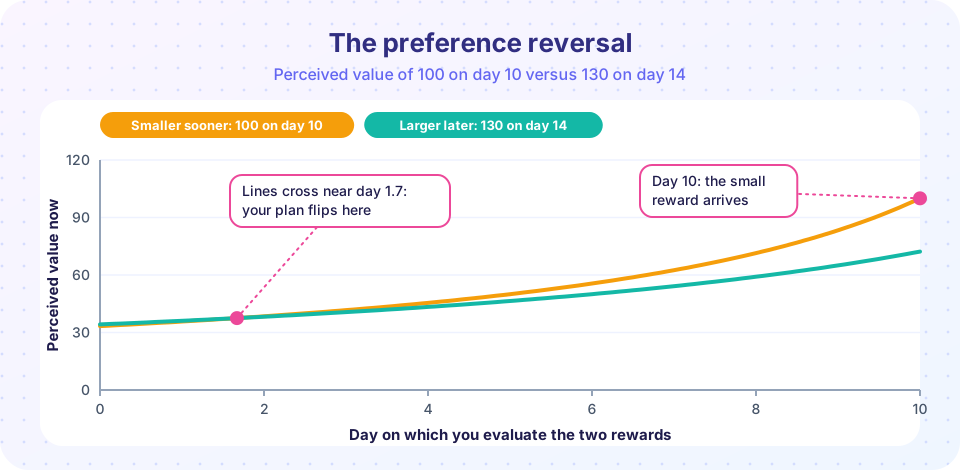
The chart at the top of this lesson shows the same reversal with the hyperbolic function V = amount / (1 + 0.2 × days until it arrives). Setting the two values equal gives a crossing at about day 1.7. Before that day you plan to wait; after it, you prefer the sooner reward. Nothing changed except the date.
Naive versus sophisticated
If your preferences will flip when the time comes, you can react in two ways. Ted O'Donoghue and Matthew Rabin analyzed both in 1999.
- A naive person does not see the flip coming. She keeps deciding "I will do it tomorrow", imagining that tomorrow's self will be as patient as she feels today.
- A sophisticated person knows tomorrow's self will also be tempted and plans around it.
The sophisticated person can do better, but not always in the way you expect. Consider a task that must be done by day 3 and whose effort cost rises the longer you wait: 6 on day 0, 7 on day 1, 8 on day 2 and 9 on day 3. The person feels immediate costs fully but waits-and-pays costs at β times their size (with δ = 1). With β = 0.8:
- Naive: on day 2, doing it costs 8, waiting costs
0.8 × 9 = 7.2, so wait. On day 1, doing it costs 7, and she believes tomorrow she will do it at 8, so waiting looks like0.8 × 8 = 6.4: wait. On day 0,6 > 0.8 × 7 = 5.6: wait. She ends up paying 9 on day 3. - Sophisticated: she knows that day 2's self will wait. So on day 1 she compares 7 with
0.8 × 9 = 7.2and does it now. She pays 7.
The same impulse leads to a better outcome for the person who anticipates it. Run the code below to see the whole table.
Commitment devices
A sophisticated person has a reason to ask for help. If she knows she will put things off, she is willing to pay to remove her own option to do so. The story of Ulysses tying himself to the mast to hear the Sirens without steering toward them is the usual metaphor. Everyday versions include:
- savings accounts that block withdrawals until a goal or date,
- paying in advance for a class or training session you would otherwise skip,
- deadlines imposed by a friend or an app, with a penalty for missing them,
- buying small packs of snacks instead of one huge bag.
Nava Ashraf, Dean Karlan and Wesley Yin tested a commitment savings product in a Philippine bank in 2006. Customers offered the "SEED" account locked their deposits until a goal date; only a share of those offered took it up (roughly a quarter to a third), and those who did saved more over the following year than comparison customers. Importantly, people with more present-biased answers in a survey task were more likely to take up the offer, which is what the model predicts. Supriya Kaur, Michael Kremer and Sendhil Mullainathan found similar behavior at work: data-entry workers in India sometimes chose pay schemes that penalized them for low output, in ways that only make sense as self-control.
How strong is the evidence?
Present bias is plausible, but the data are mixed on how general it is. Several studies using money rewards find little evidence of present bias, while choices that involve effort show more of it. Ned Augenblick, Muriel Niederle and Charles Sprenger (2015) found present bias in how people allocate effort tasks across time but much less in monetary choices. One reading is that money is fungible (you can borrow or save to smooth it), so a choice about money does not reveal your preferences about consumption, while effort cannot be shifted between days. Measure carefully before concluding that "people are present biased"; the answer depends on what you ask them to trade off.
Common misconceptions
"Present bias means lack of willpower, so it is a character flaw." It is a feature of how the pull of immediate rewards works in most people, and it can be modeled and managed. Many successful people use commitment devices.
"Sophisticated people never procrastinate." The sophisticated person predicts her own delays but may still choose to delay, because it is optimal for each self given what later selves will do. Knowing is not the same as solving.
"Commitment devices are always good." They help a person who correctly predicts her future behavior. If she is wrong about what she will want later (for example, if an emergency makes the locked money valuable), the device has a cost. That is why a good commitment is flexible: a penalty that can be paid, not an absolute lock.
Try it
First, reproduce the preference reversal chart and find the crossing day numerically. This plot uses the hyperbolic form V = amount / (1 + 0.2 × days to wait); it is an illustration, not data.
Press Run (or Ctrl + Enter) to see the result here.
Program input · what you'd type while the program runs
Type the answers before you press Run, one per line. Each time the program reads a line (with input()), it gets the next line from this box.
Second, the naive versus sophisticated example from the lesson. The code computes the day each type completes the task for different values of β; it is a model, not a prediction about any real person.
Press Run (or Ctrl + Enter) to see the result here.
Program input · what you'd type while the program runs
Type the answers before you press Run, one per line. Each time the program reads a line (with input()), it gets the next line from this box.
Third, an interactive reversal lab. Choose β and the two amounts; the widget shows what a beta-delta person would choose when the sooner reward is available now and when both rewards are 30 days away. It simply applies the formula with δ = 1.
Check your understanding
Quick check · 5 questions
of 5 answered You scored / 5 · perfect!
-
1. In the beta-delta model, what does β < 1 do?
β multiplies all future utility, creating a one-time drop between now and later and enabling reversals. -
2. With β = 0.7, δ = 1, a person chooses between 100 now and 130 in four days. What does she do?
The value of 130 later is 0.7 × 130 = 91, which is below 100, so she takes the sooner reward. -
3. What distinguishes a sophisticated present-biased person from a naive one?
Sophistication is about beliefs: the sophisticated person forecasts her own future temptation. -
4. Why might a sophisticated person pay for a commitment device?
A commitment device removes options on purpose, which only helps someone who expects to misuse them. -
5. Why is the evidence for present bias mixed?
Studies of effort allocation tend to find more present bias than studies of monetary choices, which suggests measurement matters.
Summary
- The beta-delta model adds one factor
βfor everything that is not now;β < 1creates preference reversals. - A naive planner expects to behave tomorrow; a sophisticated planner knows she will not, and sometimes acts earlier because of it.
- Commitment devices (locked savings, deadlines, paid-in-advance classes) are rational responses for sophisticated people; evidence from the Philippines and India supports their use.
- The prevalence of present bias is debated: it appears more clearly in effort than in money choices.
Track your progress
Create a free account to tick off lessons and pick up where you left off on any device.
of Behavioral Economics lessons completed