


















Lesson 6 of 47 · Rational Choice and Its Limits
Chapter 2 overview: Rational choice and its limits
Overview of chapter 2: the standard model of rational choice, expected utility, Simon's bounded rationality and the paradoxes of Allais and Ellsberg.
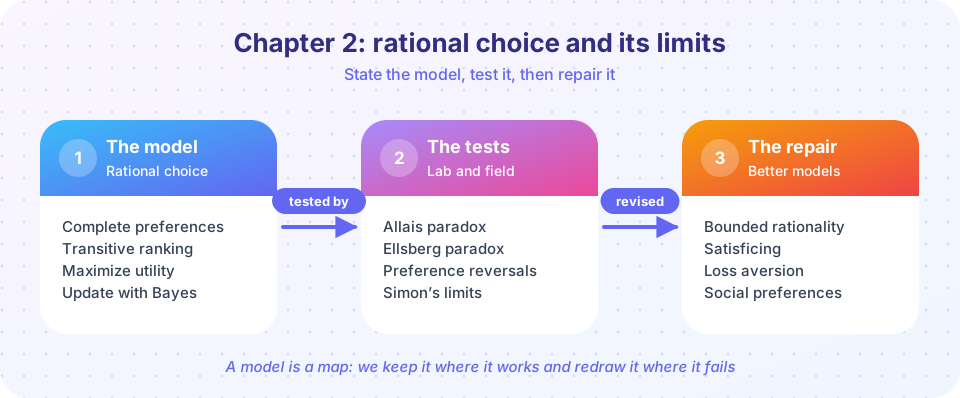
Before you can show where a model fails, you must state it clearly. Chapter 2 does both. It lays out the standard model of rational choice, then presents the evidence and the thinking that led economists to refine it.
The plan is simple: state the model, test it against evidence, then repair it. This is how good science works, and it explains why behavioral economics is a refinement of economics, not a rebellion against it.
What you will learn
- What chapter 2 covers and why it comes before heuristics and prospect theory.
- The questions each lesson answers.
- How the chapter connects to the rest of the course.
Why rational choice?
What it assumes
Where it strains
The repair
What is in this chapter
- Expected utility and Homo economicus states the model: preferences, utility, expected utility and risk aversion. You will compute a certainty equivalent.
- Bounded rationality and satisficing introduces Herbert Simon's alternative: search until something is good enough.
- Preference anomalies presents the Allais and Ellsberg paradoxes, intransitive choices and preference reversals.
- Chapter 2 review ties it together with a quiz.
Key terms
Rational choice: choosing consistently so as to achieve your goals given your beliefs.
Utility: a numerical representation of preferences.
Expected utility: the probability-weighted average of the utilities of possible outcomes.
Bounded rationality: reasoning limited by information, time and cognitive capacity.
Paradox: a pattern of choices that contradicts a theory's predictions.
Two meanings of "rational"
The word rational causes confusion, so settle it now. In economics, rationality usually means internal consistency: your preferences do not contradict each other, and you act on your beliefs. It does not mean being cold, selfish or smart, and it does not say your goals are good. Someone who loves risky hobbies can be perfectly rational in this sense. In everyday speech "rational" means sensible or unemotional, which is a different thing. Keeping the two apart will save you from many arguments.
Try it
Check your understanding
Quick check · 4 questions
of 4 answered You scored / 4 · perfect!
-
1. In economics, 'rational' most often means
Rationality is about consistency, not about emotions, intelligence or selfishness. -
2. Why does the course state the standard model before showing its failures?
A precise benchmark makes it possible to identify systematic departures. -
3. Which lesson in this chapter introduces satisficing?
Satisficing is Simon's alternative to maximizing and appears in the bounded rationality lesson. -
4. An 'anomaly' in this course is
Anomalies are observed behaviors that conflict with the model's predictions.
Summary
- Chapter 2 states the standard model, then examines where evidence strains it.
- "Rational" means consistent, not unemotional or selfish.
- The chapter covers expected utility, bounded rationality and satisficing, and the Allais and Ellsberg paradoxes.
- The goal is to revise the model, keeping what works.
Track your progress
Create a free account to tick off lessons and pick up where you left off on any device.
of Behavioral Economics lessons completed