


















Lesson 20 of 47 · Prospect Theory and Framing
Framing effects
Learn how framing changes choices: the Asian disease problem, attribute and goal framing, the medical survival-mortality study, prospect theory's explanation and its limits.
A surgeon says an operation has a 90% survival rate. Another describes the same operation as having a 10% mortality rate. A reasoning person should react the same way to both, because they say the same thing. Yet people often do not. Framing effects are changes in choices caused by changes in how identical information is described.
Framing matters because the description of options is almost always chosen by someone: a doctor, a marketer, a lawmaker. If the frame can shift decisions, then the frame is part of the decision. In this lesson you will study the most famous framing experiment, see how prospect theory explains it, and learn why the effect is real but not as simple as it first looks.
What you will learn
- The Asian disease problem and what it showed.
- Three kinds of framing: risky-choice, attribute and goal framing.
- How prospect theory predicts a preference reversal.
- The evidence on how large and general framing effects are, and how to defend against them.
Key terms
Frame: a way of describing a choice problem, such as in terms of gains or in terms of losses.
Invariance principle: logically equivalent descriptions should lead to the same choice.
Risky-choice framing: describing the same risky options in gain or loss terms.
Attribute framing: describing one feature positively or negatively (75% lean versus 25% fat).
Goal framing: emphasizing the benefits of acting versus the costs of not acting.
The Asian disease problem
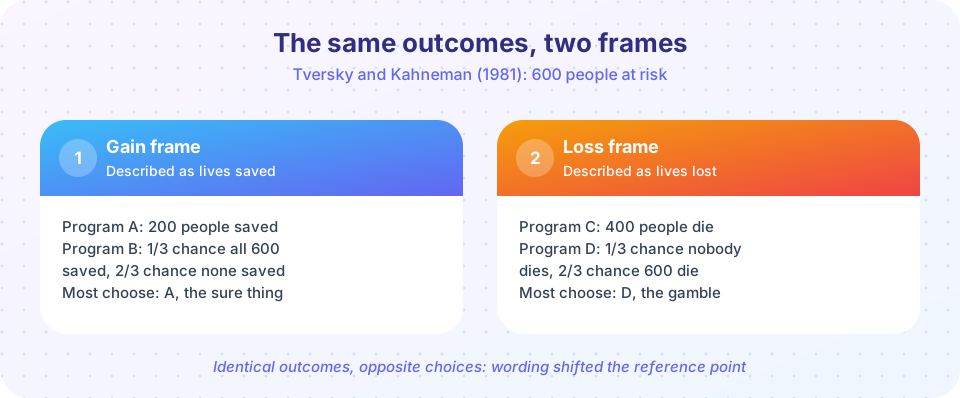
In 1981 Amos Tversky and Daniel Kahneman asked people to imagine that a country is preparing for an outbreak of an unusual Asian disease expected to kill 600 people. Two programs are proposed.
Gain frame (lives saved)
- Program A: 200 people will be saved.
- Program B: a one-third probability that 600 people will be saved and a two-thirds probability that no one will be saved.
Loss frame (lives lost)
- Program C: 400 people will die.
- Program D: a one-third probability that nobody will die and a two-thirds probability that 600 people will die.
A and C are the same outcome, as are B and D. In the gain frame, about 72% of respondents chose the sure option A. In the loss frame, about 78% chose the risky option D. The choices reversed even though the facts did not change. This violates the invariance principle, and it is hard to explain with expected utility, because the expected number of lives saved is 200 in every program.
How prospect theory explains it
The explanation uses the reference point. In the gain frame, the reference point is "600 die," so the outcomes are coded as gains in lives saved. The value function is concave for gains, so a sure gain of 200 beats a gamble with the same expected gain: risk aversion. In the loss frame, the reference point is "no one dies," so outcomes are coded as losses. The value function is convex for losses, so a gamble to avoid a sure loss of 400 is attractive: risk seeking.
With the standard parameters (exponent 0.88, loss aversion 2.25, weights 0.61 for gains and 0.69 for losses) the model predicts A over B in the first frame and D over C in the second. The code below computes it. The theory's key claim is that the frame selects the reference point.
Other kinds of framing
- Attribute framing. Irwin Levin and Gary Gaeth (1988) found that ground beef labeled "75% lean" was rated better than the same beef labeled "25% fat." A positive label works as a cue for quality.
- Medical decisions. Barbara McNeil, Stephen Pauker, Harold Sox and Tversky (1982) described lung cancer treatments to patients, physicians and students in terms of survival or mortality. Surgery looks riskier in the short term, so it was less appealing when mortality was emphasized: roughly 18% preferred radiation under the survival frame and roughly 44% under the mortality frame. Physicians were affected too.
- Goal framing. Messages that stress the loss from not acting (for example skipping a screening) are sometimes more persuasive than those that stress the gain from acting. Findings are mixed and depend on the behavior.
- Prices. Richard Thaler noted that credit card companies lobbied for a "cash discount" label rather than a "credit card surcharge." The same price difference feels like a loss in one frame and a forgone gain in the other.
How strong is framing?
Framing effects are real, but their size varies. Anton Kühberger's 1998 meta-analysis of risky-choice framing found a reliable effect of moderate size, with large differences across studies. Some changes to the problem (adding details, making the wording explicit, asking for reasons) can shrink or remove the effect. Critics such as David Mandel have argued that parts of the Asian disease wording are ambiguous: "200 saved" may be read as "at least 200 saved," which would make the gain frame different in meaning from the loss frame. When the wording is made fully explicit, framing effects are often weaker. The lesson is that frames work partly through reference points and partly through what the wording implies, and both matter in real communication.
Defending against framing
- Re-describe the options in the other frame. If a choice looks very different when restated, you have learned something about your reaction.
- Convert to final outcomes. Ask what you end up with in each option, not what is gained or lost relative to an unstated reference.
- Ask who chose the frame and why. The person describing the options may have a reason to prefer one frame.
Common misconceptions
- "Framing proves people are irrational." It shows that descriptions matter, which can be sensible when a frame carries information (for example about what the speaker considers normal).
- "Everyone is framed in the same way." The size varies by person, domain and wording; some people show no effect.
- "Framing is manipulation." Any description is a frame. Ethical communication means choosing frames that inform and that you would be comfortable showing the audience.
Try it
First, compute the Asian disease problem with prospect theory. We code gains and losses relative to each frame's reference point and compare the sure option with the gamble.
Press Run (or Ctrl + Enter) to see the result here.
Program input · what you'd type while the program runs
Type the answers before you press Run, one per line. Each time the program reads a line (with input()), it gets the next line from this box.
Second, an attribute-framing demonstration. Drag the slider and see the same fact in positive and negative wording. This is a demonstration of wording, not an experiment.
Check your understanding
Quick check · 5 questions
of 5 answered You scored / 5 · perfect!
-
1. In the Asian disease problem, which pair describes the same outcome?
'200 saved' and '400 die' are the same outcome for 600 people. B and D are also the same. -
2. In the gain frame, most people chose
About 72% chose the sure program in the gain frame; about 78% chose the gamble in the loss frame. -
3. How does prospect theory explain the reversal?
Gains yield risk aversion and losses yield risk seeking relative to the reference point. -
4. What is attribute framing?
The same attribute is described in positive or negative terms. -
5. A criticism of the Asian disease wording is that
Mandel and others argued that ambiguity in the wording accounts for part of the effect; explicit wording often weakens it.
Summary
- Framing effects are changes in choice caused by logically equivalent descriptions.
- The Asian disease problem: most choose the sure option in the gain frame and the gamble in the loss frame.
- Prospect theory: the frame sets the reference point, producing risk aversion for gains and risk seeking for losses.
- Framing is real but variable in size; wording ambiguity explains part of it.
- Defend by re-describing in the other frame and focusing on final outcomes.
Track your progress
Create a free account to tick off lessons and pick up where you left off on any device.
of Behavioral Economics lessons completed