


















Lesson 38 of 47 · Markets, Finance and Policy Applications
Chapter 8 Overview: Markets, Finance and Policy Applications
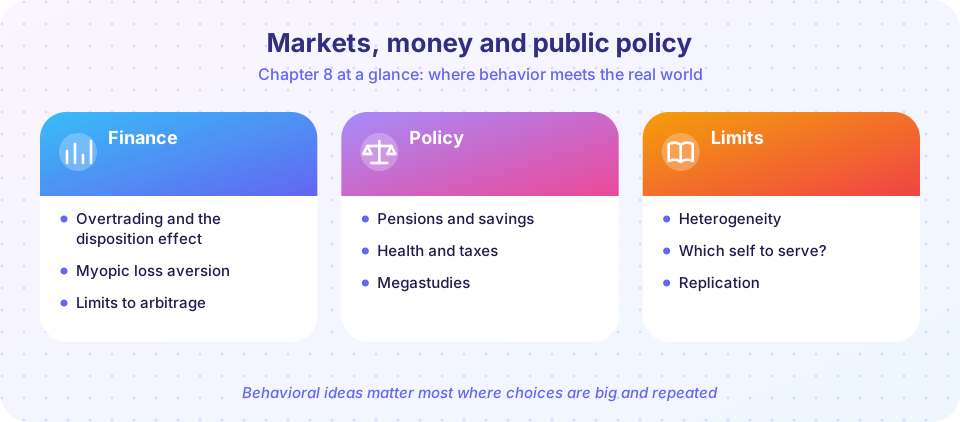
A map of chapter 8: how behavioral ideas apply to financial markets, savings, health and public policy, and what remains uncertain about their reach.
So far we have studied individual decisions in the laboratory and in simple field settings. This chapter asks the larger question: do these patterns matter in markets and in public policy? Markets contain professionals, competition and large stakes, which many economists expected to wash out individual quirks. Policy deals with millions of people and costly mistakes. The answer from the evidence is nuanced: behavioral forces leave visible marks on how households invest and on how programs perform, but the deep question of whether they move market prices is still debated.
What you will learn
- The central question: do behavioral biases survive in markets?
- The structure of the two content lessons and what each covers.
- Why "limits to arbitrage" matter for the answer.
- A first toy model of momentum-chasing and price swings.
Key terms
Efficient market hypothesis (EMH): the claim that prices fully reflect available information, so there are no easy profits.
Behavioral finance: the study of how psychology affects investors and prices.
Arbitrage: trading to profit from price differences; it is supposed to push prices toward fundamental value.
Limits to arbitrage: reasons arbitrageurs cannot always correct mispricing (risk, costs, short horizons).
Behavioral welfare economics: methods for judging policy when people's choices may not reflect their own best interests.
The big picture
The debate
Households and investors
Policy
Test, then scale
Do biases survive in markets?
Two arguments say they should not. First, competition: investors who make costly mistakes lose money and leave, while rational ones prosper. Second, arbitrage: if a price is wrong, smart traders buy the bargain and sell the overpriced asset until the gap closes. These arguments, associated with Eugene Fama's work on efficient markets (1970), are powerful and explain why most prices are hard to beat.
Behavioral finance responds with three observations. Many market participants are ordinary households whose mistakes do not disappear. Arbitrage is risky and limited: Andrei Shleifer and Robert Vishny (1997) showed that professional arbitrageurs who manage other people's money may be forced to close positions before prices correct. And J. Bradford De Long and colleagues (1990) showed that noise traders (investors who trade on sentiment) can themselves create risk that rational traders will not fully offset.
The result was a famous disagreement. In 2013 the Nobel Memorial Prize in Economics was awarded to Eugene Fama, Robert Shiller and Lars Peter Hansen. Fama emphasized that prices are hard to predict and that markets are largely efficient. Shiller stressed that prices move more than changes in fundamentals can explain (his 1981 excess volatility results) and that bubbles occur. Both views contain truth, and the modern synthesis stresses different questions: how much can a typical investor expect to earn, and what mistakes cost them?
Where the chapter goes
| Lesson | What you will learn |
|---|---|
| Behavioral finance | Overtrading, the disposition effect, myopic loss aversion, limits to arbitrage, momentum and bubbles |
| Behavioral policy | Saving, health and tax applications, megastudies, welfare questions and critiques |
| Chapter 8 review | One-picture summary and a ten-question quiz |
Common misconceptions
"If behavioral finance were right, you could easily beat the market." Behavioral patterns mostly describe average investor mistakes; they do not hand out easy profits, because costs, risk and limits to arbitrage apply to you too.
"Efficient markets means that nothing behavioral matters." Efficiency concerns whether prices are predictable. Households can still make costly mistakes inside an efficient market.
"Policy based on psychology is always cheap." Some interventions are cheap, others are not, and all need testing.
Try it
First, a bias-spotting exercise. Read each scenario and pick the behavior it illustrates. This is a learning aid; real behavior usually mixes several motives.
Second, a toy model of price swings. Fundamental value is fixed at 100; price is pulled toward it, but some traders extrapolate the latest price change. The parameter gamma is the strength of extrapolation. This is a simple illustration of how trend chasing can create swings, not a model of any real market.
Press Run (or Ctrl + Enter) to see the result here.
Program input · what you'd type while the program runs
Type the answers before you press Run, one per line. Each time the program reads a line (with input()), it gets the next line from this box.
Check your understanding
Quick check · 4 questions
of 4 answered You scored / 4 · perfect!
-
1. What does the efficient market hypothesis claim?
EMH is about the predictability of prices and the absence of easy profits. -
2. What are limits to arbitrage?
Shleifer and Vishny (1997) showed that professional arbitrage is risky and may be cut short. -
3. Which Nobel laureates in 2013 represented opposite emphases on efficiency?
Fama emphasized efficiency and unpredictability; Shiller emphasized excess volatility and bubbles. -
4. In the toy model, what does a larger gamma do?
Stronger extrapolation of recent moves produces persistent trends away from fundamental value.
Summary
- The core question of the chapter is whether biases survive competition and arbitrage in markets and policy.
- Limits to arbitrage and noise traders explain how mispricing can persist; efficiency and behavioral views both capture something real.
- Household investors show costly patterns even in efficient markets.
- Policy applications are promising but must be tested before scaling.
Next: Behavioral finance
Track your progress
Create a free account to tick off lessons and pick up where you left off on any device.
of Behavioral Economics lessons completed