


















Lesson 42 of 47 · Projects and Practice
Chapter 9 Overview: Projects and Practice
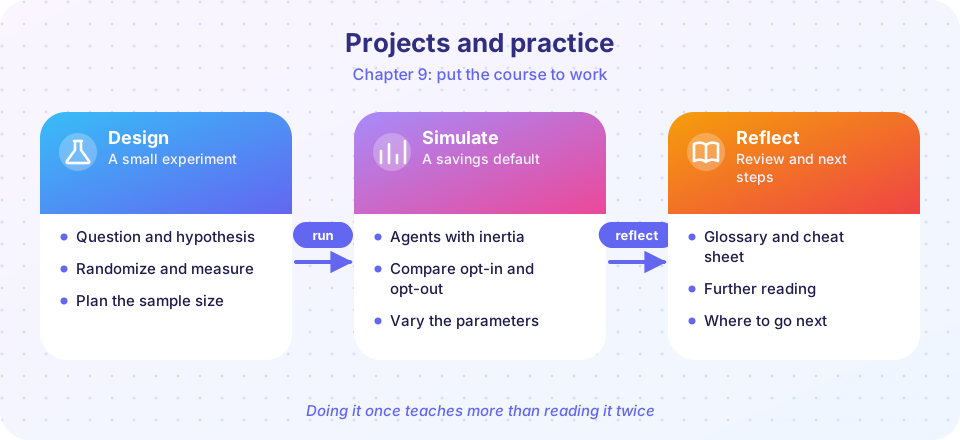
A map of chapter 9: design a behavioral experiment, simulate a savings default, and use the glossary, cheat sheet and further study guide to consolidate your learning.
You have covered the core ideas of the second half of the course: patience and risk, fairness and cooperation, nudges and choice architecture, and applications in markets and policy. The best way to cement them is to do something with them. This chapter has two projects, a glossary, a one-page cheat sheet and a guide to what to learn next. The projects deliberately reuse earlier tools: sample sizes and effect sizes from the nudge chapter, the inertia model from the lesson on defaults, and the habit of reading evidence critically that runs through the whole course.
What you will learn
- What each project asks you to do and which earlier lessons you will use.
- How to plan your study time across the chapter.
- How to check your own progress against a list of skills.
Key terms
Randomized experiment: a study in which people are assigned to groups by chance.
Power: the probability that a study detects an effect of a given size if it exists.
Preregistration: writing the hypothesis and analysis plan before collecting data.
Agent-based model: a simulation in which many simple "agents" follow rules and the overall pattern emerges.
Glossary: an alphabetical list of the course's key terms with definitions.
The big picture
Project 1: design
Project 2: simulate
Reflect
Learn by building
Where the chapter goes
| Lesson | What you will do |
|---|---|
| Project: design an experiment | Plan a randomized test of a nudge, calculate the sample size and see why peeking at results breaks tests |
| Project: simulate a default | Build an agent-based model of opt-in, opt-out and active choice and find a good default rate |
| Glossary | Search the key terms and quiz yourself with flashcards |
| Cheat sheet | A one-page recap of formulas, findings and cautions |
| Further study | Books, skills and connected tracks on this site |
How to work through the projects
- Read the lesson first, then run the code. Change one parameter at a time and predict the result before you run it.
- Write down your predictions. Predicting and checking is the quickest way to find gaps in understanding.
- Explain it to someone. If you can explain the sample size calculation or the winner's curse in plain words, you understand it.
- Keep the cautions in mind. Simulations and calculators in this course are labeled models; they show what follows from assumptions, not what the world does.
Common misconceptions
"A simulation proves a theory." It shows what follows from the assumptions, not whether the assumptions are true.
"More data always fixes a bad design." Bias from poor design, such as non-random assignment or measuring the wrong outcome, does not vanish with a bigger sample.
"Projects are extras." They are where you find out what you do and do not understand.
Try it
First, a self-assessment tracker. Tick the skills you feel confident about; the bar shows your progress, and unticked items are the ones to revisit.
Second, a planner that turns your weekly study time into a schedule for the chapter. It simply divides assumed hours per lesson by the time you have; the hours are rough guesses you can change.
Press Run (or Ctrl + Enter) to see the console output here.
No output.
Check your understanding
Quick check · 4 questions
of 4 answered You scored / 4 · perfect!
-
1. What does preregistration help prevent?
Writing the plan in advance limits flexibility that can inflate false positives. -
2. What is an agent-based model?
Behavior at the group level emerges from individual rules. -
3. Does a simulation prove that a theory is true?
Assumptions still have to be checked against data. -
4. Which tool from the nudge chapter will the experiment project reuse?
Power and sample size determine whether a nudge test can detect small effects.
Summary
- Chapter 9 has two projects, a glossary, a cheat sheet and a guide to further study.
- The projects reuse sample size, the inertia model and critical reading skills.
- Predict before you run; treat simulations as models with assumptions.
- Use the tracker to find the lessons to revisit.
Track your progress
Create a free account to tick off lessons and pick up where you left off on any device.
of Behavioral Economics lessons completed