


















Lesson 32 of 47 · Social Preferences and Fairness
Chapter 6 Review: Social Preferences and Fairness
Review chapter 6 with a one-picture summary, a recap table of games and models, and a ten-question quiz on ultimatum, dictator, trust and public goods games.
This chapter replaced a single assumption, that people care only about their own money, with a more detailed picture. Experiments showed that responders reject unfair offers, that dictators sometimes give, that strangers send money to each other, and that cooperation in groups starts high and decays. Models such as inequity aversion and reciprocity organize these facts, while critics ask how far the lab results travel. Use this page to consolidate before moving on to nudges.
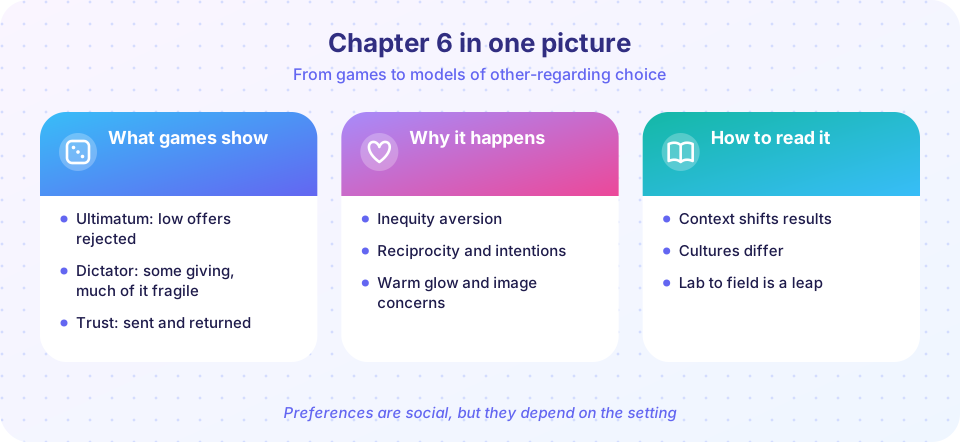
What you will learn
- A compact recap of the four games and the main models.
- How to test yourself on predictions versus findings.
- Which cautions to carry into later chapters.
Recap table
| Game or model | Money-only prediction | What is typically found |
|---|---|---|
| Ultimatum | Tiny offer, always accepted | Offers 40-50 percent; low offers often rejected |
| Dictator | Give nothing | Mean gift about a quarter or more; many give zero, some half; fragile to the setup |
| Trust | Send nothing, return nothing | About half sent; returns roughly break-even on average |
| Public goods (repeated) | Contribute zero | Start at 40-60 percent; contributions decay; conditional cooperators |
| Public goods with punishment | No punishment | Costly punishment; cooperation can be sustained (but antisocial punishment exists) |
| Fehr-Schmidt model | n/a | Accept if s ≥ 10α/(1+2α); dictator gives half if β > 0.5 |
Cautions to carry forward
- Context matters. Take options, anonymity, framing and culture change results.
- Motives are mixed. Fairness, strategic fear, image and confusion can all contribute.
- Models must predict. Compare models on new games, not only on the data used to fit them.
- Lab to field is a leap. Gift exchange and charitable giving in the field are real but often smaller or different from lab results.
Try it
First, a toolkit of the chapter's calculations: public goods payoffs, the responder's threshold and the dictator's choice under the Fehr-Schmidt rule.
Press Run (or Ctrl + Enter) to see the console output here.
No output.
Second, plot the responder's threshold and the dictator's gift as parameters change. It is a model illustration, not a data plot.
Press Run (or Ctrl + Enter) to see the result here.
Program input · what you'd type while the program runs
Type the answers before you press Run, one per line. Each time the program reads a line (with input()), it gets the next line from this box.
Check your understanding
Quick check · 10 questions
of 10 answered You scored / 10 · perfect!
-
1. In the ultimatum game, which behavior contradicts the money-only prediction?
Rejecting a positive offer means giving up money, which a money-only responder would never do. -
2. What can the dictator game tell us that the ultimatum game cannot?
With no veto, gifts are not strategic fear of rejection. -
3. Which finding shows that dictator-game giving is fragile?
List (2007) found that adding a take option reduced giving. -
4. In the trust game, trustworthiness refers to:
Returning money when you could keep it is the measure of trustworthiness. -
5. A public goods game has n = 5 and m = 3. Is it a dilemma?
Contributing costs the contributor more than it returns, yet the group gains from contributions. -
6. What is a conditional cooperator?
Matching others' contributions explains much of the decay in repeated games. -
7. In the Fehr-Schmidt model a responder with α = 1 faces a pie of 10. What is her minimum acceptable offer?
10α/(1 + 2α) = 10/3. -
8. A dictator with α = 0.5 and β = 0.7 will give:
β above 0.5 makes giving up to the equal split raise her utility. -
9. What did the mini-ultimatum game show?
The same split was rejected more often when a fairer option was available. -
10. Why is it important to test models on new games?
Out-of-sample prediction is the test of a theory.
Summary
- Money-only predictions fail in all four classic games, in systematic ways.
- Fairness, reciprocity, strategic fear, image concerns and confusion all contribute.
- The Fehr-Schmidt model captures rejection thresholds and giving with two parameters; other models emphasize intentions and warm glow.
- Always ask how results change with context, culture and the field versus the lab.
Track your progress
Create a free account to tick off lessons and pick up where you left off on any device.
of Behavioral Economics lessons completed