


















Lesson 5 of 47 · Getting Started
Chapter 1 review: Getting Started
Review chapter 1: what behavioral economics is, its history and methods. A recap table, a one-picture summary, flashcards and a ten-question quiz.
You have met the field, its story and its tools. Before moving on to the standard model in Chapter 2, take a few minutes to consolidate. This lesson gives you the chapter in one picture, a recap table, a flashcard drill and a mixed quiz.
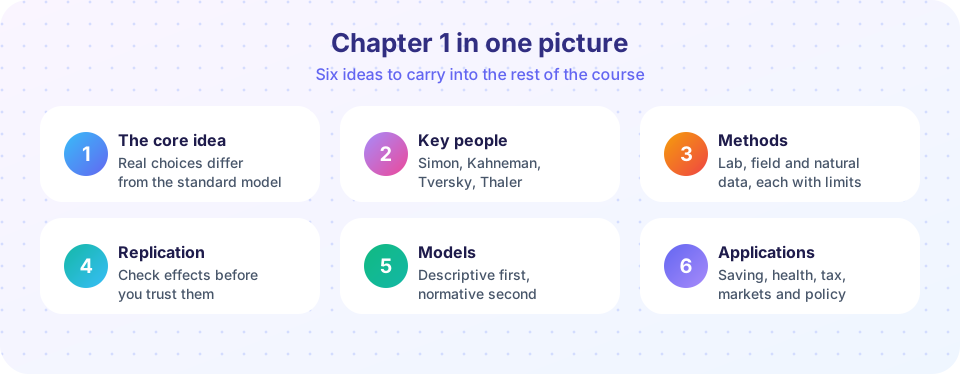
What you will learn
- A compact summary of the whole chapter.
- Which ideas to be able to explain in your own words.
- Where your understanding still needs work, through a mixed quiz.
Recap table
| Lesson | Key idea | Example to remember |
|---|---|---|
| What is behavioral economics? | Keep economics' tools; give them a more realistic psychology (three bounds) | Gym memberships, defaults, the ultimatum game |
| The history of behavioral economics | Bernoulli to Simon to Kahneman and Tversky to Thaler and nudges | St. Petersburg paradox; prospect theory (1979) |
| Methods and evidence | Randomize, check validity, read effect sizes, expect replication problems | The winner's curse |
Key terms
Bounded rationality, willpower and self-interest: the three limits that behavioral economics adds to the standard model.
Normative versus descriptive: how people should choose versus how they do.
RCT: randomized controlled trial, the workhorse for causal claims.
Internal and external validity: is the comparison fair, and does the result generalize?
Winner's curse: significant results from small studies tend to overstate the true effect.
Common misconceptions
- Behavioral economics is not the claim that people are foolish; it studies systematic, predictable departures from a benchmark.
- It is not separate from economics; it uses the same models, data and evidence standards.
- A famous effect is not automatically true; check the sample, the size and the replications.
Try it
Check your understanding
Quick check · 10 questions
of 10 answered You scored / 10 · perfect!
-
1. Which pair correctly names two of Mullainathan and Thaler's three bounds?
The three bounds are rationality, willpower and self-interest. -
2. Which statement is descriptive?
Descriptive statements report what people do. The others state standards. -
3. In which year did Kahneman and Tversky publish prospect theory?
Prospect theory appeared in Econometrica in 1979. -
4. A 2002 Nobel prize in economics went to which psychologist?
Kahneman shared the 2002 prize with Vernon L. Smith. Simon won in 1978 and Thaler in 2017. -
5. Randomly assigning participants to treatment and control mainly improves
Random assignment makes the groups comparable, which supports a causal reading of the difference. -
6. A field experiment, compared with a lab experiment, typically offers
Field experiments study behavior in natural settings but give the researcher less control. -
7. Which description of the standard model is most accurate?
Stable preferences and utility maximization are the core of the standard model. -
8. Why do nudge-unit trials often show smaller effects than academic papers?
Selective publication inflates academic estimates, and large-scale trials reach more varied populations. Nudges still often work, but by smaller amounts. -
9. What did the ultimatum game show about the fourth standard assumption (own-payoff focus)?
Rejecting a positive offer costs money, so it reveals that fairness matters to many people. -
10. Which statement best describes a good way to read a famous behavioral effect?
Evidence quality, not fame or surprise, should drive belief.
Summary
- The field improves economic models by adding realistic psychology, not by abandoning rigor.
- History: Bernoulli, Simon, Kahneman and Tversky, Thaler, nudges and a replication reckoning.
- Methods: randomize, think about validity, read effect sizes, and expect fragile results to need checking.
- Chapter 2 states the standard model carefully, so we can see exactly where it breaks.
Track your progress
Create a free account to tick off lessons and pick up where you left off on any device.
of Behavioral Economics lessons completed