


















Lesson 21 of 47 · Prospect Theory and Framing
Endowment effect and mental accounting
Understand the endowment effect and status quo bias, the Kahneman-Knetsch-Thaler mug experiment, mental accounting, sunk costs and the evidence for and against these effects.
Two ideas from prospect theory show up in ordinary life. First, once you own something, it seems more valuable than it did a moment before: this is the endowment effect. Second, people keep track of money in separate mental "accounts" with their own rules, rather than treating all dollars alike: this is mental accounting, developed by Richard Thaler.
Both ideas bend a basic rule of economics, that a good has a value independent of who holds it, and that money is fungible (any dollar equals any other). In this lesson you will learn the classic experiments, the evidence that complicates them and how they matter in markets and personal finance.
What you will learn
- The endowment effect and the mug experiment.
- Status quo bias and when the effect disappears.
- The main ideas of mental accounting: categories, budgets and fungibility.
- Sunk-cost thinking and how to correct it.
Key terms
Endowment effect: valuing something more because you own it.
Willingness to accept (WTA): the lowest price at which you would sell.
Willingness to pay (WTP): the highest price at which you would buy.
Status quo bias: a preference for the current state of affairs.
Mental accounting: the habit of sorting money into categories and judging decisions within each one.
Sunk cost: money or effort already spent that cannot be recovered.
The mug experiment
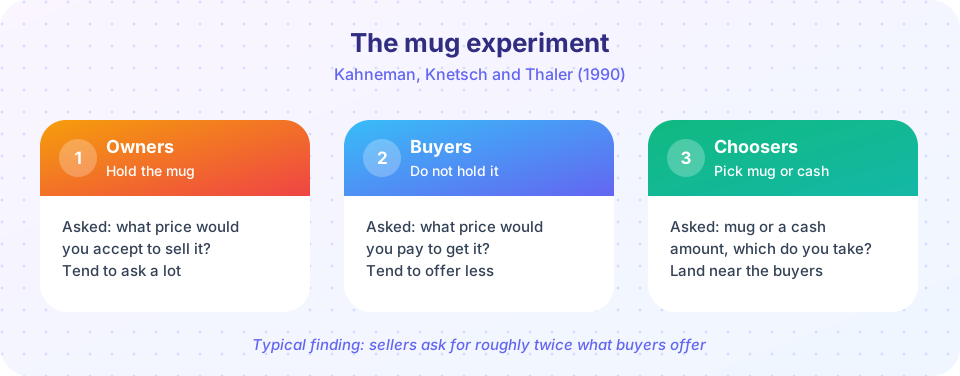
Daniel Kahneman, Jack Knetsch and Richard Thaler (1990) gave coffee mugs, at random, to half the students in a classroom. Owners were asked the lowest price at which they would sell; non-owners were asked the highest price they would pay. A third group, choosers, were given no mug but were asked to choose, for each amount of money, whether they would rather have that amount or a mug.
Because the mugs were assigned at random, the owners and non-owners should have, on average, the same valuation of mugs, and about half the mugs should have changed hands. Instead, the median selling price was roughly twice the median buying price, and far fewer mugs traded than the standard model predicts. (In a control market using money-like tokens, trade volume was close to the prediction, so the students understood the market procedure.) The choosers, who had neither bought nor owned the mug, valued it close to the buyers, not the sellers. Owners did not value the mug more because it was a better mug: they valued it more because giving it up felt like a loss.
Prospect theory explains this with loss aversion: the reference point is "owning the mug," so selling is coded as a loss of the mug (weighted heavily) set against a gain of money (weighted less).
Status quo bias and the limits of the effect
William Samuelson and Richard Zeckhauser (1988) documented a related status quo bias: people stick with current options, such as a health plan or default investment allocation, more than a standard model predicts. This is related to the powerful role of defaults you will study in Chapter 7.
The endowment effect is not universal, and researchers disagree about its causes.
- Charles Plott and Kathryn Zeiler (2005) found that when the instructions, practice and anonymity were improved, the gap between willingness to accept and willingness to pay shrank or vanished in their experiments. They argued that the gap reflects participants' misunderstanding of the procedure.
- John List (2003) studied experienced sports-card traders and found that those with many trades showed little endowment effect, while beginners showed a lot. Experience seems to reduce it.
- The effect appears weaker for goods held for exchange (money, tokens, items you intend to resell) and stronger for goods intended for use.
A reasonable summary: the endowment effect is well documented for ordinary consumer goods in many settings, it can be substantial, and it depends on experience, procedure and the kind of good.
Mental accounting
Thaler's mental accounting (1980s and 1999) describes three habits.
- Categories. People sort money by source and purpose: salary, windfall, vacation fund, "fun money." Each category has its own rules about what it can be spent on.
- Narrow framing of decisions. People evaluate each decision within its own account, not as part of total wealth.
- Fungibility violations. The same dollar is treated differently depending on its account. A tax refund gets spent more freely than the same amount from salary.
Two classic examples
The lost ticket. Tversky and Kahneman (1981) asked people to imagine arriving at a theater and discovering they had lost either the $10 ticket or a $10 bill. In the first case, most people said they would not buy another ticket (about 46% would); in the second, most said they would (about 88%). Financially the two situations are identical: you have lost $10 and can pay $10 to see the show. But losing the ticket is charged to the "theater" account, which makes a second ticket feel like paying $20 for one show.
The calculator and the jacket. People were asked whether they would travel 20 minutes to save $5 on a $15 calculator, or on a $125 jacket. Many more said yes for the calculator (about 68%) than the jacket (about 29%), even though the saving is the same $5 for the same 20-minute trip. People judged the saving relative to the price, not as an absolute gain in wealth.
Other effects
- House money effect. After a windfall gain (like casino winnings), people take greater risks with that money (Thaler and Johnson, 1990), as though it belonged to a "play" account.
- Sunk costs. Having paid for something that cannot be recovered (a ticket, a project's costs so far), people may continue even when future costs exceed future benefits. The economic rule is to ignore sunk costs and compare only future costs and benefits.
Common misconceptions
- "Mental accounting is always a mistake." It can be a useful self-control tool (a separate savings account, an envelope budget). Problems arise when it leads to poor trade-offs, such as holding savings at low interest while carrying credit-card debt.
- "The endowment effect proves people cannot trade." People do trade; the effect is a gap between selling and buying values, and it shrinks with experience.
- "Ignoring sunk costs means ignoring the past." The past is useful information; it just should not drive the choice to continue on its own.
Try it
First, a market simulation. Forty-four people have random valuations of a mug, half are given the mug, and trades happen when a non-owner values it more than an owner does. We add an endowment multiplier to owners' valuations and watch trading volume fall. This is a toy model, not data.
Press Run (or Ctrl + Enter) to see the result here.
Program input · what you'd type while the program runs
Type the answers before you press Run, one per line. Each time the program reads a line (with input()), it gets the next line from this box.
Second, the lost-ticket problem as a ledger. Choose a scenario, and the page shows that your final wealth is the same in both.
Check your understanding
Quick check · 5 questions
of 5 answered You scored / 5 · perfect!
-
1. In the mug experiment, owners' selling prices were roughly how large compared with buyers' prices?
The median selling price was about twice the median buying price, and fewer trades occurred than predicted. -
2. Which group's valuations were close to the buyers' valuations?
Choosers neither owned nor bought a mug, and they valued it near the buyers' level, indicating the owners' high valuations came from ownership. -
3. According to List (2003), who showed little endowment effect?
Trading experience reduces the effect. -
4. Why is losing a ticket different from losing $10 in cash in the ledger sense?
Both leave you $10 worse off. Charging the ticket loss to the theater account makes a second ticket feel like a double price. -
5. The correct treatment of sunk costs is to
Sunk costs cannot be recovered, so they should not drive the choice to continue.
Summary
- The endowment effect: owning raises value, explained by loss aversion with the reference point at ownership.
- The mug experiment: asking prices about twice offering prices, fewer trades; evidence depends on procedure and experience.
- Mental accounting: categories, narrow framing and fungibility violations (lost ticket, calculator and jacket).
- House money and sunk-cost thinking are related; mental accounts can also be a useful self-control device.
Next: Chapter 4 review
Track your progress
Create a free account to tick off lessons and pick up where you left off on any device.
of Behavioral Economics lessons completed