


















Lesson 46 of 47 · Projects and Practice
Cheat Sheet: Behavioral Economics at a Glance (Chapters 5 to 8)
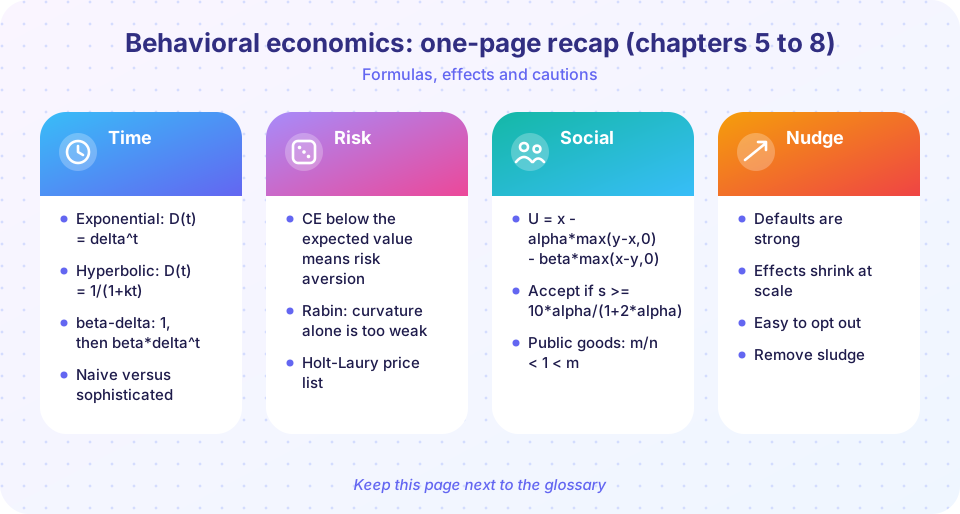
A one-page recap of the formulas, experiments and cautions from time and risk, social preferences, nudges and applications, with calculators and practice problems.
This page is the whole second half of the course on one sheet. It lists the formulas you can compute, the experiments you should be able to describe, and the cautions that keep you honest. Read it before a test or before you read a new paper, and use the calculator and the practice problems to check that you can still do the arithmetic. Everything here is explained in detail in the lessons; this is a map, not a replacement.
What you will learn
- A compact summary of formulas, findings and cautions.
- How to check your arithmetic with a calculator.
- Ten quick problems with worked answers.
Key terms
Formula sheet: the set of equations you should recognize and use.
Rule of thumb: a short guide that is often right but not always.
Sanity check: a quick test of whether an answer is reasonable.
Order of magnitude: the rough size of a number, such as tens, hundreds or thousands.
Time
| Idea | Formula or fact |
|---|---|
| Discounted utility | U = Σ δ^t · u(c_t) |
| Exponential discounting | D(t) = δ^t; constant rate, no reversals |
| Hyperbolic discounting | D(t) = 1 / (1 + k·t); steep early, flat later |
| Beta-delta | U_0 = u_0 + β · Σ δ^t · u_t; β < 1 is present bias |
| Reversal rule | Take sooner S over later L when S > β · L (with δ = 1) |
| Planners | Naive: expects to behave. Sophisticated: foresees lapses and buys commitment |
Risk
| Idea | Formula or fact |
|---|---|
| Expected utility | EU = Σ p_i · u(x_i); concave u is risk averse |
| Certainty equivalent | u(CE) = EU; risk premium = expected value − CE |
| CRRA | u(x) = x^(1−ρ) / (1−ρ), ln x at ρ = 1 |
| Rabin | Small-stakes aversion cannot be curvature alone; points to loss aversion |
| Holt-Laury | 4 safe choices is risk neutral; more is risk averse |
| Caution | Risk attitudes vary with domain, stakes and method |
Social preferences
| Idea | Formula or fact |
|---|---|
| Ultimatum | Money-only: offer little, accept. Reality: offers 40–50%, low offers rejected |
| Dictator | Gifts exist but are fragile (take options, anonymity, exit) |
| Public goods | Dilemma when m / n < 1 < m; payoff E − c_i + (m/n)·Σc |
| Fehr-Schmidt | U = x − α·max(y−x,0) − β·max(x−y,0) |
| Responder rule | Accept if s ≥ 10α / (1 + 2α) (pie of 10) |
| Dictator rule | Gives half if β > 0.5, otherwise nothing |
| Other models | ERC (shares), Rabin (intentions), warm glow, image concerns |
Nudges
| Idea | Formula or fact |
|---|---|
| Definition | Changes choice architecture; keeps options and incentives |
| Default effect | 37% to 86% in a 401(k) study; effort, endorsement, reference point |
| Inertia model | Opt-in w·a; opt-out w + (1−w)(1−a); active choice w |
| EAST | Easy, Attractive, Social, Timely |
| Sample size | n ≈ (1.96 + 0.84)² · [p1(1−p1) + p2(1−p2)] / (p2−p1)² |
| Evidence | 8.7 points (academic) versus 1.4 points (nudge units); publication bias |
| Ethics | Transparent, easy to opt out, serves the chooser, fair |
Markets and policy
| Idea | Formula or fact |
|---|---|
| Overtrading | Most active households earned about 11.4% versus about 17.9% for the market |
| Disposition effect | PGR above PLR (about 15% versus 10% in one study) |
| Myopic loss aversion | Gain-loss ratio rises with the horizon; frequent checking feels risky |
| Limits to arbitrage | Risk and funding constraints let mispricing persist |
| Megastudies | Compare many interventions fairly; expect winner's curse |
| Critiques | Welfare standard, heterogeneity, i-frame versus s-frame |
Common misconceptions
"A cheat sheet replaces understanding." It only helps if you know what each line means; go back to the lesson for any line you cannot explain.
"Numbers from one study are universal." Effects depend on setting and population.
"Formulas give the facts." Formulas describe models; facts come from data.
Try it
First, a calculator with the main formulas. Pick one from the menu, fill in the numbers and read the answer.
Second, ten quick problems. Try each on paper first, then run the code to see the answers and check your arithmetic.
Press Run (or Ctrl + Enter) to see the result here.
Program input · what you'd type while the program runs
Type the answers before you press Run, one per line. Each time the program reads a line (with input()), it gets the next line from this box.
Check your understanding
Quick check · 4 questions
of 4 answered You scored / 4 · perfect!
-
1. Which formula gives the minimum acceptable offer of a Fehr-Schmidt responder with a pie of 10?
Setting s − α(10 − 2s) = 0 gives s = 10α / (1 + 2α). -
2. With β = 0.6 and δ = 1, a person compares 100 now with 150 later. What does she do?
The later reward is worth 90 to her today, which is below 100. -
3. A public goods game with n = 4 and m = 1.6 has MPCR:
m / n = 1.6 / 4 = 0.4. -
4. In the inertia model, opt-out participation is:
Those who want to save stay enrolled, and those who do not want to save but fail to opt out also remain.
Summary
- The cheat sheet lists the key formulas for time, risk, social preferences, nudges and markets.
- Use the calculator to check arithmetic and the practice problems to test yourself.
- Formulas describe models; always check the assumptions and the evidence.
- Pair this sheet with the glossary when you revise.
Next: Further study
Track your progress
Create a free account to tick off lessons and pick up where you left off on any device.
of Behavioral Economics lessons completed